
By continuing, you agree to LoansJagat's Credit Report Terms of Use, Terms and Conditions, Privacy Policy, and authorize contact via Call, SMS, Email, or WhatsApp
Disclaimer: The information published on LoansJagat is intended for general informational and educational purposes only and should not be considered financial, legal, or investment advice. Interest rates, loan terms, statistics, and other data may change over time and may vary by lender or source. Please verify the latest information and consult a qualified financial advisor or the respective Bank/NBFC before making any financial decisions.
Subscribe Now
About the author

Arshathul Afia
Arshathul Afia is a journalism graduate and fintech content writer with 4+ years of experience in digital publishing and research-led writing. She has written 200+ articles covering personal finance, lending, banking, digital payments, credit, insurance, and major financial developments in India. At LoansJagat, she focuses on simplifying complex fintech news, RBI updates, loan-related changes, policy developments, and industry trends for everyday readers. Her journalism background helps her approach stories with research, context, and clarity, while her SEO experience ensures content remains discoverable and relevant. She aims to make financial news easier to understand, practical, and useful for readers across India.
Related News
Simplify All Your Loans Into One Affordable EMI

Customers Served

Debt Consolidated

1200+ Reviews

Locations in India
Club all Loans & Credit Card Bills into Single EMI

Quick Apply Loan
Consolidate your debts into one easy EMI.

Takes less than 2 minutes. No paperwork.

10 Lakhs+
Trusted Customers

2000 Cr+
Loans Disbursed

4.7/5
Google Reviews

50+
Banks & NBFCs Offers
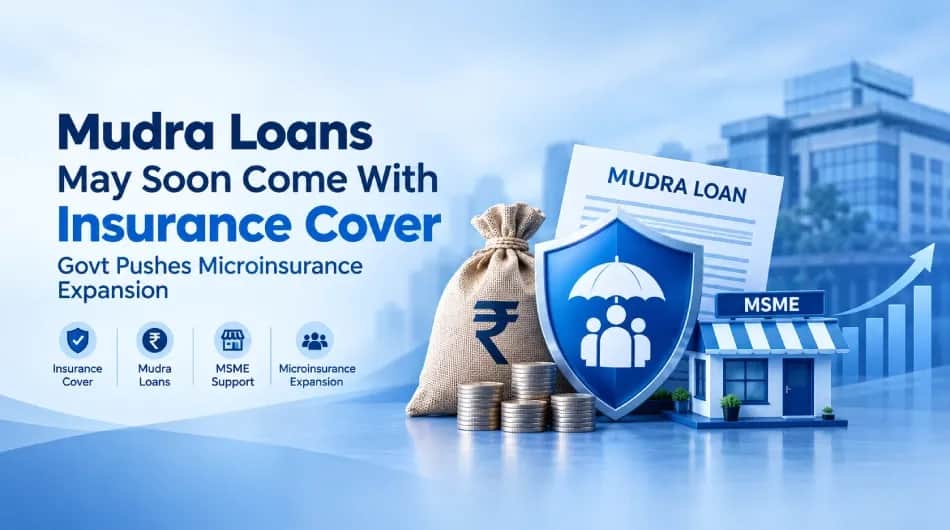
India is considering insurance alongside Mudra loans, a move that could widen protection for micro-entrepreneurs while raising questions over premiums, consent and borrowing costs nationwide.
Insurance may be offered alongside loans under the Pradhan Mantri MUDRA Yojana as the government looks for a wider route into microinsurance. Moneycontrol reported on 7 September 2026 that insurers and insurance brokers have been discussing a possible framework with the Insurance Regulatory and Development Authority of India, or IRDAI, and the Department of Financial Services, or DFS. The talks concern India’s Mudra lending network and remain at an early stage. No final rule has been issued on the product, premium, eligibility or whether borrowers would have to take the cover.
The short-term impact will depend almost entirely on those missing details. A useful policy could protect a small retailer, mechanic or other micro-enterprise when an insured event disrupts income. A badly designed one could simply place another charge beside the EMI. Over a longer period, the idea could help insurers reach borrowers who rarely buy standalone cover, but only if the premium is visible, the claim process works properly and borrowers know exactly what they are accepting.
Mudra gives the proposal a very large distribution route. The Press Information Bureau, in a Ministry of Finance release dated 21 July 2026, said 59.14 crore PMMY loans worth ₹41.71 lakh crore had been sanctioned as of 26 June 2026. PMMY provides collateral-free institutional finance of up to ₹20 lakh for eligible income-generating activities in manufacturing, trade, services and agriculture-linked work. That reach explains why a loan-linked distribution model attracts insurers. The customer is already dealing with a bank, NBFC, MFI or another participating lender.
For borrowers, the benefit is more practical than promotional. A small entrepreneur may never approach an insurance branch separately, compare products or complete another onboarding process. If suitable cover is offered during the loan journey, that gap becomes smaller. Yet the borrower still needs control over the decision. A ₹50,000 Shishu borrower and a ₹15 lakh Tarun Plus borrower do not carry the same cash-flow capacity. Pricing cannot assume every Mudra account looks alike.
The proposal is still open on several important points.
That uncertainty is why the first borrower-facing rule should be simple: show the insurance cost separately before the loan is accepted. If a premium is financed inside the loan, the customer should also see how much interest may be paid on that premium over the tenure. The policy should state who receives a claim, what is excluded and what happens if the loan closes early.
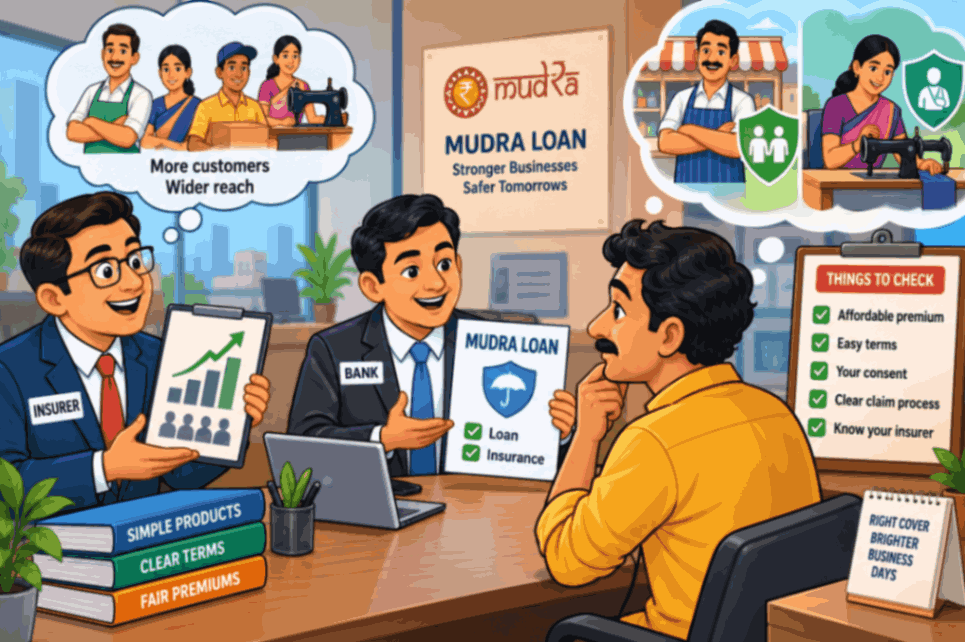
The insurance industry sees distribution as the main opportunity. Moneycontrol quoted an industry executive saying banks and other institutions originating Mudra loans could reduce the distribution gap that has held back microinsurance. An insurance broker also said a borrower already dealing with a lender could be offered a simple product through that existing relationship, reducing the need for insurers to find the customer separately.
The warning from the same reporting deserves equal attention. The broker said products would need to remain affordable and easy to follow, especially because small-ticket borrowers may have little appetite for complicated terms or premiums that raise borrowing costs. That is where policy design needs more work than the sales channel. Consent should be recorded. Premiums should not disappear into the sanctioned amount. Claim documents should stay short, and borrowers should know which insurer is responsible when a claim arises.
From a borrower-cost perspective, the better test is not how many policies get sold. The useful question is whether the cover protects against a financial risk large enough to justify the premium. A shop owner taking a small working-capital loan may prefer accident or business protection, while another borrower may already have adequate life insurance. Automatically giving both the same product can create waste rather than protection.
A borrower-side example from LoansJagat’s 31 August 2026 Tarun Plus explainer also shows why the fine print has to appear early. The ₹10 lakh to ₹20 lakh Tarun Plus category is available to entrepreneurs who have successfully repaid an earlier Tarun loan. The headline says ₹20 lakh, but an eligibility condition decides who can actually use it. Insurance linked with Mudra would need the same direct disclosure of eligibility, price, exclusions and claim rights before enrolment.
The proposal fits India’s wider Insurance for All by 2047 policy direction. At the 3rd IFSCA-IRDAI-GIFT City Global Reinsurance Summit in Mumbai, DFS Secretary M. Nagaraju said on 19 January 2026 that the 2047 vision provided a roadmap for inclusive insurance growth. The Ministry of Finance release carried by the Press Information Bureau said insurance penetration in FY2024-25 stood at 3.7%, with life insurance at 2.7% and non-life insurance at 1%.
Those figures explain the policy interest without needing a long list of statistics. India already has a sizeable formal insurance business, yet many households and small enterprises remain outside regular protection. Mudra brings lenders into contact with microbusinesses across cities, small towns and rural districts. Using that contact point can be quicker than creating an entirely new insurance distribution system.
IRDAI has also spoken for years about the difficulty of expanding microinsurance. Small premiums leave less room for high distribution costs, while customers may struggle with product complexity, servicing and claims. The Mudra route could cut the customer-acquisition problem. It cannot solve affordability or poor policy design by itself.
Read Also : Gold Loan Rules 2026: 85% LTV, ₹5,000 Daily Penalty and 8 Risks Borrowers Must Know
PMMY was launched on 8 April 2015 to provide collateral-free institutional credit to micro-enterprises. Its latest major loan-limit revision came after the Union Budget 2024-25. The Department of Financial Services records that Tarun Plus became effective from 24 October 2024, allowing eligible loans above ₹10 lakh and up to ₹20 lakh. The category applies to entrepreneurs who previously took and successfully repaid a Tarun loan.
That history is useful because insurance would change a different part of the Mudra experience. Tarun Plus expanded the amount available to established borrowers. Insurance would add financial protection around the borrowing relationship rather than increase the credit limit.
There could also be more paperwork. Banks would need to explain another product, while borrowers would need enough information to judge whether the cover fits their business. If several insurers participate, comparison may become useful. If only one product appears at the point of sanction, borrowers may assume they have no choice even when the final framework says otherwise.

The stakeholders quoted in the 7 September Moneycontrol report broadly support using Mudra lenders as an insurance channel. An official from a brokers’ association said increasing coverage among low-income households, small entrepreneurs and informal businesses represents an important opportunity for the insurance industry. Existing credit infrastructure, according to the official, could help close part of the distribution gap.
Insurers have an obvious commercial reason to support such a model. Acquiring a customer separately for a very small insurance premium can cost too much. A customer already verified and interacting with a lender reduces part of that effort.
Borrowers view the same transaction differently. They are primarily at the branch, portal or lending institution for credit, not to shop for another financial product. That difference makes disclosure especially important. An insurance offer should show the premium in rupees, who receives the benefit, the period of cover, important exclusions and whether cancellation is available.
There is still no public government announcement saying insurance will become compulsory for Mudra borrowers. No notified premium, product list or rollout date exists either. The government has also not said whether Shishu, Kishor, Tarun and Tarun Plus borrowers would receive different insurance options.
The case for using Mudra as a microinsurance channel is fairly straightforward. PMMY already reaches a huge number of small businesses, while India is trying to take insurance beyond conventional urban and higher-income customers. If a final framework offers affordable cover with visible terms and a workable claim process, it could help a borrower avoid a deeper financial setback after an insured event.
The risk lies in execution. Insurance should not become an unexplained addition to a small loan, particularly where the borrower is mainly looking for working capital quickly. Premium financing, exclusions and consent deserve attention before any rollout begins.
As of 7 September 2026, the proposal remains under discussion. Until the government or IRDAI publishes a final framework, claims that every Mudra loan will carry compulsory insurance are premature.
No such rule has been announced. Discussions are still at an early stage, and the government has not decided whether insurance would be voluntary or loan-linked.
The final product has not been disclosed. Insurance could address borrower or business risks, but no life, health, accident or repayment product has been officially confirmed.
That remains undecided. A final framework would need to explain whether the borrower pays, whether any premium is financed, and how the cost appears in loan documents.
At present, there is no newly announced nationwide PMMY rule requiring borrowers to purchase the proposed insurance. Borrowers should check official loan documents rather than relying on verbal sales claims.
The proposed Mudra framework has not approved such a process. Borrowers should check the premium, financed amount, total interest impact, consent terms and cancellation conditions before accepting any bundled insurance.









.png&w=3840&q=75)


