
By continuing, you agree to LoansJagat's Credit Report Terms of Use, Terms and Conditions, Privacy Policy, and authorize contact via Call, SMS, Email, or WhatsApp
Disclaimer: The information published on LoansJagat is intended for general informational and educational purposes only and should not be considered financial, legal, or investment advice. Interest rates, loan terms, statistics, and other data may change over time and may vary by lender or source. Please verify the latest information and consult a qualified financial advisor or the respective Bank/NBFC before making any financial decisions.
Subscribe Now
About the author

Arshathul Afia
Arshathul Afia is a journalism graduate and fintech content writer with 4+ years of experience in digital publishing and research-led writing. She has written 200+ articles covering personal finance, lending, banking, digital payments, credit, insurance, and major financial developments in India. At LoansJagat, she focuses on simplifying complex fintech news, RBI updates, loan-related changes, policy developments, and industry trends for everyday readers. Her journalism background helps her approach stories with research, context, and clarity, while her SEO experience ensures content remains discoverable and relevant. She aims to make financial news easier to understand, practical, and useful for readers across India.
Related News
Simplify All Your Loans Into One Affordable EMI

Customers Served

Debt Consolidated

1200+ Reviews

Locations in India
Club all Loans & Credit Card Bills into Single EMI

Quick Apply Loan
Consolidate your debts into one easy EMI.

Takes less than 2 minutes. No paperwork.

10 Lakhs+
Trusted Customers

2000 Cr+
Loans Disbursed

4.7/5
Google Reviews

50+
Banks & NBFCs Offers
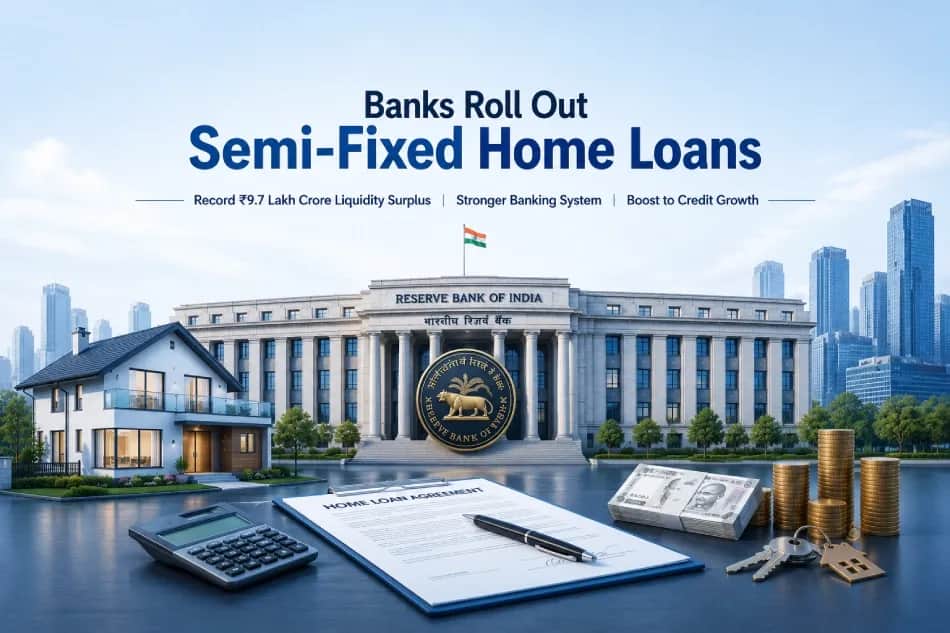
HSBC and Kotak are offering semi-fixed home loans as bank liquidity reaches ₹9.7 lakh crore, giving borrowers stable opening EMIs but later rate risk and exit costs.
The offer can help a new homeowner keep the EMI stable while paying for registration, furniture, repairs and other early expenses. There is a catch further down the road. Once the protected period ends, the loan changes to floating pricing. A higher benchmark at that point could raise the EMI or stretch the repayment tenure. A borrower who wants to close or refinance the account during its fixed phase may also face a prepayment charge.
A semi-fixed home loan divides a long mortgage into 2 phases. During the first phase, the contracted rate stays unchanged. Market rate movements do not alter the EMI for that selected period. During the second phase, the lender applies its prevailing floating rate, calculated through the applicable benchmark and the borrower’s sanctioned spread.
That opening certainty could help a salaried couple buying its first flat in Mumbai, Bengaluru or Delhi-NCR. Household spending is usually heavy soon after possession. A fixed EMI makes the monthly calculation easier. Self-employed applicants with uneven income may benefit too, provided they keep enough savings for weaker business months.
More competition among banks could bring attractive opening rates. Lenders holding surplus funds have an incentive to win dependable borrowers, particularly applicants with high credit scores, steady income and properties carrying proper approvals. Yet an advertised starting rate does not go to every applicant. Banks may quote a higher figure after reviewing age, income, repayment record, loan size and property risk.
Housing affordability also extends beyond commercial bank offers. A Press Information Bureau update published on August 9, 2026, said the government had sanctioned more than 18.38 lakh houses under PMAY-U 2.0, including 1.36 lakh approvals under the Interest Subsidy Scheme. The Press Information Bureau figures show that subsidised housing support and regular bank credit are serving different parts of the same housing demand.
Kotak announced its Hybrid Home Loan on August 10, 2026. Eligible salaried and self-employed borrowers can select a fixed period of 39, 52 or 65 months. The interest rate and EMI stay unchanged throughout that window. The account then moves automatically to a floating rate based on the prevailing benchmark plus the spread stated at sanction.
HSBC offers a 3-year fixed option starting at 7.50% and a 5-year option at 8.25%, according to product information reported on September 4, 2026. After the selected term, the loan changes to the prevailing floating structure. The difference between 7.50% and 8.25% shows that a longer rate lock may come at a higher initial cost.
Before comparing the products, borrowers should look beyond the first EMI. The table presents the main differences disclosed for the 2 offers.
The table does not identify a single winner. A 3-year lock may suit someone expecting income to rise soon, while a 65-month option may appeal to a family that wants a longer predictable period. The decision changes again if the borrower expects to make a large part-payment.
HSBC’s published charges show why that check is needed. During the fixed-interest period, partial prepayment carries a charge of 4% of the amount prepaid, plus GST. Foreclosure attracts 4% of the outstanding principal, plus GST. Once the account enters its variable-rate period, the bank lists no prepayment charge for an individual floating-rate home loan.
Read Also : RBI’s Proposed Revolving Credit Ban Could Reshape ₹30 Lakh Crore NBFC Sector
Indian banks were holding a reported liquidity surplus of ₹9.7 lakh crore on September 3, 2026, higher than the earlier peak of around ₹9.2 lakh crore seen in September 2021. The Economic Times reported the semi-fixed loan development on September 4, linking the renewed product push with lenders’ need to deploy excess funds without giving up too much interest income.
The cash build-up followed a large inflow of foreign-currency deposits and overseas borrowings through a special forex arrangement. When banks exchanged much of that foreign currency for rupees, domestic liquidity rose sharply. That money cannot remain idle forever. Banks can buy government securities, increase lending or use a combination of both.
Housing loans offer regular repayments over 15, 20 or 25 years. The borrower’s rate remains locked during the opening period, which gives the lender a more predictable spread for those years. Government bonds provide another route, although their market value can fall when yields rise. That has made semi-fixed mortgages a useful option for deploying part of the surplus.
The product launches did not begin only after liquidity touched ₹9.7 lakh crore. Kotak announced its loan several weeks earlier. Customer demand for predictable instalments and uncertainty about future rates were already encouraging hybrid pricing. The record surplus has added urgency to that push.
Nakul Saxena, Head of Mortgages at Kotak Mahindra Bank, said the rate lock provides a planning cushion during the early years of homeownership. The bank also stated that its hybrid product does not carry a separate premium over a comparable floating loan, although the final rate remains subject to credit assessment.
A bank executive quoted by The Economic Times said lenders were more interested in putting surplus funds to work while locking in a spread than predicting the direction of rates. The executive added that government securities can carry market-price risk when yields change. The remark explains the benefit for lenders. Borrowers still need to calculate their own cost.
LoansJagat’s borrower-focused review of hidden home loan costs flags processing fees, legal checks, technical verification and conversion expenses that can reduce the benefit of a low advertised rate. Applied to the latest offers, the practical takeaway is simple: compare the total loan cost, not merely 7.50% against 7.60%.
A borrower should request 3 repayment illustrations. The first can use the offered rate, while the next 2 can show what happens if the floating rate is 1% and 2% higher when conversion occurs. This reveals whether the lender would increase the EMI, extend the tenure or adjust both.
The applicant should also ask for the benchmark, spread, reset frequency and first conversion date in writing. The Department of Financial Services says new floating-rate retail loans, including housing loans, have used approved external benchmarks since October 1, 2019. Its official banking guidance helps explain why a borrower’s rate can change once the fixed phase ends.
National Housing Bank publications and advisories also encourage greater transparency across housing finance. Even where a bank salesperson explains the terms verbally, the borrower should rely on the sanction letter, Key Facts Statement and signed agreement. A missing promise is difficult to enforce later.
For years, most Indian homebuyers chose between floating and fixed loans. Floating rates generally started lower and responded to benchmark changes. A fully fixed loan offered predictable repayments but could carry a higher rate or tighter exit conditions. Hybrid loans were available from selected lenders, though they remained less visible than standard floating products.
The rate cycle made those differences more noticeable. When lending rates increased, some floating-rate borrowers found that their loan tenures had stretched sharply even though the EMI barely moved. Others considered balance transfers, only to discover processing, legal and conversion costs attached to the switch.
The newer semi-fixed format tries to address the fear of immediate EMI changes. It gives the borrower a protected opening period without requiring the bank to fix the rate for 20 or 25 years. After that, the usual floating-rate exposure returns.
Kotak’s August 2026 launch widened the choice by offering 3 fixed-period lengths. HSBC’s 3-year and 5-year plans followed the same basic direction. Other lenders may examine similar products if surplus liquidity remains high and competition for creditworthy homebuyers grows.
Read Also : Axis Bank Eyes Young Consumers as India Credit Cards Cross 12.29 Crore
Banks see these loans as a route to deploy funds and protect lending income for a limited period. Kotak has presented its product as a household-planning tool. HSBC’s offer gives customers 2 rate-lock choices but places specific costs on early repayment during the fixed phase.
Homebuyers receive temporary EMI protection. They also accept a later reset whose result cannot be known on the sanction date. A borrower expecting to retain the property for decades may accept that trade-off. Someone likely to sell, refinance or prepay within 3 to 5 years needs to look much harder at exit charges.
Semi-fixed home loans give banks a place to deploy surplus cash and offer borrowers several years of stable EMIs. The structure can work well for a family facing high expenses soon after buying a property. Still, the fixed window ends.
Borrowers should compare the rate after conversion, sanctioned spread, reset schedule and prepayment cost before choosing. The cheapest opening rate may not produce the lowest overall bill. For a loan running across decades, the terms after year 3 or year 5 can carry far more weight than the first advertisement.
It keeps the rate fixed initially, then converts the remaining loan to floating pricing.
It may rise if the applicable benchmark is higher when the loan converts to floating pricing.
Kotak Mahindra Bank and HSBC have published semi-fixed or hybrid home loan options in India.
It suits borrowers wanting temporary stability, but future rates and early-exit charges require comparison.
That depends on its current phase. Fixed-period prepayment may attract charges under the lender’s terms.









.png&w=3840&q=75)


