Check AI Loan Optimisation Plans to Reduce Your EMI

Disclaimer: The information published on LoansJagat is intended for general informational and educational purposes only and should not be considered financial, legal, or investment advice. Interest rates, loan terms, statistics, and other data may change over time and may vary by lender or source. Please verify the latest information and consult a qualified financial advisor or the respective Bank/NBFC before making any financial decisions.
Subscribe Now
About the author

Vaishnavi is a Financial Content Writer at LoansJagat. She holds a B.Sc. and an M.Sc. She has experience in writing SEO-focused content across finance. At LoansJagat, Vaishnavi writes on banking, loans, personal finance, and insurance. Her work involves researching financial topics, understanding user search intent, and creating content that is clear and accurate. She has experience in SEO content writing, keyword research, content optimisation, and AEO.
Related Blog Post
Simplify All Your Loans Into One Affordable EMI

Customers Served

Debt Consolidated

1200+ Reviews

Locations in India
Club all Loans & Credit Card Bills into Single EMI

Quick Apply Loan
Consolidate your debts into one easy EMI.

Takes less than 2 minutes. No paperwork.

10 Lakhs+
Trusted Customers

2000 Cr+
Loans Disbursed

4.7/5
Google Reviews

50+
Banks & NBFCs Offers
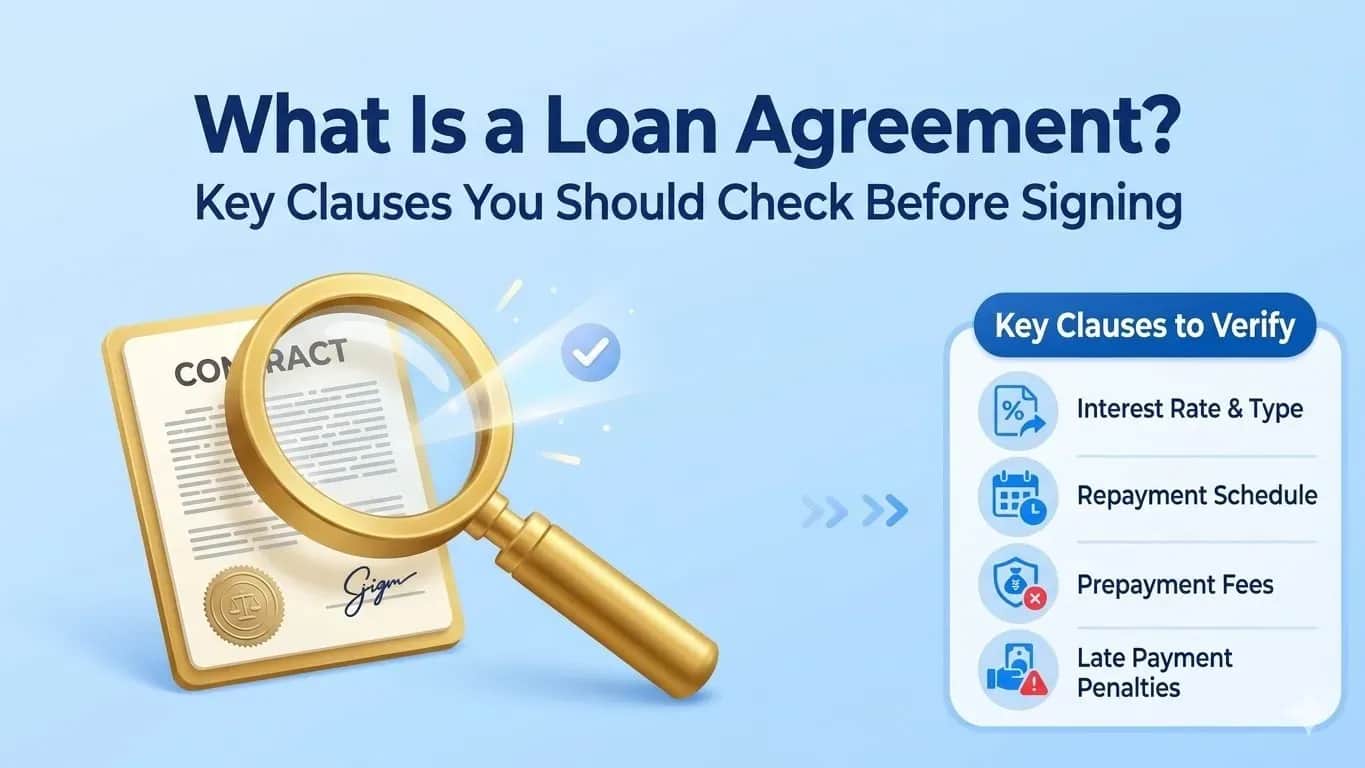
Taking a loan involves more than receiving money and repaying it through EMIs. A loan agreement records the terms of this financial commitment, including the loan amount, interest rate, repayment schedule and applicable charges. It also explains what happens if you miss payments, repay the loan early or fail to meet specific conditions. Before signing, review the agreement carefully and check whether its terms match the sanction letter and Key Facts Statement (KFS). Understanding these clauses can help you avoid unexpected costs and disputes later.
Key Takeaways
A loan agreement is a written contract between a lender and a borrower. It sets out the terms under which the lender provides credit and the borrower agrees to repay it.
The document explains the rights and responsibilities of both parties. It covers details such as the principal amount, interest rate, loan tenure, EMI dates, fees and consequences of default.
The terms depend on the loan product and lender. For example, a personal loan agreement may differ from a home loan or vehicle loan agreement. A secured loan may also include details about the asset offered as collateral.
Before signing, pay attention to the following clauses. They explain how the loan will work and what you are agreeing to during the repayment period.
The principal amount is the amount sanctioned by the lender, while the disbursed amount is the money actually transferred to your account.
These figures may differ if the lender deducts upfront charges, such as processing fees and applicable taxes, before disbursement.
Check the agreement for:
After disbursement, compare the amount credited to your account with the loan documents. Ask the lender to explain any difference.
The interest rate determines the cost charged on the borrowed amount. The agreement should specify whether the rate is fixed or floating.
A fixed interest rate remains unchanged for the period specified in the agreement. A floating interest rate can change when its linked benchmark or other permitted pricing components change.
For a floating-rate loan, check:
Also review the Annual Percentage Rate (APR). It represents the annual cost of credit, including interest and applicable charges. For loans covered by RBI's Key Facts Statement framework, lenders must disclose the APR and its calculation.
Do not compare loans using only the advertised interest rate. Review the APR and charges in the KFS for a broader understanding of borrowing costs.
The repayment clause explains when and how you must repay the loan. It should specify the EMI amount, payment frequency and repayment period.
Check the following details:
The amortisation schedule shows how each EMI is divided between principal and interest. It also indicates how the outstanding loan balance reduces over time.
Check the first EMI date and repayment schedule before setting up an e-NACH or other auto-debit mandate. This helps you plan your monthly expenses and maintain sufficient funds for repayments.
A loan may involve charges beyond the interest payable. The agreement should explain the applicable fees and when the lender can collect them.
Look for:
Compare these details with the KFS and sanction letter. If a charge was not explained earlier, ask the lender for clarification before signing. Also check whether a fee will be deducted from the disbursed amount or collected separately.
Prepayment means repaying part of the outstanding loan before the scheduled date. Foreclosure means repaying the entire outstanding amount before the loan tenure ends.
Check the agreement for:
RBI's Pre-payment Charges on Loans Directions, 2025, effective from 1 January 2026, restrict prepayment charges on specified floating-rate loans. For instance, regulated lenders cannot levy such charges on floating-rate loans granted to individuals for non-business purposes, subject to the applicable directions.
Do not assume that every loan carries a foreclosure penalty or that every loan is exempt. Check the applicable rules and your loan agreement.
An event of default refers to a situation where the borrower fails to meet an important obligation under the agreement.
Examples may include:
An acceleration clause may allow the lender to demand repayment of the outstanding amount earlier than scheduled if specified default conditions occur.
Read these provisions carefully. Check when the lender can invoke them and what steps it must follow.
This clause is relevant for secured loans, such as home loans and loans against property. It identifies the asset offered as security and explains the lender's rights over it.
For example, a home loan may involve a mortgage over the property, while a vehicle loan may involve hypothecation of the vehicle.
Check the agreement for:
The SARFAESI Act, 2002, provides a legal framework through which eligible secured creditors can enforce security interests, subject to the Act and applicable procedures. It does not mean that a lender can take possession of every secured asset immediately after a missed EMI.
The agreement should explain how to contact the lender if you have a complaint or dispute.
Check for:
Raise complaints through the lender's grievance redressal process first and retain written communication. If an eligible complaint remains unresolved, you may be able to approach the RBI under the applicable Ombudsman Scheme.
Complete this final checklist before accepting the loan:
Do not sign an incomplete document or rely only on verbal assurances. If any amount, date or condition is incorrect, ask the lender for a correction or written clarification. Keep a copy of the signed agreement and related loan documents for future reference.
A loan agreement explains the financial and legal responsibilities you accept when borrowing money. Check the principal amount, interest rate, APR, repayment schedule, charges and default conditions before signing. Review the security and grievance redressal clauses where relevant, and compare the agreement with your KFS and sanction letter. If any term is unclear, get written clarification from the lender before accepting the loan.
It depends on whether the loan has a fixed or floating interest rate. A floating rate may change when its linked benchmark changes. The agreement should explain how rate revisions can affect the EMI or tenure.
Compare the loan agreement, KFS and repayment schedule. Contact the lender and obtain written clarification before relying on the communicated date or setting up an auto-debit mandate.
Check the agreement and KFS for applicable charges. For loans covered by RBI's KFS framework, charges not mentioned in the KFS cannot be imposed during the loan tenure without the borrower's explicit consent, subject to the applicable provisions.
An acceleration clause may allow the lender to demand repayment of the outstanding loan earlier than scheduled if specified events of default occur. Its application depends on the agreement and applicable law.
A KFS summarises important loan details, including APR, charges and repayment schedule. The loan agreement contains the detailed contractual terms governing the borrowing. Review both before accepting the offer.
Part-prepayment or foreclosure may be allowed, depending on the loan terms and applicable RBI directions. Check the agreement for the procedure and any permitted charges.
Missing an EMI can result in charges and other consequences specified in the agreement. Continued defaults may allow the lender to take further action under the contract and applicable law. Contact the lender promptly if you anticipate difficulty making a repayment.
The lender must follow the agreement and applicable law. Changes may be permitted in circumstances already covered by the contract, such as a floating-rate reset. Ask for written communication if the lender proposes a change.
Start your journey today
Apply Now*T&C apply