

By continuing, you agree to LoansJagat's Credit Report Terms of Use, Terms and Conditions, Privacy Policy, and authorize contact via Call, SMS, Email, or WhatsApp
Disclaimer: The information published on LoansJagat is intended for general informational and educational purposes only and should not be considered financial, legal, or investment advice. Interest rates, loan terms, statistics, and other data may change over time and may vary by lender or source. Please verify the latest information and consult a qualified financial advisor or the respective Bank/NBFC before making any financial decisions.
Subscribe Now
About the author

Arshathul Afia
Arshathul Afia is a journalism graduate and fintech content writer with 4+ years of experience in digital publishing and research-led writing. She has written 200+ articles covering personal finance, lending, banking, digital payments, credit, insurance, and major financial developments in India. At LoansJagat, she focuses on simplifying complex fintech news, RBI updates, loan-related changes, policy developments, and industry trends for everyday readers. Her journalism background helps her approach stories with research, context, and clarity, while her SEO experience ensures content remains discoverable and relevant. She aims to make financial news easier to understand, practical, and useful for readers across India.
Related News
Simplify All Your Loans Into One Affordable EMI

Customers Served

Debt Consolidated

1200+ Reviews

Locations in India
Club all Loans & Credit Card Bills into Single EMI

Quick Apply Loan
Consolidate your debts into one easy EMI.

Takes less than 2 minutes. No paperwork.

10 Lakhs+
Trusted Customers

2000 Cr+
Loans Disbursed

4.7/5
Google Reviews

50+
Banks & NBFCs Offers
A ₹2 lakh take-home salary may support a ₹90 lakh home loan, but existing EMIs, tenure and family costs decide whether repayment remains financially manageable.
A salaried Indian earning ₹2 lakh a month may be able to borrow up to ₹90 lakh for a house, according to an NDTV Profit assessment published on September 7, 2026. The estimate applies mainly to a borrower with stable employment, no large existing EMI, enough money for the down payment and a repayment period extending up to 30 years.
The loan can widen the choice of homes available to a middle or upper-middle-income household. Short-term access, however, brings a long commitment. The borrower may still be paying the EMI during job changes, children’s education, medical emergencies and the years approaching retirement. A large sanction can therefore help with the purchase now while reducing the money available for other goals over the next 20–30 years.
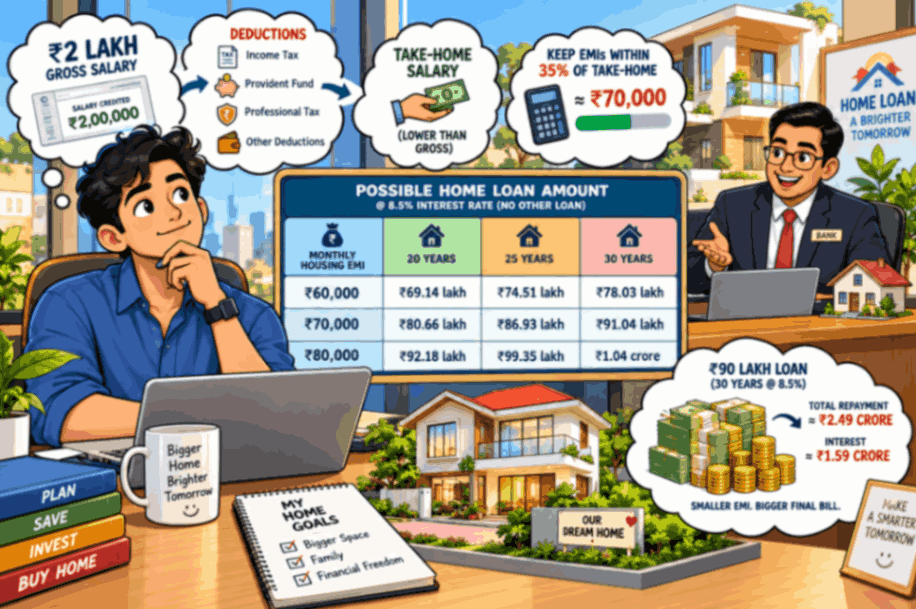
The starting point is take-home salary, not annual CTC divided by 12. Income tax, provident fund contributions, professional tax and other deductions reduce the amount reaching the bank account. If ₹2 lakh is gross monthly pay, the affordable home loan would usually be lower than the headline figure.
A cautious calculation keeps total debt repayments near 35% of take-home income. On ₹2 lakh, that creates an overall EMI limit of about ₹70,000. The table below uses an illustrative home-loan rate of 8.5% and assumes that no other loan instalment is running.
The ₹90 lakh figure becomes workable near a 30-year tenure because the EMI falls to about ₹69,202 at 8.5%. A 20-year tenure pushes the same loan’s EMI to approximately ₹78,104. That may still receive lender approval, but it would consume more than the preferred ₹70,000 limit used in this calculation.
Long tenure carries a price that buyers can miss while comparing monthly EMIs. A ₹90 lakh loan at 8.5% over 30 years could result in total repayment near ₹2.49 crore if the rate remained unchanged. About ₹1.59 crore would then represent interest. The EMI looks smaller. The final bill does not.
A ₹75–₹90 lakh loan can open more options for families buying in Bengaluru, Hyderabad, Pune, Chennai, Ahmedabad and the outer areas of Delhi-NCR or Mumbai. It may allow a second bedroom, a shorter work commute or a ready-to-move home instead of a property still under construction. For households paying high rent, the shift to ownership may also provide a more predictable housing arrangement.
Property prices have already moved higher across much of urban India. The National Housing Bank’s Q3 FY2025-26 RESIDEX release reported annual price growth in 46 of the 50 cities covered by the official housing index. Its combined index increased by 5% from the previous year. Bengaluru recorded a sharper rise, while several other large cities also reported higher assessment prices.
That movement can create pressure to buy before prices rise again. Buyers should resist building an EMI around fear. A property priced at ₹1.20 crore may require a ₹30 lakh contribution if the lender finances ₹90 lakh. Registration, stamp duty, brokerage, legal checks, interiors and moving expenses come separately. Using every rupee of savings for the purchase leaves the household exposed from the first month.
There is a positive side when the numbers fit. Principal repayment gradually creates ownership in the property, while a sensible EMI allows the family to continue investing for retirement and education. The purchase works better when the buyer expects to remain in the city for several years and has checked the property’s legal papers, construction status and resale demand.
Most financial advisors divorce loan eligibility from household affordability. As reported in the Hindustan Times on February 8, 2026, a couple in Bengaluru with a ₹2 lakh monthly income, considered the purchase of a plot and construction with an estimated cost of ₹1.8 crores. The proposed EMI was approximately ₹1.20 lakhs which would be about 60% of their monthly income.
Financial adviser Suresh Sadagopan described the remaining cash flow as a “cut-to-cut situation with very little room for contingencies”. The example was larger than the ₹90 lakh loan considered here, yet the warning applies. An EMI can fit on a calculator and still leave too little money after groceries, transport, insurance, rent during construction and family support.
The first solution is to decide the EMI from the monthly surplus. A borrower should subtract essential expenses, existing debt, insurance premiums and regular investments from take-home income. The home EMI comes from what remains, with another buffer left untouched. If the result is ₹55,000 rather than ₹70,000, the property budget should come down.
An original LoansJagat calculation adds another check. At an assumed 8.5%, ₹70,000 monthly can support about ₹80.66 lakh for 20 years or ₹91.04 lakh for 30 years. The longer option adds borrowing capacity, though it keeps the debt active for another decade. The LoansJagat guide to home-loan EMI calculations, published on May 29, 2025, explains how principal, interest rate and tenure alter both the instalment and total repayment.
Clearing a car or personal loan before applying can change the result considerably. If ₹20,000 from the ₹70,000 total EMI budget already goes towards another debt, only ₹50,000 remains for housing. At 8.5%, that amount supports approximately ₹62 lakh over 25 years or ₹65 lakh over 30 years. Salary has not changed, yet affordable borrowing falls by more than ₹25 lakh.
Read Also : Gold Loan Rules 2026: 85% LTV, ₹5,000 Daily Penalty and 8 Risks Borrowers Must Know
The September estimate follows an NDTV Profit assessment published on June 23, 2026, which examined a borrower earning ₹1 lakh a month. That earlier analysis placed possible eligibility at around ₹50–₹60 lakh, depending on the applicant’s credit record, existing liabilities and selected tenure.
The difference between the 2 salary levels does not produce an automatic doubling of the loan. People earning more often spend more on housing, transport, schooling, insurance and family commitments. Lenders may also treat variable pay differently from fixed salary. Annual bonuses help with prepayment, but relying on them for the regular EMI can leave a gap during a weak business year.
Public conversations have shown the same concern. A June 2026 Reddit discussion involved an employee earning ₹1.33 lakh who considered a ₹60 lakh loan for a property costing about ₹90 lakh after associated expenses. The buyer had around ₹30 lakh saved but worried that the down payment would leave almost no liquid money. That is the part many affordability calculations miss.
A loan decision should survive more than a normal month. If the borrower loses employment, rental income stops or a medical bill arrives, the EMI will still become due. At least 6 months of essential expenses and loan repayments should remain available after completing the purchase.
A salary of ₹2 lakh a month translates to ₹24 lakh annually before any variation in pay. That places the household above the income limit under the Interest Subsidy Scheme of PMAY-U 2.0.
A Press Information Bureau release dated March 16, 2026 states that eligible young adults and working professionals with annual household income up to ₹9 lakh may receive a 4% interest subsidy of up to ₹1.80 lakh. The linked home loan cannot exceed ₹25 lakh, while the house value cannot exceed ₹35 lakh.
The ₹90 lakh borrower should therefore prepare the budget without adding a PMAY-U 2.0 benefit. Any tax advantage should also stay outside the initial affordability calculation. Tax treatment depends on the chosen tax regime, property use and applicable rules for the relevant year.
Read Also : Mudra Loans May Soon Come With Insurance Cover as Govt Pushes Microinsurance Expansion

The borrower should collect the sanction letter, repayment schedule and complete charge sheet from the lender. Processing fees, legal valuation costs, insurance products and conversion charges can add to the purchase bill. A lower advertised rate may not remain the cheapest option after these costs are added.
A second calculation should test the EMI at a rate 1% higher than the initial offer. The family should also make a monthly budget for groceries, utilities, education, transport, health care and investments. If the family is left with very little after following the budget, the lender would consider the loan size too big.
A ₹2 lakh monthly salary can support a home loan of up to ₹90 lakh, mainly when the amount represents take-home pay and the borrower accepts a tenure close to 30 years. The same loan becomes tighter over 20 years because the EMI rises beyond ₹78,000 at an assumed 8.5%.
For many Indian households, ₹75 lakh may be the more workable borrowing level. It leaves greater room for a shorter tenure, routine investments and unexpected bills. The final choice should follow the family’s actual monthly surplus, not the largest figure printed on a sanction letter.
A borrower may consider approximately ₹75–₹90 lakh when take-home income is ₹2 lakh, other EMIs are limited and the repayment period ranges from 20–30 years.
A total EMI near ₹60,000–₹70,000 offers a more workable starting point. The final amount should follow household expenses, dependants, insurance and income stability.
Yes. An existing ₹20,000 EMI leaves only ₹50,000 for housing under a ₹70,000 total repayment budget, reducing the possible loan considerably.
It may be workable with no major debt, a strong emergency reserve and a longer tenure. A family with high monthly expenses should borrow less.
No. Spending the entire corpus leaves no protection for job loss, medical costs or repairs. At least 6 months of expenses and EMIs should remain available.









.png&w=3840&q=75)


