
By continuing, you agree to LoansJagat's Credit Report Terms of Use, Terms and Conditions, Privacy Policy, and authorize contact via Call, SMS, Email, or WhatsApp
Disclaimer: The information published on LoansJagat is intended for general informational and educational purposes only and should not be considered financial, legal, or investment advice. Interest rates, loan terms, statistics, and other data may change over time and may vary by lender or source. Please verify the latest information and consult a qualified financial advisor or the respective Bank/NBFC before making any financial decisions.
Subscribe Now
About the author

LoansJagat Team
‘Simplify Finance for Everyone.’ This is the common goal of our team, as we try to explain any topic with relatable examples. From personal to business finance, managing EMIs to becoming debt-free, we do extensive research on each and every parameter, so you don’t have to. Scroll up and have a look at what 15+ years of experience in the BFSI sector looks like.
Related Blog Post
Simplify All Your Loans Into One Affordable EMI

Customers Served

Debt Consolidated

1200+ Reviews

Locations in India
Club all Loans & Credit Card Bills into Single EMI

Quick Apply Loan
Consolidate your debts into one easy EMI.

Takes less than 2 minutes. No paperwork.

10 Lakhs+
Trusted Customers

2000 Cr+
Loans Disbursed

4.7/5
Google Reviews

50+
Banks & NBFCs Offers
Other services mentioned in this article
Key Takeaways
A simple pre-joining call turned into a resignation moment for a new hire. The HR representative said having a credit card was almost necessary for the job. The reason was that salaries could be delayed sometimes. Employees were expected to cover work expenses from their own money first. Reimbursements would come later, after company payments were cleared.
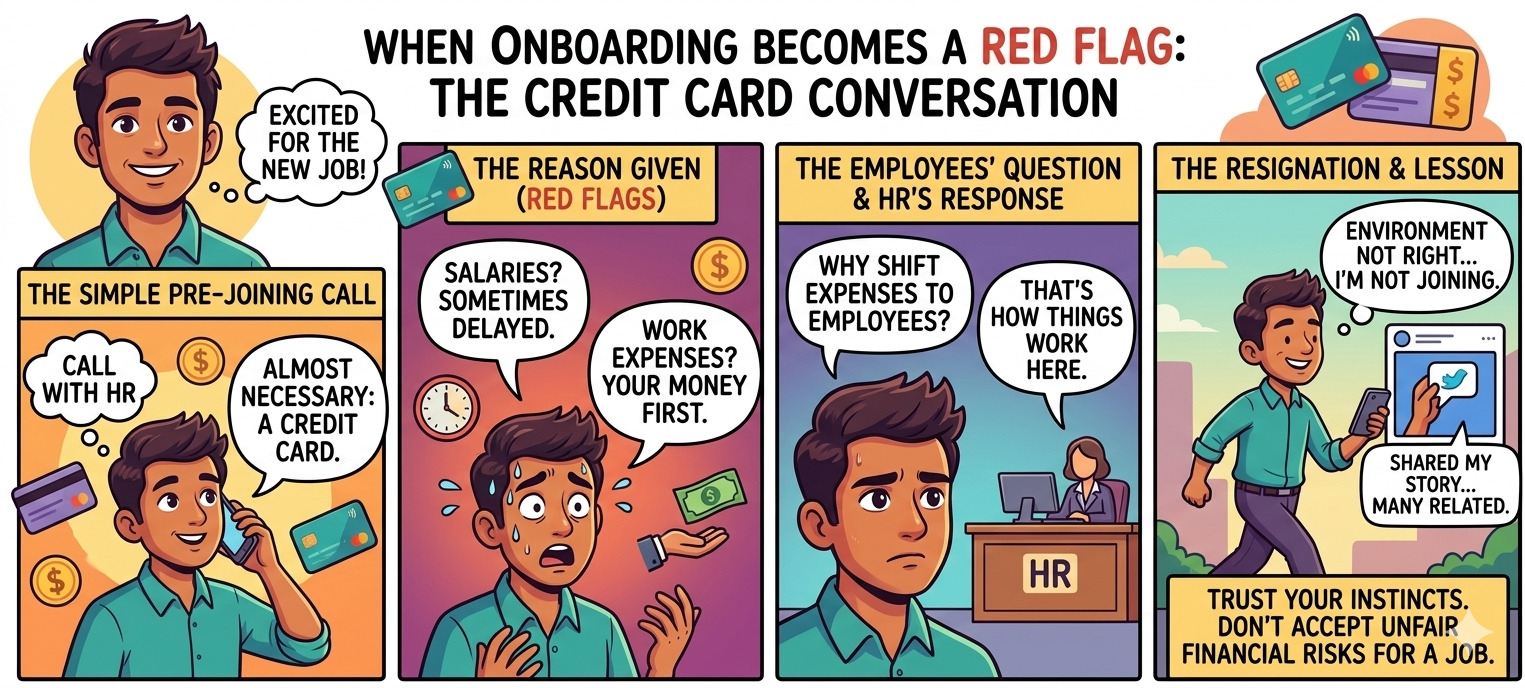
The employee questioned this system. He asked why a company would shift its own expenses to employees. HR replied that this was how things worked there. That response was enough for him to decide. He felt the environment was not right and chose not to join. He shared his experience online, and many people related to it.
This is not a one-time case. According to Gallup's State of the Global Workplace 2025 report, 49% of Indian employees are actively seeking new jobs, and 30% experience daily stress. Financial uncertainty only makes the situation worse.
Many young professionals do not have enough savings to handle such costs. They cannot afford to pay company expenses and wait for reimbursements. This creates financial pressure and anxiety.
The issue is not just about inconvenience. There is also confusion around reimbursement rules in India. Employees often do not know what they can claim or how the process works. This lack of clarity allows companies to create unfair systems. Workers end up taking financial risks without proper support.
Experts explain that reimbursement means returning money spent on approved work expenses. It is a basic part of fair workplace practices. If companies fail to reimburse properly, they may face compliance issues.
Asking employees to regularly fund company expenses is not a proper policy. It is a way to manage cash flow using employee money. This shifts the burden to the wrong people.
Many companies still track expenses manually using spreadsheets. Only a few have proper automated systems in place. Automation can speed up reimbursements and reduce policy mistakes. The solution already exists, but many companies do not implement it.
Employees should always ask about reimbursement policies before accepting an offer. They should clearly understand when and how they will be paid back. If a company cannot answer this clearly, it is a warning sign.
The employee who walked away noticed the warning signs early. He acted before getting stuck in an unfair system. Many people wish they had made similar decisions earlier.
Employees are becoming more careful about such issues as awareness grows. Companies that shift financial burdens onto workers may struggle to hire and retain talent. Clear and honest communication during onboarding builds trust. A good offer can quickly fall apart without transparency.
Related Financial News | |||
*T&C Apply









.png&w=3840&q=75)



