
By continuing, you agree to LoansJagat's Credit Report Terms of Use, Terms and Conditions, Privacy Policy, and authorize contact via Call, SMS, Email, or WhatsApp
Disclaimer: The information published on LoansJagat is intended for general informational and educational purposes only and should not be considered financial, legal, or investment advice. Interest rates, loan terms, statistics, and other data may change over time and may vary by lender or source. Please verify the latest information and consult a qualified financial advisor or the respective Bank/NBFC before making any financial decisions.
Subscribe Now
About the author

LoansJagat Team
‘Simplify Finance for Everyone.’ This is the common goal of our team, as we try to explain any topic with relatable examples. From personal to business finance, managing EMIs to becoming debt-free, we do extensive research on each and every parameter, so you don’t have to. Scroll up and have a look at what 15+ years of experience in the BFSI sector looks like.
Related Blog Post
Simplify All Your Loans Into One Affordable EMI

Customers Served

Debt Consolidated

1200+ Reviews

Locations in India
Club all Loans & Credit Card Bills into Single EMI

Quick Apply Loan
Consolidate your debts into one easy EMI.

Takes less than 2 minutes. No paperwork.

10 Lakhs+
Trusted Customers

2000 Cr+
Loans Disbursed

4.7/5
Google Reviews

50+
Banks & NBFCs Offers
Other services mentioned in this article
Key Takeaways
Domestic equity markets ended lower on Wednesday, weighed down by banking stocks and a mix of global and policy-related concerns.
The decline was led by banks after the RBI finalised its Expected Credit Loss framework and asset classification norms, raising concerns over higher provisioning requirements for lenders.
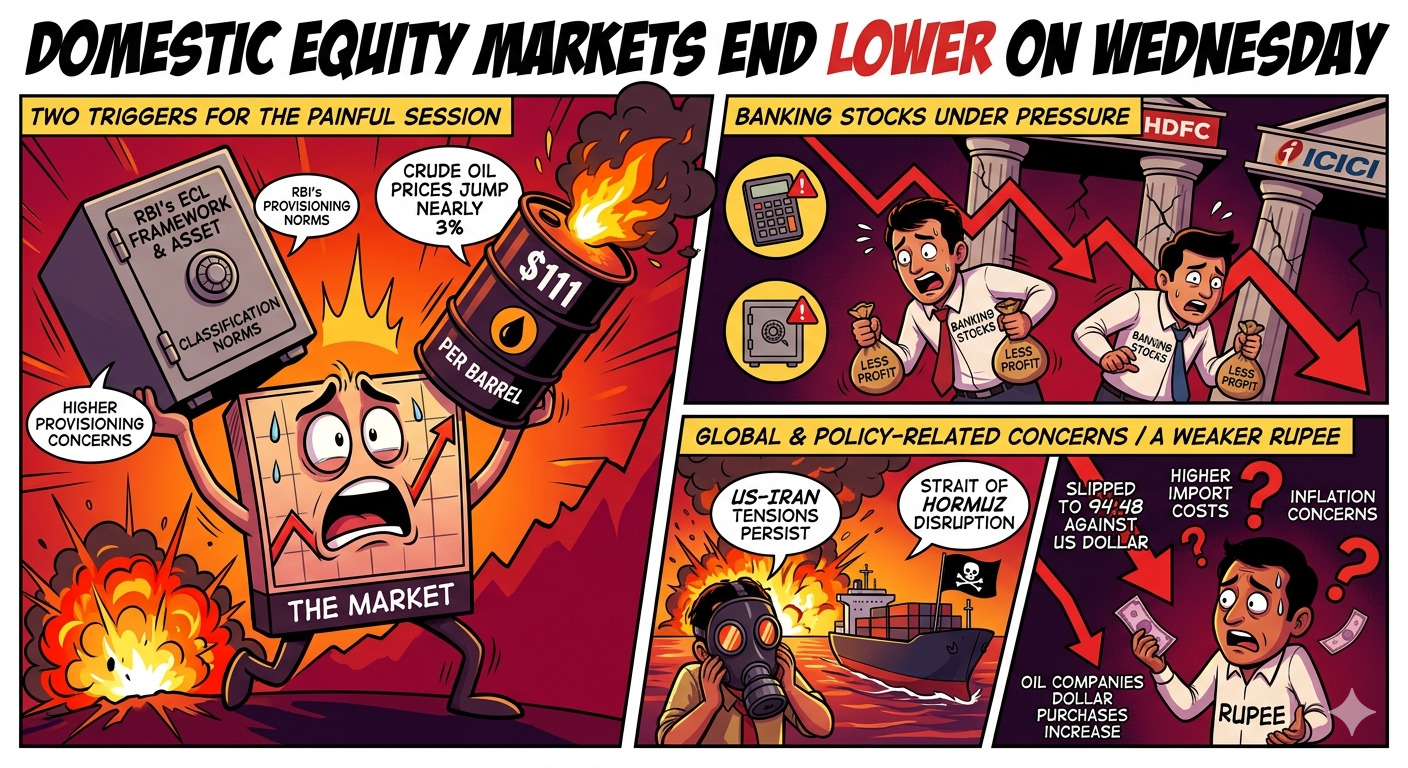
Adding to the pressure, crude oil prices jumped nearly 3% as US-Iran tensions persisted and the Strait of Hormuz remained largely disrupted, tightening global supply and pushing Brent crude to around $111 per barrel.
The compounding effect of two negative triggers on the same session was hard to absorb.
The Indian rupee slipped to 94.48 against the US dollar, driven by the surge in crude prices, which forced oil marketing companies to ramp up their dollar purchases, deepening the trade imbalance.
A weaker rupee also signals higher import costs down the line, a concern that weighs directly on inflation.
Wednesday's session was not uniformly negative. The table below captures the divergence across indices and asset classes.
The broader markets told a contrasting story.
The Nifty Midcap 100 and Nifty Smallcap 100 indices both ended in the green, indicating selective buying in mid-tier companies even as heavyweight bank stocks dragged the benchmarks lower.
Shares of public sector banks bore the sharpest brunt. Bank of India and Union Bank of India fell 2.20% and 3.45% respectively, with the broader Nifty PSU Bank Index declining 1.91%.
Down
*T&C Apply
For retail investors holding PSU bank stocks or banking sector mutual funds, this translated into immediate portfolio erosion, though not yet a structural break.
Kotak Mahindra Bank was the sole Nifty Bank constituent to close in the green on Tuesday, highlighting how investor sentiment differentiated between private banks with stronger capital buffers and PSU lenders facing steeper ECL transition costs.
That selectivity could persist in coming sessions. Indiabusiness
Vinod Nair noted that domestic equities are yielding to regulatory tightening and geopolitical pressures, struggling to sustain the recent gains from their lows.
He added that banking stocks were at the centre of the sell-off, with FII outflows and rupee weakness further weighing on sentiment. Domestic institutional investors, however, provided a cushion that limited deeper losses.
Analysts say the near-term direction will depend on global cues, central bank signals, and how markets react to evolving geopolitical developments.
A resolution around the Strait of Hormuz or a moderation in crude prices could swiftly reverse the current negativity, especially given that India's domestic macroeconomic fundamentals remain broadly intact.
Wednesday's market dip reflects short-term anxiety, not a broken trend. India's fundamentals, strong DII participation, resilient mid-caps, and a credible regulatory framework remain intact. Investors who stay focused on quality and avoid panic selling will be better positioned when sentiment stabilises.
Related Finance News | |||
RBI Expands Agri Startup Financing Through Cooperative Banks | |||









.png&w=3840&q=75)



