By continuing, you agree to LoansJagat's Credit Report Terms of Use, Terms and Conditions, Privacy Policy, and authorize contact via Call, SMS, Email, or WhatsApp
Disclaimer: The information published on LoansJagat is intended for general informational and educational purposes only and should not be considered financial, legal, or investment advice. Interest rates, loan terms, statistics, and other data may change over time and may vary by lender or source. Please verify the latest information and consult a qualified financial advisor or the respective Bank/NBFC before making any financial decisions.
Subscribe Now
About the author

LoansJagat Team
‘Simplify Finance for Everyone.’ This is the common goal of our team, as we try to explain any topic with relatable examples. From personal to business finance, managing EMIs to becoming debt-free, we do extensive research on each and every parameter, so you don’t have to. Scroll up and have a look at what 15+ years of experience in the BFSI sector looks like.
Related Blog Post
Simplify All Your Loans Into One Affordable EMI

Customers Served

Debt Consolidated

1200+ Reviews

Locations in India
Club all Loans & Credit Card Bills into Single EMI

Quick Apply Loan
Consolidate your debts into one easy EMI.

Takes less than 2 minutes. No paperwork.

10 Lakhs+
Trusted Customers

2000 Cr+
Loans Disbursed

4.7/5
Google Reviews

50+
Banks & NBFCs Offers
Other services mentioned in this article
The rupee’s fall past ₹95/$ has raised fresh fears over costlier imports, higher fuel-linked inflation and pressure on Indian financial markets.
The Indian rupee crossed the ₹95 per US dollar level on Thursday, April 30, 2026, after crude oil prices jumped sharply. Upstox reported that the rupee was trading 0.34% weaker at ₹95.174/$ at 9:39 a.m. IST, against the previous close of ₹94.85/$.
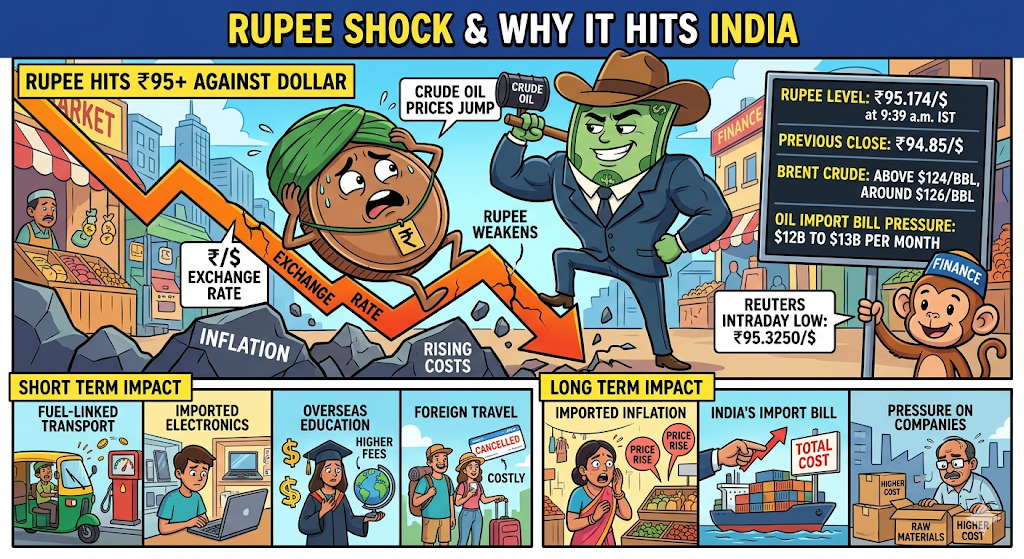
In the short run, this can make fuel-linked transport, imported electronics, overseas education and foreign travel costlier. Over a longer period, a weak rupee can lift imported inflation, raise India’s import bill and put pressure on companies that depend on foreign raw materials.
Reuters reported that the rupee touched a fresh record low of ₹95.3250/$, down 0.5% on the day, as Brent crude moved near $126/bbl, its highest level in 4 years.
India buys a large part of its crude oil from overseas. LoansJagat reported on March 19, 2026 that India imports nearly 85% to 88% of its crude oil needs, which makes the rupee sensitive to oil price jumps.
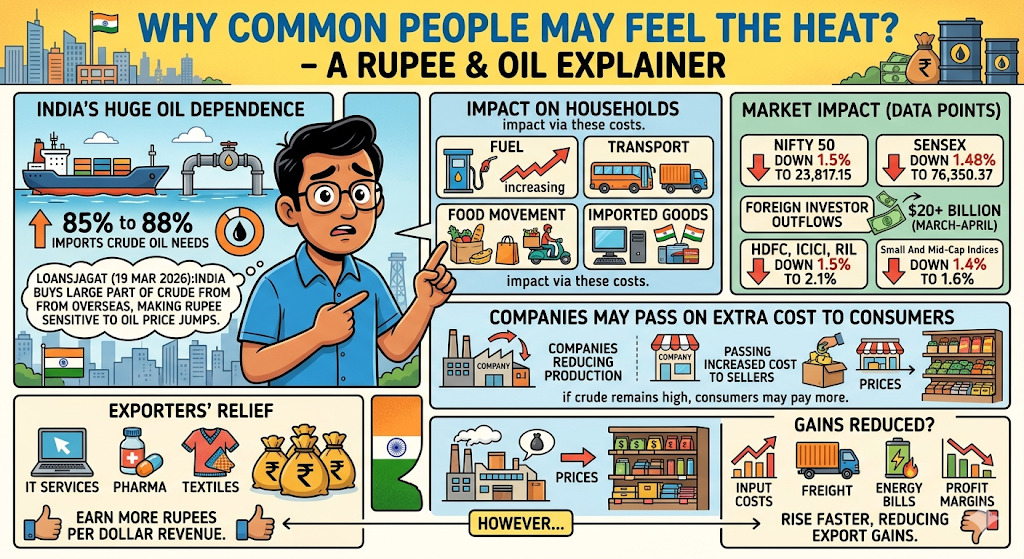
For households, the impact can come through fuel, transport charges, food movement costs and imported goods. The hit may not appear overnight, but if crude remains high, companies may pass on part of the extra cost to consumers.
There can be one relief point. Exporters in IT services, pharma and textiles may earn more rupees for every dollar of revenue. But that gain can get reduced if input costs, freight and energy bills rise faster.
Reuters reported that foreign investors sold over $20 billion of Indian stocks and bonds across March and April, adding to rupee pressure along with oil demand and a hawkish US Federal Reserve signal.
Reuters also reported on April 29, 2026 that state-run oil refiners were using SBI’s special FX credit line only partly, as further rupee weakness could raise repayment costs. The solution now depends on lower crude prices, softer dollar demand, steadier foreign flows and reduced spot-market dollar buying by oil firms.
The rupee’s slide past ₹95/$ is a direct warning from the oil market. If crude stays high, India may face costlier imports, weaker markets and fresh inflation pressure.
*T&C Apply
Why Higher Crude Oil Prices Create Trouble For India
Rising crude oil prices are a big concern for India because the country imports most of its oil needs. When Brent crude becomes expensive, India has to spend more US dollars on oil imports. This increases the import bill, puts pressure on the rupee and can raise petrol, diesel and transport costs.
Higher fuel costs also affect food prices, logistics, airlines, paint, chemicals and many manufacturing sectors. For common people, this can mean higher monthly expenses. For the economy, it can widen the trade deficit and increase inflation pressure, especially if oil prices stay high for long.
Who Fixes Crude Oil Rates In India?
Crude oil prices in India are not fixed by one single authority. They mainly depend on global crude benchmarks like Brent crude, international supply and demand, OPEC+ production decisions, geopolitical tensions, shipping costs and the rupee-dollar exchange rate. Since India imports nearly 85% to 88% of its crude oil needs, global prices directly affect domestic costs.
Oil marketing companies use these global prices, refining costs, taxes, dealer commission and currency movement to decide petrol and diesel prices. Government taxes also play a major role in the final fuel price paid by Indian consumers.
Related Finance News | |||
RBI Expands Agri Startup Financing Through Cooperative Banks | |||









.png&w=3840&q=75)



