
By continuing, you agree to LoansJagat's Credit Report Terms of Use, Terms and Conditions, Privacy Policy, and authorize contact via Call, SMS, Email, or WhatsApp
Disclaimer: The information published on LoansJagat is intended for general informational and educational purposes only and should not be considered financial, legal, or investment advice. Interest rates, loan terms, statistics, and other data may change over time and may vary by lender or source. Please verify the latest information and consult a qualified financial advisor or the respective Bank/NBFC before making any financial decisions.
Subscribe Now
About the author

LoansJagat Team
‘Simplify Finance for Everyone.’ This is the common goal of our team, as we try to explain any topic with relatable examples. From personal to business finance, managing EMIs to becoming debt-free, we do extensive research on each and every parameter, so you don’t have to. Scroll up and have a look at what 15+ years of experience in the BFSI sector looks like.
Related Blog Post
Simplify All Your Loans Into One Affordable EMI

Customers Served

Debt Consolidated

1200+ Reviews

Locations in India
Club all Loans & Credit Card Bills into Single EMI

Quick Apply Loan
Consolidate your debts into one easy EMI.

Takes less than 2 minutes. No paperwork.

10 Lakhs+
Trusted Customers

2000 Cr+
Loans Disbursed

4.7/5
Google Reviews

50+
Banks & NBFCs Offers
Other services mentioned in this article
EY India and FICCI have pushed for 9% GST on premium hotel rooms, saying lower taxes can lift India’s inbound tourism appeal.
EY India and FICCI have recommended a lower GST rate for hotel rooms priced above ₹7,500 per night. The proposal is part of the report “Reimagining Inbound Tourism in India: Trends, Technology & Transformational Opportunities – Towards Incredible India 4.0,” released at GITB 2026 in Jaipur, held from April 26 to April 28, 2026.
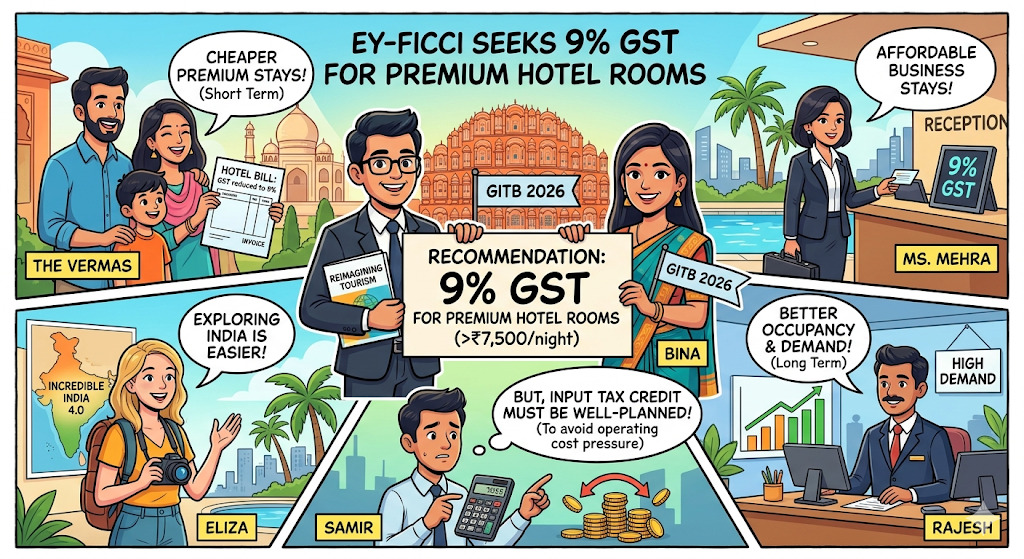
The short-term impact can be cheaper premium stays for travellers, especially families, business guests and foreign tourists. In the long term, hotels may gain through better occupancy and higher demand. The negative side is that any GST cut without a well-planned input tax credit structure can create pressure on hotel operating costs.
The report has asked for a sharper tax rethink because India is competing with tourism-heavy markets such as Thailand and Vietnam, where total travel cost often becomes a deciding factor.
LoansJagat also highlighted the same proposal, saying GST on premium hotel rooms above ₹7,500 may be reduced from 18% to 9%, with the aim of making luxury stays more affordable and increasing hotel demand.
For Indian travellers, the proposed GST cut can lower the final bill at premium hotels. This can help during holidays, weddings, corporate travel and medical tourism trips, where accommodation takes a large share of the budget.
The benefit can also reach workers linked with hotels, taxis, restaurants, guides, events and local shopping. EY-FICCI’s tourism numbers, including ₹21 trillion GDP contribution and over 46 million jobs, show why hotel taxation is not only a luxury travel issue. It connects with employment and local business income.
The fresh proposal comes after the GST Council’s earlier move on mid-market hotels. On September 3, 2025, the 56th GST Council recommended reducing GST on hotel rooms priced up to ₹7,500 per day from 12% with ITC to 5% without ITC.
That earlier reform helped lower-priced rooms, but premium rooms continued at 18%. EY-FICCI now wants the higher slab reduced so India’s luxury and upscale hospitality market can compete better with global destinations.
*T&C Apply
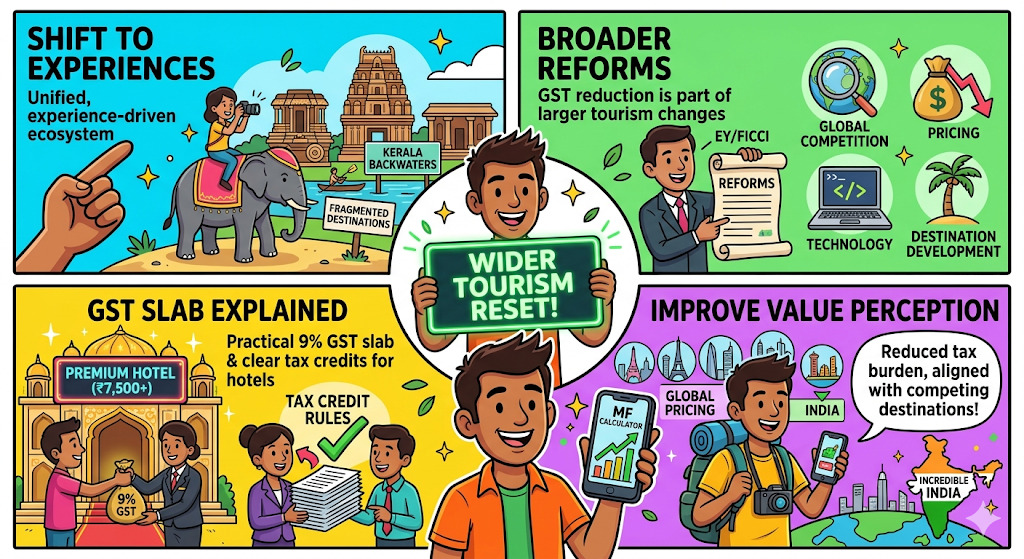
EY India and FICCI said India needs a shift from fragmented, destination-led tourism to a unified, experience-driven tourism ecosystem. Their report places GST reduction alongside broader reforms for inbound tourism, pricing, technology and destination development.
The practical solution can be a 9% GST slab for rooms above ₹7,500, with tax credit rules explained properly for hotels. Travel Trade Journal reported that the recommendation aims to reduce the tax burden, improve value perception and align India’s hospitality pricing with competing global destinations.
A 9% GST rate on premium hotel rooms can make India’s upscale stays more attractive for domestic and foreign tourists. The final call now depends on the government and the GST Council.
Why do luxury hotel restaurants charge higher GST in India?
Luxury hotel restaurants in India can charge 18% GST when the hotel’s room tariff is above ₹7,500 per night. This has created confusion among customers, as many expect restaurant food to attract a lower GST rate.
The Reddit discussion shows that several users feel this rule is not new, while others believe it increases the total dining bill at premium hotels. This topic is now more relevant because EY-FICCI has urged the government to cut GST on premium hotel rooms from 18% to 9%, which may also improve India’s tourism pricing.
What GST Rate Can Hotels Legally Charge On Room Bills In India?
Hotels in India can charge GST only as per the government-approved slab, not any random extra amount. At present, hotel rooms priced up to ₹7,500 generally attract 5% GST without input tax credit, while rooms above ₹7,500 attract 18% GST. The GST is calculated on the room tariff and added to the final bill.
A hotel cannot charge more GST than the applicable rate shown on the invoice. Travellers should always check the GSTIN, room tariff, tax rate and final amount before paying. If overcharged, they can raise a complaint with the hotel or GST authorities.
Related Finance News | |||
RBI Expands Agri Startup Financing Through Cooperative Banks | |||









.png&w=3840&q=75)



