
By continuing, you agree to LoansJagat's Credit Report Terms of Use, Terms and Conditions, Privacy Policy, and authorize contact via Call, SMS, Email, or WhatsApp
Disclaimer: The information published on LoansJagat is intended for general informational and educational purposes only and should not be considered financial, legal, or investment advice. Interest rates, loan terms, statistics, and other data may change over time and may vary by lender or source. Please verify the latest information and consult a qualified financial advisor or the respective Bank/NBFC before making any financial decisions.
Subscribe Now
About the author

LoansJagat Team
‘Simplify Finance for Everyone.’ This is the common goal of our team, as we try to explain any topic with relatable examples. From personal to business finance, managing EMIs to becoming debt-free, we do extensive research on each and every parameter, so you don’t have to. Scroll up and have a look at what 15+ years of experience in the BFSI sector looks like.
Related Blog Post
Simplify All Your Loans Into One Affordable EMI

Customers Served

Debt Consolidated

1200+ Reviews

Locations in India
Club all Loans & Credit Card Bills into Single EMI

Quick Apply Loan
Consolidate your debts into one easy EMI.

Takes less than 2 minutes. No paperwork.

10 Lakhs+
Trusted Customers

2000 Cr+
Loans Disbursed

4.7/5
Google Reviews

50+
Banks & NBFCs Offers
Other services mentioned in this article
Parliament’s latest funding warning puts pressure on the Centre and states to spend more on colleges, scholarships, research facilities and student accommodation.
Key Highlights
The 381st Action Taken Report was presented in New Delhi by Digvijaya Singh for the Parliamentary Standing Committee on Education on 16 June 2026. This report assessed actions taken by the government after the committee’s higher education grants report for the year 2025-26, which was the 364th report.
With the current education budget being termed insufficient, the New Indian Express cited the committee’s report to justify an education budget increase of 8-10% to prevent public educational institutions losing financial support.This will hinder appointing enough teachers and building hostels and later hinder upgrading labs, providing scholarships, and offering more educational services.
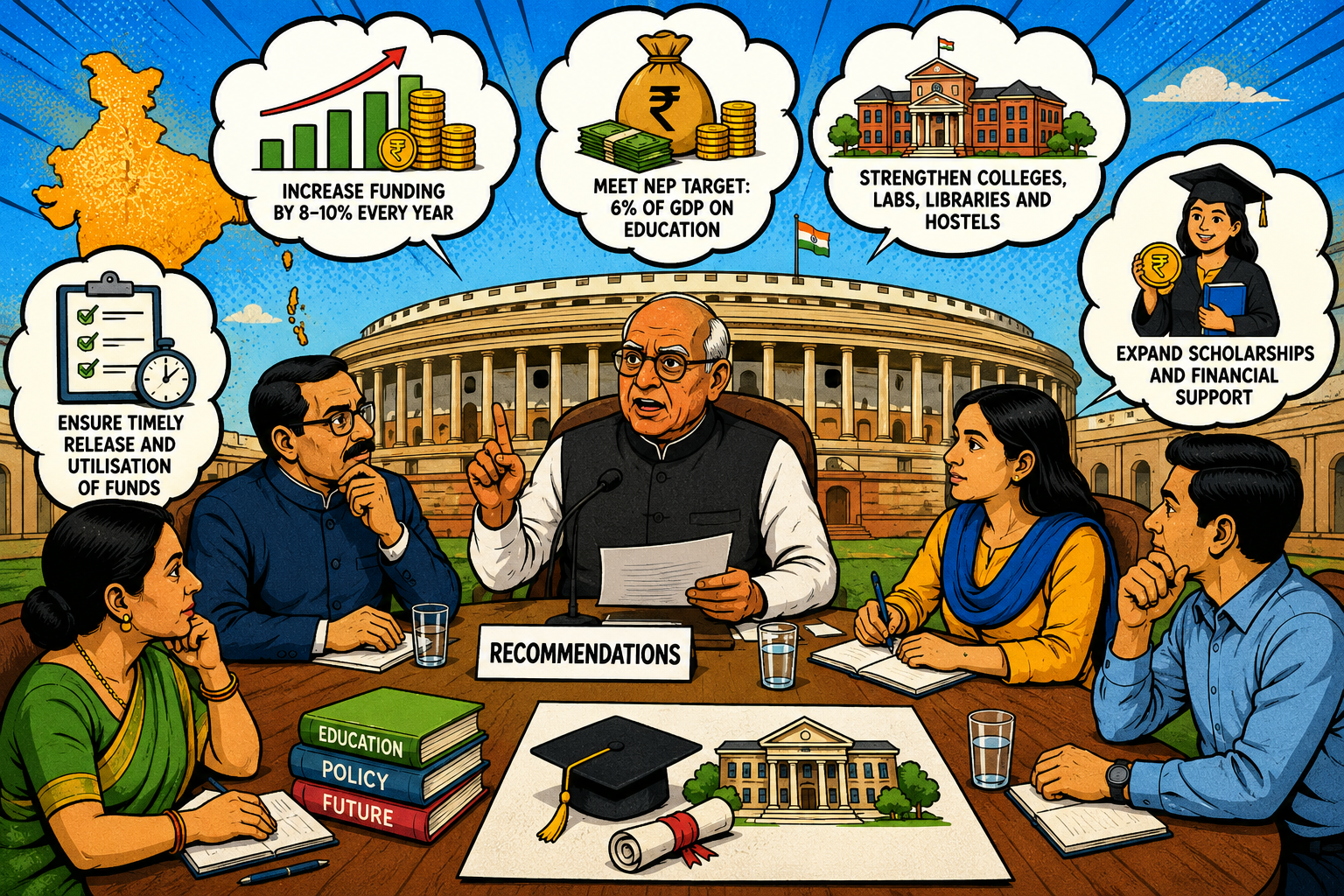
For 2021-2022, the committee said that 4.12% of GDP on Education stands below the 6% goal of the National Education Policy, 2020.
The panel also relied on educational expenditure of some neighboring states, which was published by The Economic Times on June 17, 2026.
For a student in a district with few public colleges, the effect is fairly direct. More funded seats can reduce travel costs, private tuition fees, and dependence on loans. Better hostels also decide whether many women can study outside their hometowns.
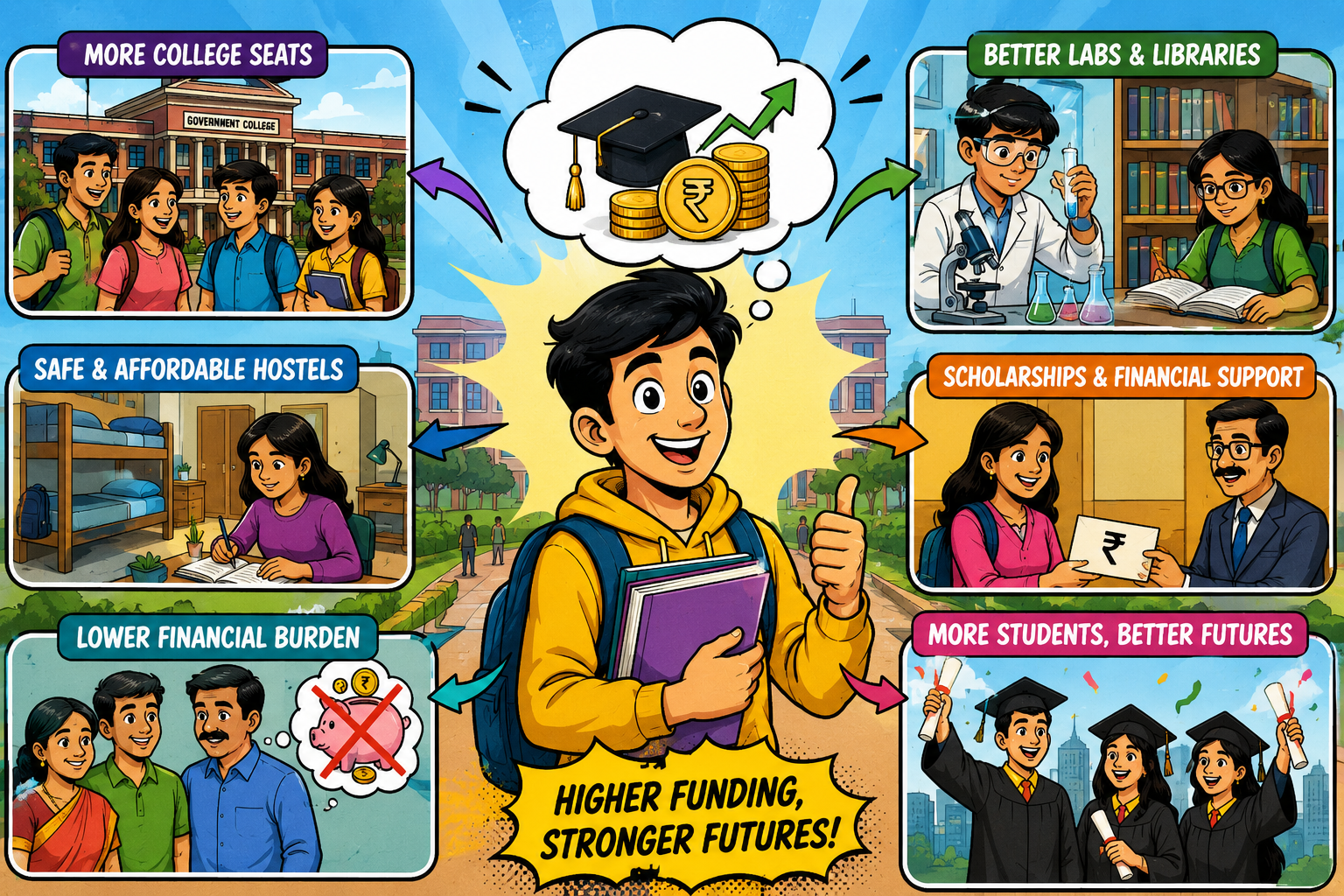
The committee flagged limited growth in male and female gross enrollment ratios between 2018 and 2023. NEP aims to raise the higher education GER to 50% by 2035, a target that needs more colleges, teachers, and affordable places.
Budget figures show an increase, though higher education received only the bottom end of the panel’s suggested range.
PRS Legislative Research published these figures on 17 February 2026. The numbers point to a familiar problem. An allocation may rise on paper, yet inflation can still leave universities buying fewer books, computers or laboratory supplies.
The government told the committee that allocations depend on departmental requirements and availability. Budget limits. The committee wanted a steadier approach, with yearly increases that protect actual purchasing power.
Spending quality also needs attention. Research of the PM-USHA scheme by PRS showed that the average budget utilization for the three years, 2022-2025, was 16% of the approved budget. A reduction in the approval time for projects, implementation of public financial management systems to ensure real-time tracking of funds, and establishing rigid timelines for fund disbursements would most likely eliminate the issue of unutilized funds.
A LoansJagat report found that 21,967 PM-Vidyalaxmi loans were disbursed from 55,887 applications.
The 6% promise remains unfinished. Larger budgets will help only when grants reach colleges on time and students see the benefit.
8–10%
18%
*T&C Apply
Under NEP 2020, the target for public education spending will be 6% of GDP.
What Is The Allocation For Higher Education For The Year 2026-27?
The Department of Higher Education was allocated ₹55,727 crore, an increase of 8%.
What Is The Rationale Behind 8-10% Annual Increase?
The allocated amount should increase to keep pace with inflation and the cost of running the institutions.
Why Is Education Budget Still Below The NEP Target Of 6% GDP?
Over budget constraints, competing needs and priorities, poor financial conditions of the states, underutilization of funds all result in lower spending on education.
How To Improve Education Infrastructure Reach To 50% GER By 2035?
Build more colleges and teaching faculty, increase hostel accommodation, invest more in digital education, and improve state public universities.
Related News Updates | |||









.png&w=3840&q=75)



