
By continuing, you agree to LoansJagat's Credit Report Terms of Use, Terms and Conditions, Privacy Policy, and authorize contact via Call, SMS, Email, or WhatsApp
Disclaimer: The information published on LoansJagat is intended for general informational and educational purposes only and should not be considered financial, legal, or investment advice. Interest rates, loan terms, statistics, and other data may change over time and may vary by lender or source. Please verify the latest information and consult a qualified financial advisor or the respective Bank/NBFC before making any financial decisions.
Subscribe Now
About the author

LoansJagat Team
‘Simplify Finance for Everyone.’ This is the common goal of our team, as we try to explain any topic with relatable examples. From personal to business finance, managing EMIs to becoming debt-free, we do extensive research on each and every parameter, so you don’t have to. Scroll up and have a look at what 15+ years of experience in the BFSI sector looks like.
Related Blog Post
Simplify All Your Loans Into One Affordable EMI

Customers Served

Debt Consolidated

1200+ Reviews

Locations in India
Club all Loans & Credit Card Bills into Single EMI

Quick Apply Loan
Consolidate your debts into one easy EMI.

Takes less than 2 minutes. No paperwork.

10 Lakhs+
Trusted Customers

2000 Cr+
Loans Disbursed

4.7/5
Google Reviews

50+
Banks & NBFCs Offers
Other services mentioned in this article
The rupee’s fall past ₹95/$ has raised import-cost fears as crude oil prices climb on renewed US-Iran tensions and dollar demand rises.
Key Takeaways
The Indian rupee remained under heavy pressure on May 5, 2026, after touching a record low of ₹95.40 per US dollar, Reuters reported. The fall came as Brent crude moved from around $70/bbl to nearly $115/bbl since the Iran conflict began, pushing the rupee down by around 4.5% in that period.
In the short term, this can make crude, fertilisers, electronics and other dollar-priced imports costlier. In the long term, a weak rupee can add pressure on inflation, trade deficit and household budgets if oil prices stay high for several weeks.
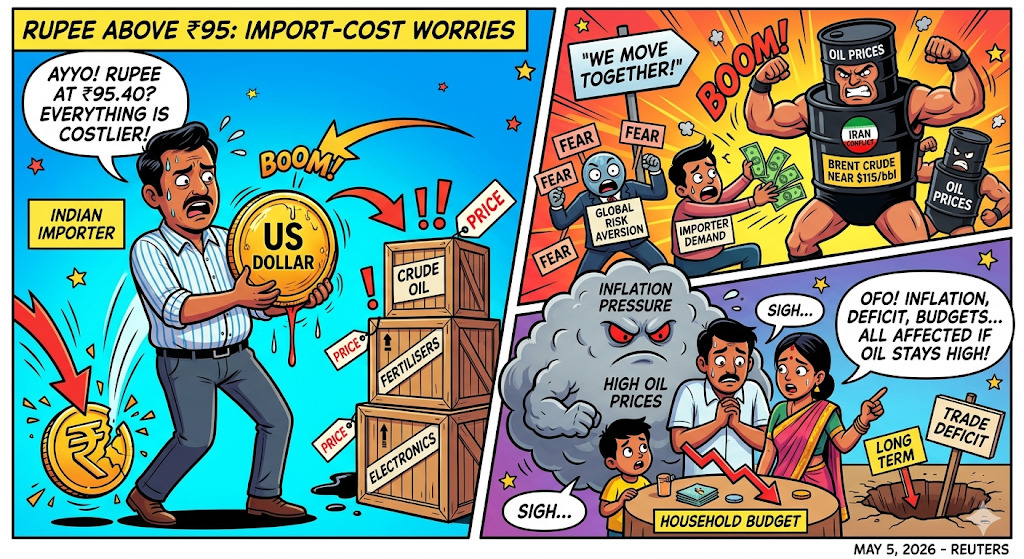
The latest currency pressure is not coming from one factor alone. Oil prices, importer demand and global risk aversion have moved together this week.
Moneycontrol reported on May 5, 2026 that Brent crude was trading near $114/bbl, as the US and Iran clashed over the Strait of Hormuz route. Financial Express also reported Brent crossing $114/bbl, adding that India imports nearly 80% of its fuel requirement from the Middle East.
For Indian households, the first hit can come through fuel-linked costs. If oil stays above $110/bbl, freight, logistics and imported inputs can become expensive. That can slowly feed into vegetables, packaged goods, airline tickets and imported electronics.
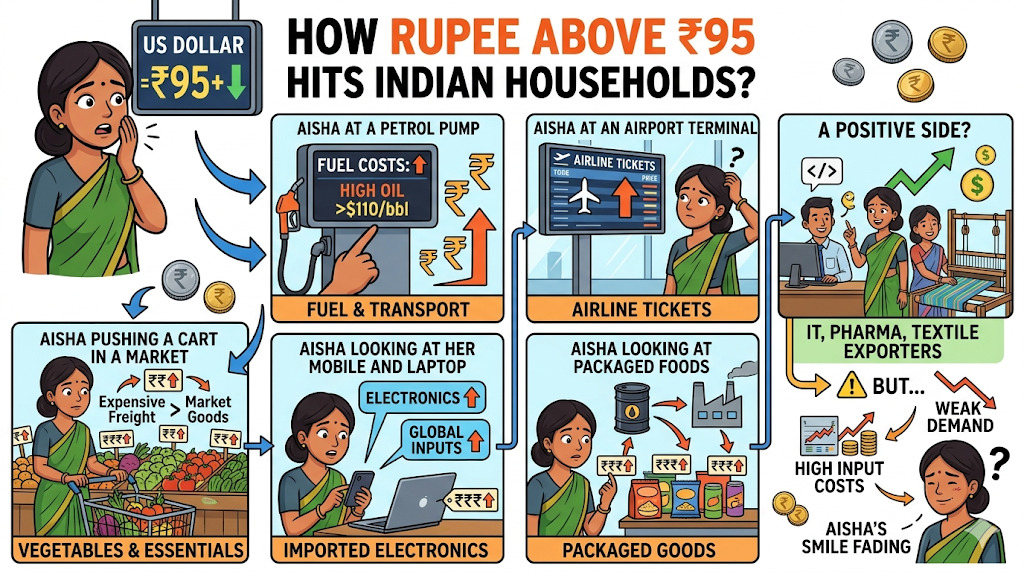
There can be one positive side for exporters. A weaker rupee may help some IT, pharma, textile and export-driven firms earn more in rupee terms. But this benefit reduces if input costs, freight and global demand also turn weak.
LoansJagat had earlier reported that the rupee’s fall past ₹95/$ raised fears of costlier imports, higher fuel-linked inflation and pressure on Indian financial conditions. That warning has now turned sharper with the rupee extending losses on May 5.
Reuters reported that traders viewed oil as the main reason behind the rupee’s latest weakness, while importer-led dollar demand added more pressure. ANZ and UBS also revised their rupee forecasts, with Reuters reporting projections of ₹98/$ and ₹96/$, respectively.
The solution depends heavily on crude cooling below recent levels and stronger dollar inflows. Until then, traders may continue to watch Brent crude, the dollar index and West Asia updates before taking big rupee positions.
The rupee’s move above ₹95/$ shows how quickly expensive crude can hit India’s currency.
If oil prices remain high, importers and consumers may face more pressure in the coming weeks.
Why does a falling rupee worry Indian stock market investors?
A falling rupee worries investors because India imports a large share of its crude oil, and oil is paid for in dollars. When the rupee weakens, the import bill rises, fuel costs can go up, and inflation pressure increases. This can hurt company margins, reduce consumer spending and delay rate cuts.
*T&C Apply
Foreign investors may also pull money out if currency risk rises. However, export-heavy sectors like IT, pharma and some textile companies may benefit because dollar earnings convert into more rupees. So, investors should avoid panic and track crude prices, FII flows and inflation data.
Can The Indian Rupee Ever Become Stronger Than The US Dollar?
It is highly unlikely that the Indian rupee will “beat” the US dollar in value soon. The dollar is still the world’s main reserve and trade currency. IMF data showed the dollar held 56.77% of global forex reserves in Q4 2025. BIS data also showed the dollar was on one side of 89.2% of global forex trades in April 2025.
India can strengthen the rupee only through higher exports, lower oil dependence, stable inflation, strong foreign investment and wider rupee trade. But becoming stronger than the dollar may take decades, not years.
Related Finance News | |||









.png&w=3840&q=75)



