Check AI Loan Optimisation Plans to Reduce Your EMI

Disclaimer: The information published on LoansJagat is intended for general informational and educational purposes only and should not be considered financial, legal, or investment advice. Interest rates, loan terms, statistics, and other data may change over time and may vary by lender or source. Please verify the latest information and consult a qualified financial advisor or the respective Bank/NBFC before making any financial decisions.
Subscribe Now
About the author

Ananya Shrivastava is a Content Writer specialising in finance-focused news, blogs, and long-form articles on Indian markets, RBI policy, personal finance, and lending. She has authored over 450 blogs and 250 news pieces, combining technical knowledge with rigorous research to simplify complex financial concepts into clear, engaging content. With a marketing-driven lens and sharp editorial judgment, she consistently achieves top Google rankings while ensuring every claim is backed by verified data.
Related Blog Post
Simplify All Your Loans Into One Affordable EMI

Customers Served

Debt Consolidated

1200+ Reviews

Locations in India
Club all Loans & Credit Card Bills into Single EMI

Quick Apply Loan
Consolidate your debts into one easy EMI.

Takes less than 2 minutes. No paperwork.

10 Lakhs+
Trusted Customers

2000 Cr+
Loans Disbursed

4.7/5
Google Reviews

50+
Banks & NBFCs Offers
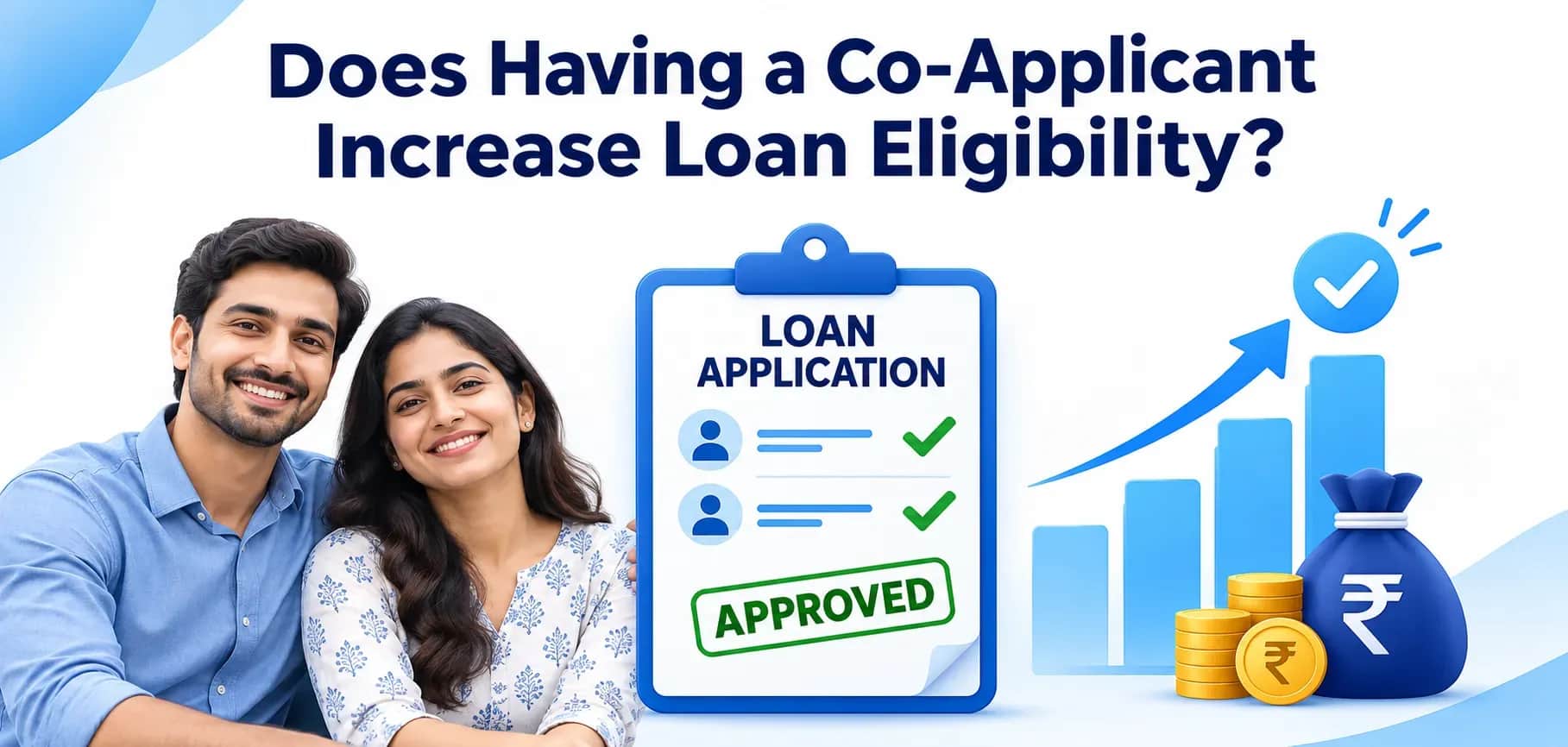
A co-applicant does raise your loan eligibility. Banks add up both incomes and review the two financial profiles together. HDFC Bank says an earning family member as a co-applicant strengthens your application, and ICICI Bank says joint income can lift the amount you qualify for.
A co-applicant helps on personal loans, home loans and most other retail loans. Ownership is a separate matter. It applies only to secured loans like home loans, since a property is involved. A personal loan is unsecured, so there is nothing to co-own.
Key Takeaways
Your income without a co-applicant may not be up to the mark, but they can help you with that. This guide covers how a co-applicant affects eligibility, who you can apply with and what documents they’ll need to provide.
Yes. Lenders add both incomes while deciding how much you can borrow and whether the EMI stays manageable.
Most lenders accept an earning family member such as a spouse, parent, sibling or adult child. Their income and credit history go into the application along with yours.
As per HDFC Bank, adding an earning family member as a co-applicant is a way to strengthen eligibility. Since exactly who qualifies shifts a bit by lender and loan type, worth checking directly with your bank before applying.
A co-applicant's income adds directly to your eligible loan amount, since lenders work out your maximum EMI capacity off combined income across everyone on the application.
Yes, just as much as their income. Lenders look at both applicants' credit history together before deciding approval and terms.
As per Kotak Mahindra Bank, lenders club your co-applicant's income and credit score together when working out eligibility.
Here's the catch, though:
Just as important as picking someone with a solid income is picking someone with a clean credit profile who manages their credit well.
The lender views them as a full and equal party to the application and needs the same core paperwork that you'd submit yourself, like proof of income, identity and address.
Salaried applicants generally need their latest 3 months' salary slips, recent Form 16, and 3 months of bank statements showing salary credits, and that standard applies equally to any co-applicant joining the loan.
A co-applicant is a joint owner of the loan with equal responsibility, often co-ownership rights too, while a guarantor steps in if the primary borrower defaults.
A co-applicant increases how much you can borrow, but a guarantor doesn't.
You can compare the solo application and co-applicant application and make the decision a lot easier for you:
Here is a home loan example. Take a salaried employee earning ₹50,000 a month who wants a home loan, but their solo eligibility falls short of what they actually need.
A co-applicant genuinely does increase loan eligibility. HDFC Bank, ICICI Bank, Axis Bank, and Kotak Mahindra Bank all confirm that pooling income and credit profiles across both applicants directly expands what you qualify to borrow. Since a co-applicant's credit score matters just as much as their income, picking someone with a stable income and a clean repayment record actually strengthens your application, not just adds a name to the form. Knowing the difference between a co-applicant and a guarantor before you apply means you're bringing in the right person for the job.
Yes, lenders pool both applicants' income and credit profiles, which bumps up your eligible loan amount over applying solo.
A co-applicant is typically an earning family member, spouse, parent, sibling or adult child, though this varies slightly between lenders.
Yes, the credit scores of both are reviewed, so having one with a high score is beneficial.
Income proof, identity proof, address proof, and bank statements showing regular income are the documents your co-applicant needs to submit.
No, a co-applicant's income counts toward eligibility, and they often get ownership rights on home loans. A guarantor just repays if you default.
Yes, co-applicants often hold shared ownership, especially on home loans, unlike a guarantor who has no claim at all.
Yes, since lenders weigh both credit profiles together, a poor score on their end can drag your application down.
Yes, plenty of lenders accept siblings, as long as they've got a documented, stable income.
Lenders generally combine both incomes for eligibility purposes, though the exact calculation varies by lender.
Not necessarily. A stable, well-documented income paired with a clean credit history matters more than income alone.
Start your journey today
Apply Now*T&C apply