
By continuing, you agree to LoansJagat's Credit Report Terms of Use, Terms and Conditions, Privacy Policy, and authorize contact via Call, SMS, Email, or WhatsApp
Disclaimer: The information published on LoansJagat is intended for general informational and educational purposes only and should not be considered financial, legal, or investment advice. Interest rates, loan terms, statistics, and other data may change over time and may vary by lender or source. Please verify the latest information and consult a qualified financial advisor or the respective Bank/NBFC before making any financial decisions.
Subscribe Now
About the author

‘Simplify Finance for Everyone.’ This is the common goal of our team, as we try to explain any topic with relatable examples. From personal to business finance, managing EMIs to becoming debt-free, we do extensive research on each and every parameter, so you don’t have to. Scroll up and have a look at what 15+ years of experience in the BFSI sector looks like.
Related News
Simplify All Your Loans Into One Affordable EMI

Customers Served

Debt Consolidated

1200+ Reviews

Locations in India
Club all Loans & Credit Card Bills into Single EMI

Quick Apply Loan
Consolidate your debts into one easy EMI.

Takes less than 2 minutes. No paperwork.

10 Lakhs+
Trusted Customers

2000 Cr+
Loans Disbursed

4.7/5
Google Reviews

50+
Banks & NBFCs Offers
Other services mentioned in this article
From April 1, 2026, high-value credit card payments and select overseas spends may face tighter tax reporting, while TCS on some foreign transactions is set to fall.
Credit card users are unlikely to see a new tax on routine swipes from April 1, 2026. The bigger change is around reporting and tax collection on certain high-value transactions.
The trigger comes from 2 sets of proposals: the Draft Income-tax Rules, 2026, released publicly in February 2026, and the Finance Bill, 2026 memorandum dated February 2, 2026. Together, they point to sharper scrutiny of big card-linked payments and lower TCS on some overseas spends. Reports by Upstox on February 16, 2026 and ABP Live on February 17, 2026 flagged the same trend.
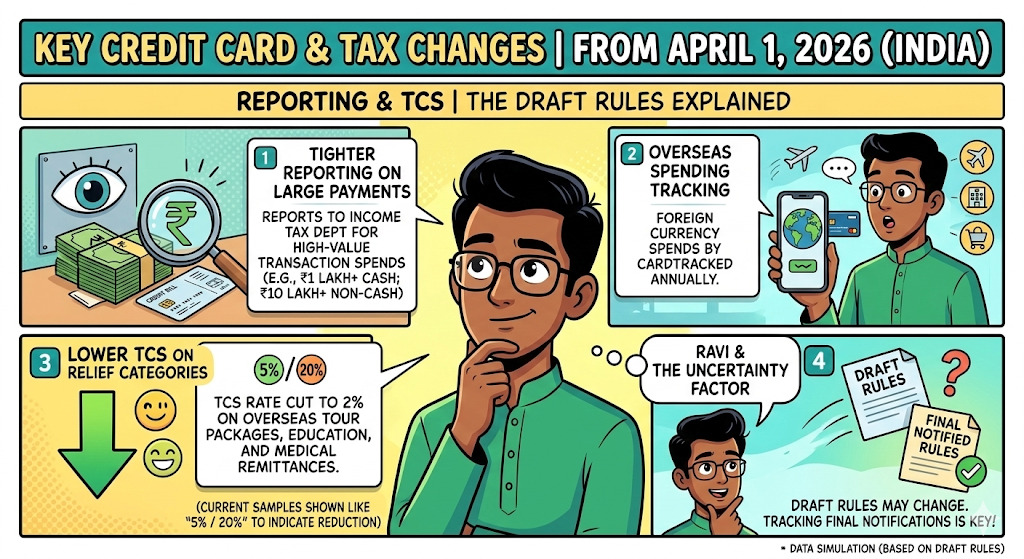
The immediate issue is visibility. Under the draft rules, banks and card issuers may have to report annual credit card bill payments of ₹1 lakh or more in cash and ₹10 lakh or more by any other mode.
Read More : Income Tax Act
The same draft also covers foreign-currency spends through debit or credit cards, with reporting thresholds of ₹10 lakh for PAN holders and ₹5 lakh without PAN in a financial year.
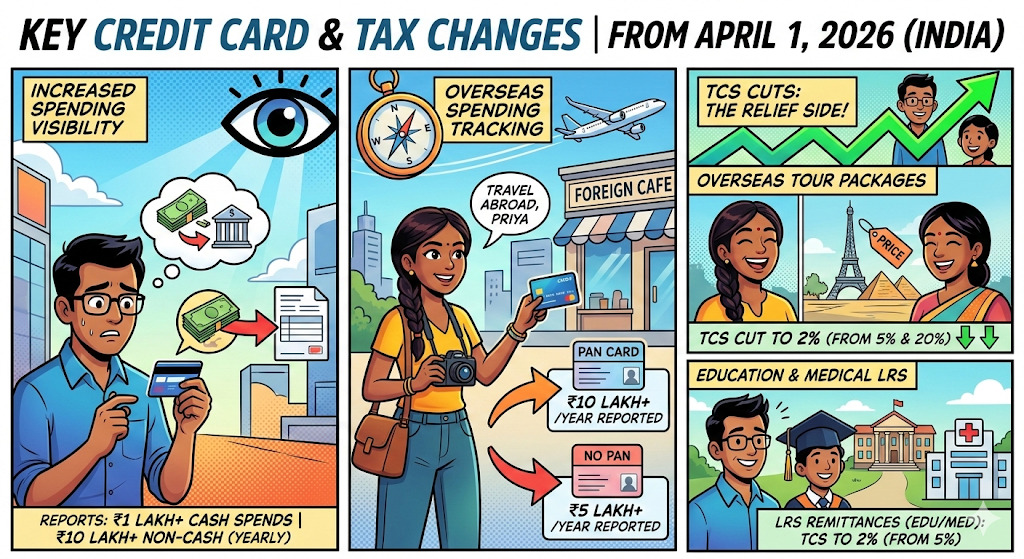
On the relief side, Budget 2026 proposes cutting TCS on overseas tour packages to 2%, from the current 5% and 20% slabs, and reducing TCS on education and medical remittances under LRS from 5% to 2%.
Before the proposals get final shape, here is the cleanest snapshot of what credit card users should track from April 1, 2026.
These are proposals, not the final notified framework yet. That distinction is important for taxpayers and for card users planning travel, tuition or big-ticket spends in FY27.
LoansJagat on February 11, 2026 also noted that the draft rules were opened for public comments till February 22, 2026, ahead of the April 1, 2026 rollout of the new law.
The build-up started with the transition to the Income-tax Act, 2025, which is scheduled to apply from April 1, 2026. The draft rules then spelt out new reporting thresholds for credit card bill payments and foreign-currency spends. Separately,
Finance Minister Nirmala Sitharaman said in her Budget Speech dated February 1, 2026 that TCS on overseas tour packages would be cut to 2% without any stipulation of amount, and TCS for education and medical purposes under LRS would fall to 2%. ET Online’s February 1, 2026 report said the move would reduce the upfront burden on overseas travel and remittances.
Also Read : What Changes Compared to the Previous Tax System?
What Stakeholders Are Saying?
Tax and forex industry voices have backed the TCS cut. ET Online quoted Amit Agarwal, Partner, Nangia & Co LLP, saying the lower 2% rate makes overseas transactions more affordable.
It also quoted Gagan Malhotra, COO, BookMyForex.com, who called the relief on education remittances a progressive step for families planning overseas studies.
For credit card users, April 1, 2026 could bring tighter reporting on large payments and softer TCS on some overseas spends. The final notified rules will decide how much of the draft survives unchanged.
Related Financial News | |||
*T&C Apply









.png&w=3840&q=75)



