
By continuing, you agree to LoansJagat's Credit Report Terms of Use, Terms and Conditions, Privacy Policy, and authorize contact via Call, SMS, Email, or WhatsApp
Disclaimer: The information published on LoansJagat is intended for general informational and educational purposes only and should not be considered financial, legal, or investment advice. Interest rates, loan terms, statistics, and other data may change over time and may vary by lender or source. Please verify the latest information and consult a qualified financial advisor or the respective Bank/NBFC before making any financial decisions.
Subscribe Now
About the author

LoansJagat Team
‘Simplify Finance for Everyone.’ This is the common goal of our team, as we try to explain any topic with relatable examples. From personal to business finance, managing EMIs to becoming debt-free, we do extensive research on each and every parameter, so you don’t have to. Scroll up and have a look at what 15+ years of experience in the BFSI sector looks like.
Related News
Simplify All Your Loans Into One Affordable EMI

Customers Served

Debt Consolidated

1200+ Reviews

Locations in India
Club all Loans & Credit Card Bills into Single EMI

Quick Apply Loan
Consolidate your debts into one easy EMI.

Takes less than 2 minutes. No paperwork.

10 Lakhs+
Trusted Customers

2000 Cr+
Loans Disbursed

4.7/5
Google Reviews

50+
Banks & NBFCs Offers
Other services mentioned in this article
In India, regular home loans stay tied to housing use. Extra cash usually comes through top-up loans or loan against property, with lender rules and tax limits.
Indian borrowers often assume a home loan works like a cash-out mortgage in the US. It does not. SBI’s regular home loan page says the product is for purchase, construction, plot plus construction, extension and repair or renovation, and notes it has already served over 31 lakh families.
HDFC’s top-up loan page, meanwhile, separately positions extra borrowing for personal or professional needs other than speculative purposes. The split is simple: the original home loan is for the house, while extra liquidity usually comes from a top-up loan or loan against property.
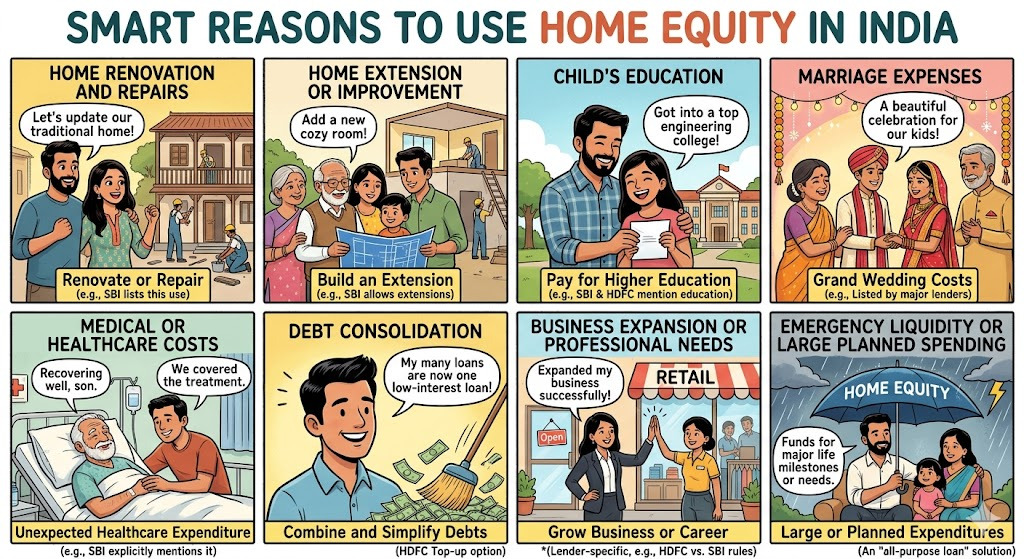
8 India-relevant reasons to tap home equity should be:
That also explains why borrowers use these products for planned expenses and not just emergencies.
Tax treatment stays narrower than borrowing flexibility. The Income Tax Department page updated on 11 December 2025 says Section 24(b) allows up to ₹2,00,000 on self-occupied property for purchase or construction, but only ₹30,000 for repairs.
Over time, the market separated housing finance from property-backed liquidity. SBI’s product pages draw that line clearly. A regular home loan is attached to the property transaction itself, while a loan against property sits under personal-purpose borrowing.
LoansJagat’s explainer published on 16 September 2025 also notes that home equity in India is generally accessed by borrowing against the value built in the property, not by freely repurposing the original home loan. Mint, in its 24 September 2025 report, reminded borrowers that pledging a home for credit carries repayment risk because the home remains collateral.
This difference shapes how lenders assess use, how tax deduction works, and how much flexibility a borrower really has.
Borrowers looking for education, medical or marriage funding are usually entering the home-equity route, not the plain home-loan route.
*T&C Apply
SBI is clear that regular home loans are for housing use, while its property-backed loan allows personal needs such as education, marriage and healthcare.
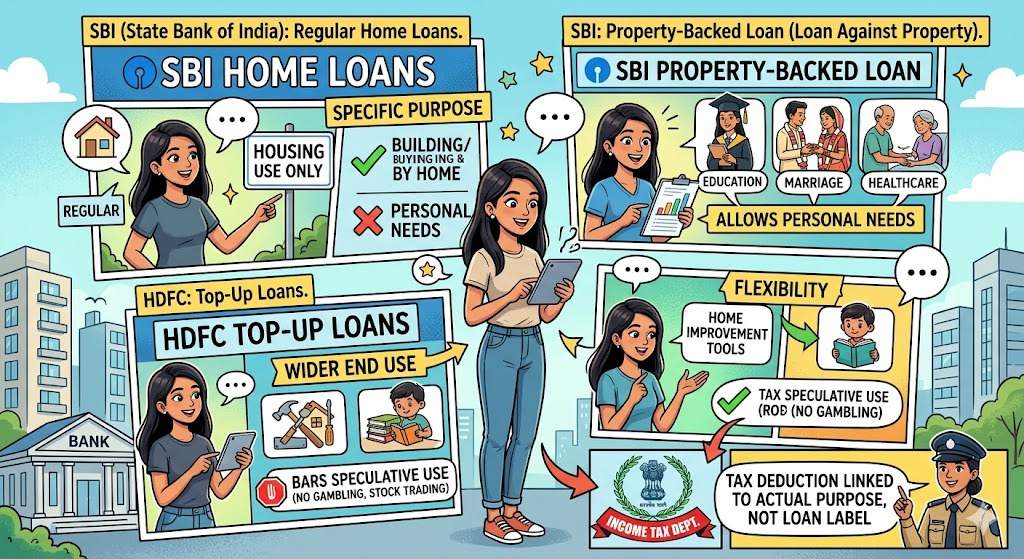
HDFC allows wider end use through top-up loans but bars speculative use. The Income Tax Department links deduction to actual purpose, not just the loan label.
In India, home-loan money is not open-ended cash. Borrowers usually need a top-up loan or loan against property for other expenses, and the tax benefit stays tied to actual end use.
Related Financial News | |||
|
|
| |
| |||
|
| ||









.png&w=3840&q=75)



