By continuing, you agree to LoansJagat's Credit Report Terms of Use, Terms and Conditions, Privacy Policy, and authorize contact via Call, SMS, Email, or WhatsApp
Disclaimer: The information published on LoansJagat is intended for general informational and educational purposes only and should not be considered financial, legal, or investment advice. Interest rates, loan terms, statistics, and other data may change over time and may vary by lender or source. Please verify the latest information and consult a qualified financial advisor or the respective Bank/NBFC before making any financial decisions.
Subscribe Now
About the author

LoansJagat Team
‘Simplify Finance for Everyone.’ This is the common goal of our team, as we try to explain any topic with relatable examples. From personal to business finance, managing EMIs to becoming debt-free, we do extensive research on each and every parameter, so you don’t have to. Scroll up and have a look at what 15+ years of experience in the BFSI sector looks like.
Related News
Simplify All Your Loans Into One Affordable EMI

Customers Served

Debt Consolidated

1200+ Reviews

Locations in India
Club all Loans & Credit Card Bills into Single EMI

Quick Apply Loan
Consolidate your debts into one easy EMI.

Takes less than 2 minutes. No paperwork.

10 Lakhs+
Trusted Customers

2000 Cr+
Loans Disbursed

4.7/5
Google Reviews

50+
Banks & NBFCs Offers
Other services mentioned in this article
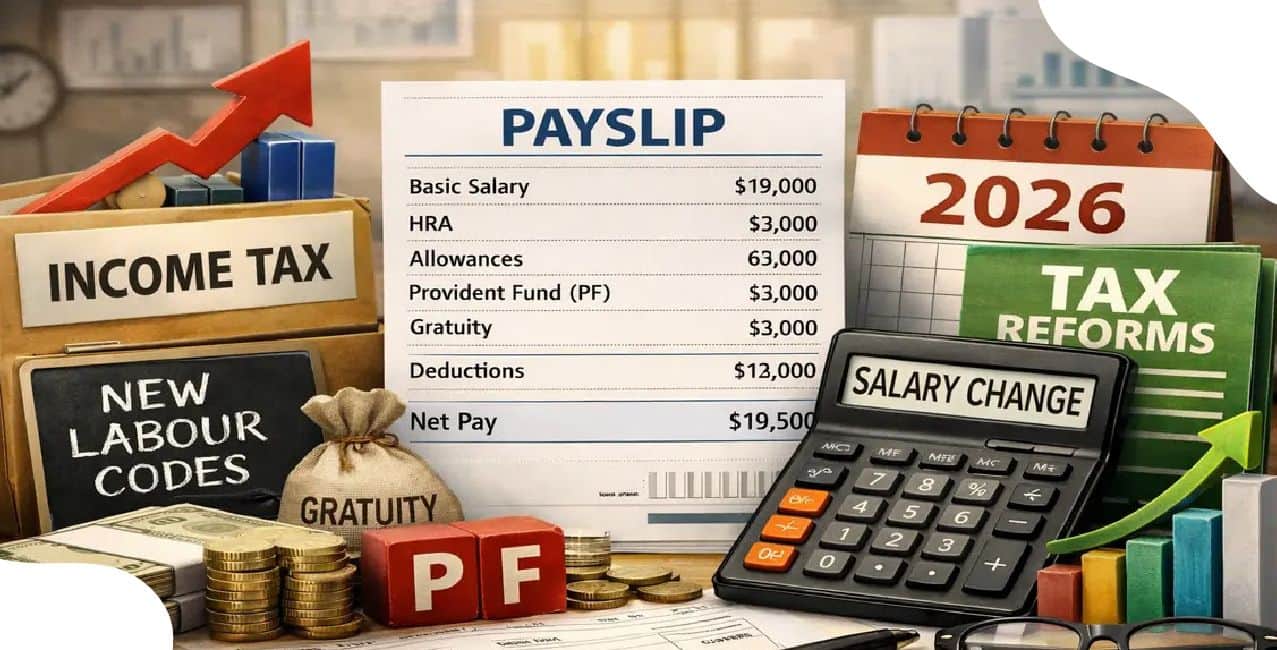
India’s salary structure is set for a major reset as companies begin aligning pay packages with new labour wage definitions and updated income-tax rules. From FY2026 onward, employers are expected to redesign salary components such as basic pay, allowances, and benefits.
While many employees fear a fall in monthly income, companies are largely trying to keep take-home pay stable. The real change lies not in how much you earn overall, but how your salary is structured and taxed.
The biggest trigger is the new definition of “wages” under India’s labour reforms. Traditionally, companies kept basic salary low — often 20–40% of total compensation — and paid the rest as allowances to reduce provident fund (PF) and gratuity liabilities.
Under the new framework, allowances cannot exceed 50% of total remuneration. If they do, the excess automatically becomes part of wages for statutory calculations.
This means companies must rebalance pay structures, increasing basic pay and reducing flexible allowances.
At the same time, changes in income-tax preferences — especially the growing shift toward the new tax regime — are pushing employers to simplify salary components further.
The impact will vary across employees and industries, but three key changes are expected:
1. Higher Basic Pay
Many firms may raise basic salary closer to 50% of CTC. A higher basic improves calculations for benefits like gratuity and retirement savings.
2. Increased PF Contributions
Since PF contributions are often linked to basic pay, deductions may rise. This can slightly reduce monthly in-hand salary but increases long-term savings.
3. Reduced Special Allowances
Flexible allowances may shrink or be renamed because they now count toward wages under the new definition.
Overall, experts expect only modest short-term changes because employers aim to maintain employee cash flow stability.
House Rent Allowance (HRA) remains an excluded allowance under wage rules, meaning it still provides tax benefits for employees using the old tax regime.
HRA exemptions can reach up to:
Recent tax rule updates have even expanded exemption attractiveness, encouraging companies to retain or slightly increase HRA components.
The reforms shift compensation from short-term cash to long-term security:
In simple terms, the new wage rules are less about salary cuts and more about forcing disciplined savings through payroll design.
India’s new wage framework marks a structural shift in how salaries are built rather than how much employees earn. While some may notice minor changes in monthly income, higher social-security contributions and clearer tax structures aim to strengthen long-term financial stability. Employees should review salary slips carefully this year, as understanding the breakup will matter more than ever.
Related Financial News | |||
*T&C Apply
|
|
|
|
|
|









.png&w=3840&q=75)



