
By continuing, you agree to LoansJagat's Credit Report Terms of Use, Terms and Conditions, Privacy Policy, and authorize contact via Call, SMS, Email, or WhatsApp
Disclaimer: The information published on LoansJagat is intended for general informational and educational purposes only and should not be considered financial, legal, or investment advice. Interest rates, loan terms, statistics, and other data may change over time and may vary by lender or source. Please verify the latest information and consult a qualified financial advisor or the respective Bank/NBFC before making any financial decisions.
Subscribe Now
About the author

LoansJagat Team
‘Simplify Finance for Everyone.’ This is the common goal of our team, as we try to explain any topic with relatable examples. From personal to business finance, managing EMIs to becoming debt-free, we do extensive research on each and every parameter, so you don’t have to. Scroll up and have a look at what 15+ years of experience in the BFSI sector looks like.
Related News
Simplify All Your Loans Into One Affordable EMI

Customers Served

Debt Consolidated

1200+ Reviews

Locations in India
Club all Loans & Credit Card Bills into Single EMI

Quick Apply Loan
Consolidate your debts into one easy EMI.

Takes less than 2 minutes. No paperwork.

10 Lakhs+
Trusted Customers

2000 Cr+
Loans Disbursed

4.7/5
Google Reviews

50+
Banks & NBFCs Offers
Other services mentioned in this article
Key Insights
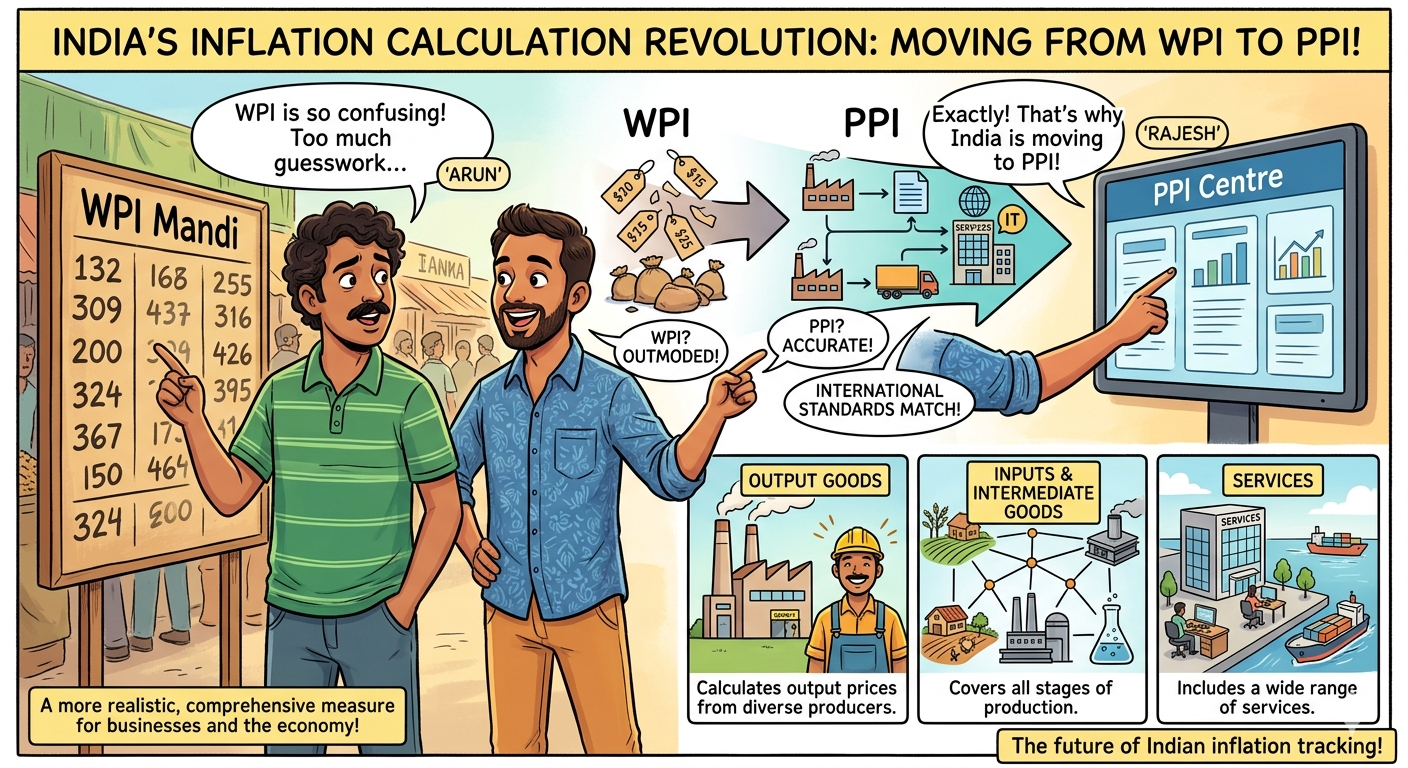
The Indian authorities intend to abandon the Wholesale Price Index in favour of more comprehensive calculations based on the Producer Price Index.
The latter would take into account prices of outputs, inputs, and services. This change would give a more realistic understanding of inflation in the country.
A Producer Price Index calculates wholesale prices from the perspective of producers of goods and services from different stages of production.
In most other countries, WPI has been substituted by PPI as it matches the national accounting standards.
This change will have important consequences both in the immediate future and in the long term.
While businesses will adjust to new calculation methods in the first place, in the long run this process might be quite lengthy as the government will have to deal with sample preparation, weighting and periodicity issues.
Therefore, until the transition process is finished, there might appear certain difficulties in understanding the inflation situation.
The table below compares key features of the WPI and the incoming PPI system, drawing on data from the Ministry of Commerce and Industry and DPIIT.
The total number of items has been increased from 697 to 957, and new sources of energy such as solar and wind have been added under the electricity group.
Nuclear electricity has also been included in the basket. The expanded coverage signals a meaningful upgrade in how India tracks producer-level price changes across the economy.
Now, inflation plays an important role in decisions made by everyday Indians. This impact on meddle class and lower class family decisions.
Interest rates on loans, subsidies given by the government, and changes in salaries across many sectors are all based on various inflation indexes.
If the figures are better captured, the RBI may have more accurate monetary policy measures.
This way, the risks of increasing interest rates due to erroneous figures and thus making mortgages and loans more expensive can be reduced.
Adding services to PPI is especially relevant for India because its service sector makes up more than 50% of the GDP, while WPI entirely ignores it.
Companies involved in banking, logistics, and insurance would finally have formal measures of prices for their inputs.
This way, investors and analysts would get an important instrument to evaluate the real input costs faced by companies.
According to P C Mohanan, former acting chairman of the National Statistical Commission, the biggest obstacle to implementation would be the choice of services to be added and the kind of services which will represent the sector.
697
*T&C Apply
Deciding on the weight of different services, their classification, as well as the number of surveys and price collection per month would take time.
Notable economists, including Dr Surjit Bhalla, Dr Shamika Ravi, head of the Economic Advisory Council to the PM, and Dr Dharmakirti Joshi, CRISIL's chief economist, are members of the 18-member group.
A trial input PPI for the manufacturing sector on a monthly basis is set to start being published from March 2026.
Experts say that a gradual transition is necessary.
Conducting WPI and PPI systems simultaneously until complete migration from WPI will allow for a smoother transition for the businesses and policymakers relying on the current index for their work.
Thus, India's adoption of PPI should not be considered a breakthrough but rather catching up with world practices. Provided that it is done properly over the next two to three years, the change can prove to be beneficial for the country.
What is the definition of producer price index?
Producer Price Index is an economic indicator that reflects changes in the price level of domestic producers' output over time.
What is producer price index and what is the importance of producer price index in economics?
The Producer Price Index (PPI) is an economic indicator that helps you to understand the changes in the price level of goods and services sold by domestic producers.
Related Financial News | |||









.png&w=3840&q=75)



