
By continuing, you agree to LoansJagat's Credit Report Terms of Use, Terms and Conditions, Privacy Policy, and authorize contact via Call, SMS, Email, or WhatsApp
Disclaimer: The information published on LoansJagat is intended for general informational and educational purposes only and should not be considered financial, legal, or investment advice. Interest rates, loan terms, statistics, and other data may change over time and may vary by lender or source. Please verify the latest information and consult a qualified financial advisor or the respective Bank/NBFC before making any financial decisions.
Subscribe Now
About the author

Arshathul Afia
Arshathul Afia is a journalism graduate and fintech content writer with 4+ years of experience in digital publishing and research-led writing. She has written 200+ articles covering personal finance, lending, banking, digital payments, credit, insurance, and major financial developments in India. At LoansJagat, she focuses on simplifying complex fintech news, RBI updates, loan-related changes, policy developments, and industry trends for everyday readers. Her journalism background helps her approach stories with research, context, and clarity, while her SEO experience ensures content remains discoverable and relevant. She aims to make financial news easier to understand, practical, and useful for readers across India.
Related News
Simplify All Your Loans Into One Affordable EMI

Customers Served

Debt Consolidated

1200+ Reviews

Locations in India
Club all Loans & Credit Card Bills into Single EMI

Quick Apply Loan
Consolidate your debts into one easy EMI.

Takes less than 2 minutes. No paperwork.

10 Lakhs+
Trusted Customers

2000 Cr+
Loans Disbursed

4.7/5
Google Reviews

50+
Banks & NBFCs Offers
Returning Indians face a tighter retirement window as healthcare, housing and tax changes can quickly reshape the savings needed for a financially comfortable move home.
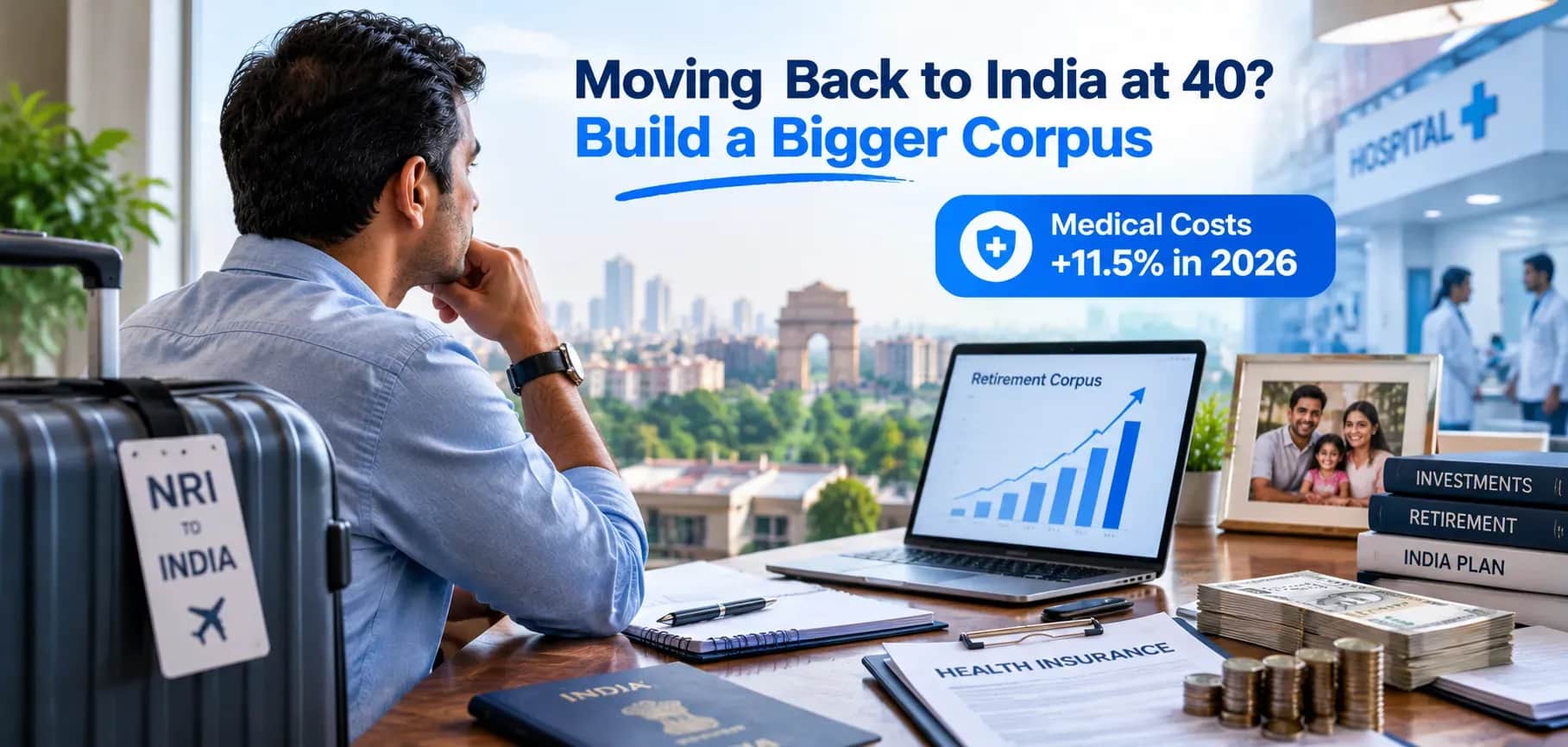
Employee medical plan costs in India are projected to rise 11.5% in 2026, Aon said when it released the India findings of its 2026 Global Medical Trend Rates Report on December 11, 2025. The projection covers insured and self-insured employee medical plans, not India’s overall medical inflation. For Indians planning to return home around 40, that cost pressure arrives when many have about 20 working years left before 60 and may also be paying for a home, children’s education and retirement.
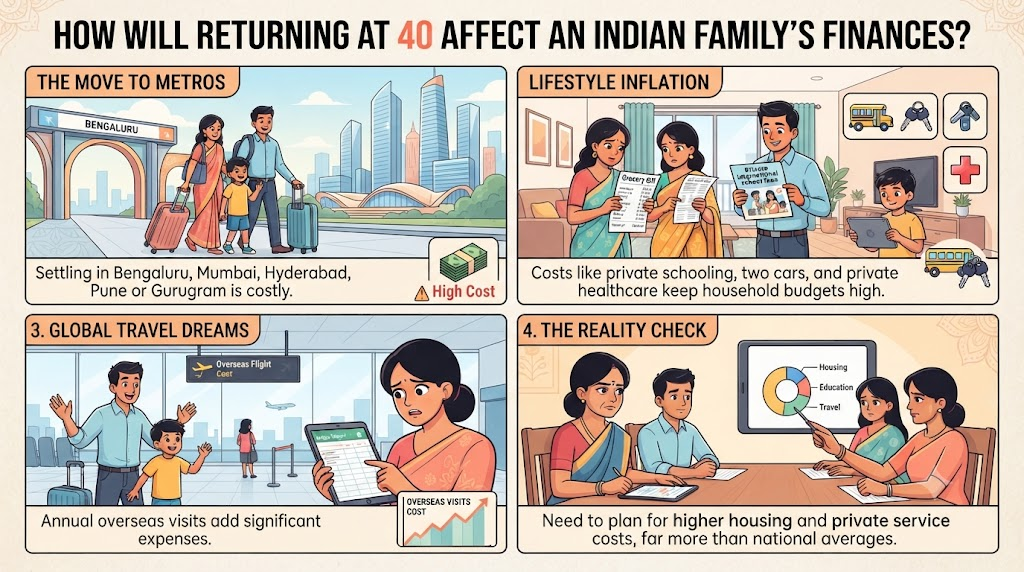
India cannot be treated as 1 low-cost market. A professional settling in Bengaluru, Mumbai, Hyderabad, Pune or Gurugram may spend far more on housing and private services than national averages suggest. Lifestyle travels too. Private schooling, 2 cars, annual overseas visits or private healthcare can keep household costs high.
There can be savings as well. A family that already owns a home, has parents nearby or receives employer health cover may cut several large expenses. The Ministry of Statistics and Programme Implementation’s HCES 2023-24, whose detailed report was released on January 30, 2025, put average urban monthly per-capita consumption expenditure at ₹6,996. That is a national reference, not an NRI household budget.
A few expenses deserve separate buckets. Healthcare is one of them. The National Statistical Office’s Household Social Consumption: Health survey, covering January to December 2025 and released on April 20, 2026, found an average out-of-pocket medical expenditure of ₹38,688 per hospitalisation in urban India, excluding childbirth. The average for private hospitals across India was ₹50,508.
Housing can alter the numbers just as sharply. The National Housing Bank’s September 8, 2026 RESIDEX data showed prices rising across 47 of the 50 cities covered, with Bengaluru up 21.5% year-on-year. A ₹2 crore home and a ₹2 crore retirement portfolio should not be treated as the same pool. The home provides housing, while the portfolio may need to fund expenses decades later.
The National Institute of Securities Markets held a webinar on August 19, 2025, on cross-border finances for NRIs and returning Indians. Vishal Dhawan, Founder and CEO of Plan Ahead Wealth Advisors, led the session. NISM’s published summary advised families to plan ahead across banking, investments, property, tax, insurance and succession when multiple jurisdictions are involved.
At 40, the order of decisions becomes important. A household can first estimate annual spending in India, hold an emergency reserve and identify retirement assets that should remain untouched. The property budget comes after that. Income Tax Department guidance, last updated on May 27, 2026, says residential status is determined separately for each financial year. RNOR status can apply under prescribed conditions, including being non-resident in 9 of the previous 10 years or staying in India for 729 days or less during the previous 7 years.
Consider a household spending ₹1.50 lakh a month today and planning to retire at 60. If spending rises by an illustrative 5% each year, the same lifestyle would cost about ₹3.98 lakh a month after 20 years, or around ₹47.8 lakh in the 1st retirement year. The 5% figure is only an assumption for this calculation, not an official inflation forecast.
The LoansJagat retirement corpus guide published on April 30, 2026 uses about 25 times annual expenses as a broad starting guideline while also pointing to inflation, life expectancy, and lifestyle. Applying that yardstick to ₹47.8 lakh gives an illustrative corpus of roughly ₹11.9 crore at 60. It is not a recommendation. It shows why several crores at 40 may still need to remain invested when retirement is 20 years away.
The example also shows the cost of buying property too early. If ₹2 crore leaves the investment portfolio for a home purchase, it stops compounding there. The home may rise in value, but a self-occupied property does not automatically generate monthly retirement cash.
For a returnee, the more revealing test is annual surplus after the move. If Indian household income can cover rent or EMI, school fees, insurance, travel, and daily spending while retirement contributions continue, the overseas corpus gets time to grow.
The reverse deserves attention. If monthly expenses need repeated withdrawals from that corpus, the household is partly funding its working years with money reserved for later life. That gap can remain hidden for several years because the bank and investment balances may still look large.
Read Also: Consumer Loans Overtake Credit Cards as Young Indians’ First Credit Product
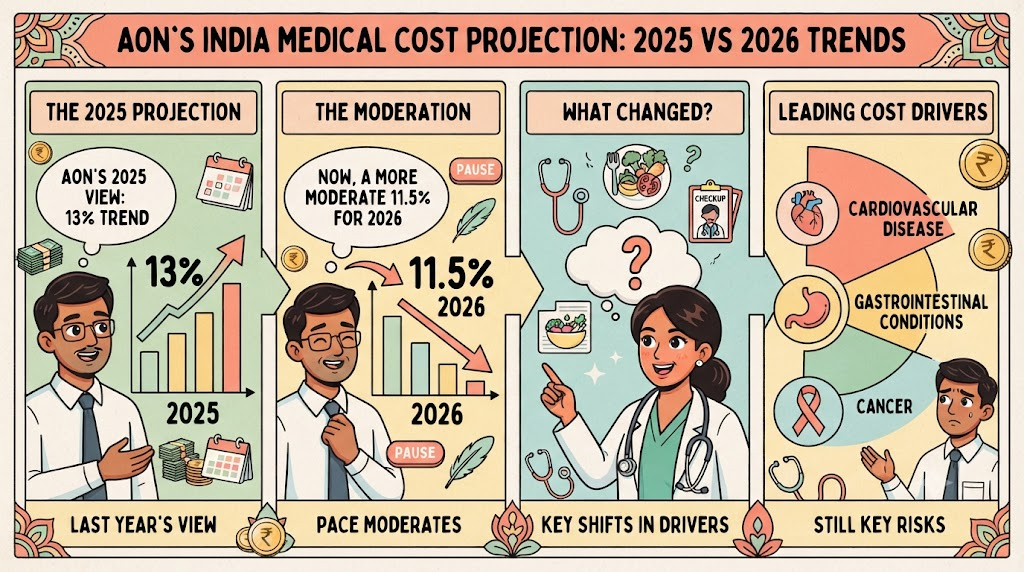
Aon had projected a 13% employee medical plan trend for India in 2025. Its 2026 projection is lower at 11.5%, so the pace has moderated, although costs are still expected to rise. Aon identified cardiovascular disease, gastrointestinal conditions and cancer among the leading cost drivers.
Official health data later provided another view. The 2025 Household Social Consumption: Health survey reported wider insurance or health-financing coverage while also showing a sizeable difference between public and private hospital spending.
For somebody coming back after years of employer-sponsored healthcare overseas, that distinction is important. The new Indian employer may offer family cover, but parents may need separate policies. A person planning an employment break could lose corporate cover altogether. Health insurance, waiting periods and an emergency medical reserve should therefore enter the relocation budget before an illness forces the decision.
Also Read: Canara Bank, BOI, IDFC FIRST Revise Savings Rates, Top Return Hits 7%
Ashley D’Silva, Aon’s Head of Health Solutions in India, said employers were increasingly adopting “flexible benefit plans, cost containment strategies and wellbeing programs” as medical costs rise. The comment points towards employers changing how they fund and design medical benefits rather than simply absorbing every increase.
Ariz Rizvi, Aon’s Head of Health Risk Management in India, also called for greater use of preventive health strategies. For a returnee, employer-sponsored insurance can be a useful 1st layer, but personal cover becomes more important if the household plans early retirement, self-employment or a career break.
Dhawan’s NISM session raised another issue. Cross-border finances bring several decisions into the same year. Foreign pensions, brokerage accounts, deposits and property can carry different tax consequences after the person returns. Selling first and checking tax treatment later can prove expensive.
There is also no reason to move every overseas asset to India immediately. The tax position, future expenses in foreign currency, investment structure and eventual residential status need to be reviewed together. Professional tax advice becomes especially useful where a person holds retirement accounts, shares or property in another country.
Read Also: Home Loan EMI Burden: 6 Ways to Reduce Your Financial Stress
An overseas salary converted into rupees produces an impressive number but tells very little about the family's financial position after returning. What counts is annual post-tax surplus after the family's chosen Indian lifestyle has been paid for.
Take 2 households returning with ₹5 crore each. One already owns a debt-free home, has 2 working spouses, and can leave almost the entire ₹5 crore invested. The other wants to spend ₹2 crore on a house immediately and expects 1 spouse to leave work. Both arrived with the same corpus. Their retirement positions can look very different after 12 months.
That is also why a smaller Indian salary does not automatically make returning financially weak. If housing costs are manageable, debt is low, and the family can keep adding to retirement investments, the corpus can continue doing its job. The problem begins when the return plan assumes that accumulated savings will pay for the house, lifestyle upgrade, education, and retirement at the same time.
Read Also: EPFO 2026 Update: 5 Benefits for Salaried Employees
Moving back to India at 40 is not automatically expensive, and the 11.5% medical plan projection alone cannot decide whether a family should return. It does add another cost to housing, education, taxes, and retirement funding.
The safer calculation starts before the flight home. A returnee should separate relocation money, housing money, and retirement money, then check whether expected Indian income can carry the family without constant withdrawals from long-term savings.
At 40, there is still time for wealth to compound. Large early withdrawals simply make the next 20 years work harder.
The financial experience depends on the city, job, housing, and family needs. A returnee can reduce risk by testing the Indian budget first and keeping enough liquid money for the transition.
There is no single figure. A Reddit discussion involving a 40-year-old NRI raised the same question. Current expenses, retirement age, dependants, home ownership, and medical cover determine the target.
It may fund the transition for some families, but the entire amount should not automatically become a property budget. Post-return income, monthly spending, and existing retirement assets change the answer.
Not necessarily. Renting for 6 to 12 months can help a family test commute, schools and neighbourhoods while keeping capital liquid before making a large property purchase.
Income Tax Department guidance provides several tests. RNOR may apply to a person who was non-resident in 9 of the previous 10 years or stayed in India for no more than 729 days during the previous 7 years, subject to the full residency rules.









.png&w=3840&q=75)


