
By continuing, you agree to LoansJagat's Credit Report Terms of Use, Terms and Conditions, Privacy Policy, and authorize contact via Call, SMS, Email, or WhatsApp
The information published on LoansJagat is intended for general informational and educational purposes only and should not be considered financial, legal, or investment advice. Interest rates, loan terms, statistics, and other data may change over time and may vary by lender or source. Please verify the latest information and consult a qualified financial advisor or the respective Bank/NBFC before making any financial decisions.
Subscribe Now
About the author

‘Simplify Finance for Everyone.’ This is the common goal of our team, as we try to explain any topic with relatable examples. From personal to business finance, managing EMIs to becoming debt-free, we do extensive research on each and every parameter, so you don’t have to. Scroll up and have a look at what 15+ years of experience in the BFSI sector looks like.
Related News
Simplify All Your Loans Into One Affordable EMI

Customers Served

Debt Consolidated

1200+ Reviews

Locations in India
Club all Loans & Credit Card Bills into Single EMI

Quick Apply Loan
Consolidate your debts into one easy EMI.

Takes less than 2 minutes. No paperwork.

10 Lakhs+
Trusted Customers

2000 Cr+
Loans Disbursed

4.7/5
Google Reviews

50+
Banks & NBFCs Offers
Other services mentioned in this article
The ceasefire has cooled oil and markets, but India still faces slower growth, higher inflation and a fragile rupee if West Asia tensions flare again.
The 2-week US-Iran ceasefire has given financial markets a breather, with crude prices dropping sharply and the rupee recovering. But the bigger policy reading is less cheerful. India remains exposed because it imports about 90% of its crude oil, and any fresh disruption in West Asia can quickly lift import costs, inflation and external pressure.
On 8 April 2026, policy signals and market data together showed that the immediate panic had eased, not the structural risk. That is why the outlook for FY27 still looks tight despite the relief rally
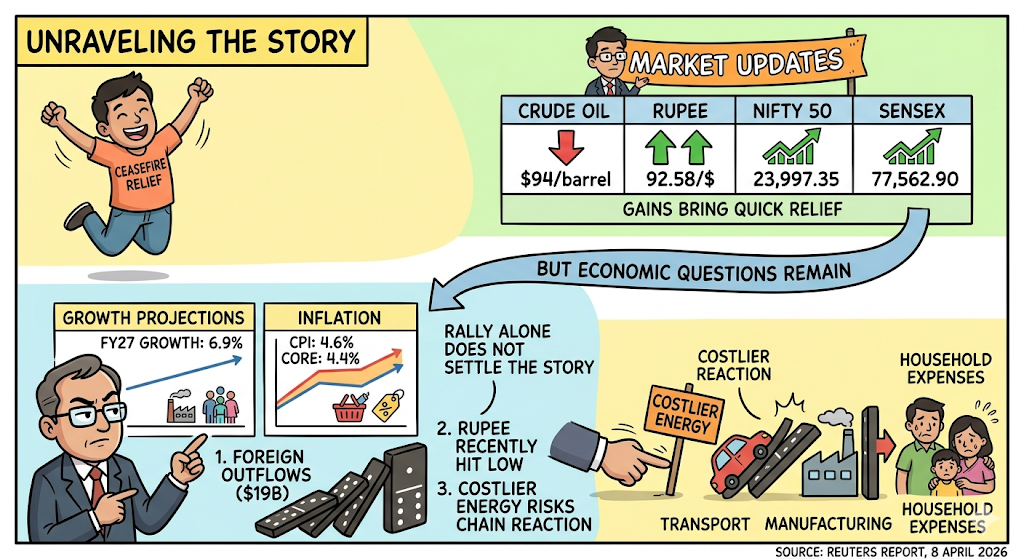
The first response came from markets. Reuters reported on 8 April 2026 that oil slumped 14% to $94 a barrel after the ceasefire, the rupee strengthened 0.5% to 92.58 per US dollar, and Indian equities rose nearly 4%. The Nifty 50 closed at 23,997.35, while the Sensex ended at 77,562.90. That gave traders quick relief.
That rally, though, does not settle the economic story. Reuters reported on 8 April 2026 that India’s FY27 growth is seen at 6.9%, while CPI inflation is projected at 4.6% and core inflation at 4.4%.
The same report noted that foreign capital outflows had touched $19 billion and the rupee had recently hit a record low before the ceasefire relief. For India, costlier energy can lift transport, manufacturing and household expenses in one chain reaction.
This caution did not appear suddenly on ceasefire day. Reuters reported on 6 April 2026 that 69 of 71 economists expected no change in the policy rate, reflecting a broad view that policymakers would wait for clearer signals on inflation and global risk. A Reuters poll published on 27 March 2026 also found all but 2 of 71 economists expecting rates to stay unchanged. LoansJagat, in a report published on 6 April 2026, linked that pause to sticky inflation, rupee pressure and global uncertainty.
Indian Express reported on 8 April 2026 that the ceasefire may improve sentiment, but oil-linked risks still cloud the year ahead. The Economic Times and Times of India carried similar readings, pointing to weaker growth visibility and inflation risks even after the latest truce.
Policymakers have indicated a wait-and-watch approach. Reuters said the current reading is shaped by supply shocks, inflation risk and weaker growth visibility. Market participants welcomed the oil drop and rupee rebound.
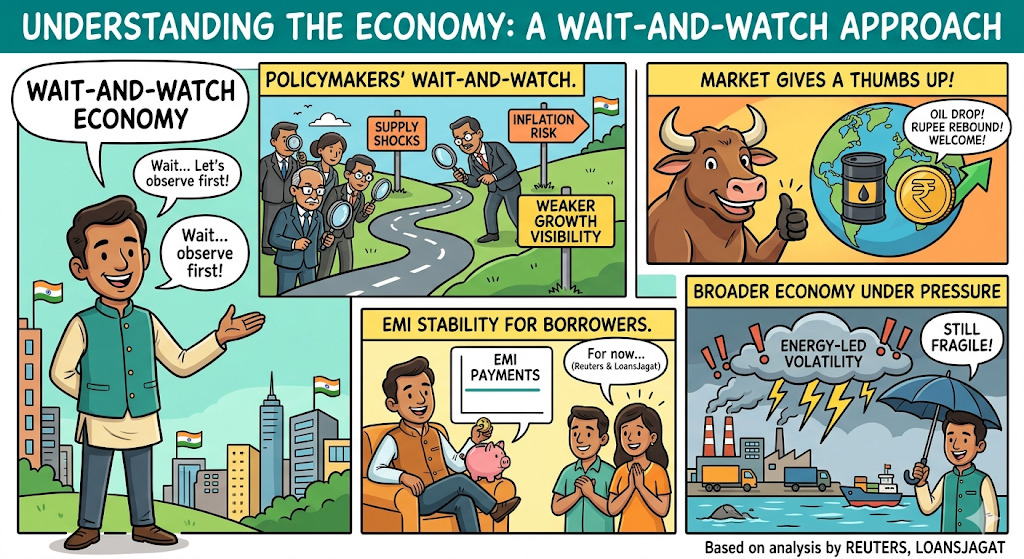
Analysts quoted by Reuters and LoansJagat said borrowers may see EMI stability for now, but the broader economy remains under pressure from energy-led volatility.
The ceasefire has reduced immediate stress, but it has not repaired India’s vulnerability to oil and external shocks. FY27 still looks like a year of slower growth, firmer inflation and cautious policy choices.
*T&C Apply
Related Financial News | |||









.png&w=3840&q=75)



