By continuing, you agree to LoansJagat's Credit Report Terms of Use, Terms and Conditions, Privacy Policy, and authorize contact via Call, SMS, Email, or WhatsApp
Disclaimer: The information published on LoansJagat is intended for general informational and educational purposes only and should not be considered financial, legal, or investment advice. Interest rates, loan terms, statistics, and other data may change over time and may vary by lender or source. Please verify the latest information and consult a qualified financial advisor or the respective Bank/NBFC before making any financial decisions.
Subscribe Now
About the author

‘Simplify Finance for Everyone.’ This is the common goal of our team, as we try to explain any topic with relatable examples. From personal to business finance, managing EMIs to becoming debt-free, we do extensive research on each and every parameter, so you don’t have to. Scroll up and have a look at what 15+ years of experience in the BFSI sector looks like.
Related News
Simplify All Your Loans Into One Affordable EMI

Customers Served

Debt Consolidated

1200+ Reviews

Locations in India
Club all Loans & Credit Card Bills into Single EMI

Quick Apply Loan
Consolidate your debts into one easy EMI.

Takes less than 2 minutes. No paperwork.

10 Lakhs+
Trusted Customers

2000 Cr+
Loans Disbursed

4.7/5
Google Reviews

50+
Banks & NBFCs Offers
Other services mentioned in this article
India’s rupee stayed firm near 93, after a 1.8% jump as forex curbs squeezed speculative trades but pushed importer hedging costs to crisis-era highs again.
The rupee has held on to most of last week’s rebound after one of its strongest single-day moves in over a decade. On 2 April 2026, the currency closed at 93.10 per US dollar after touching an intraday high near 92.83, recovering from a record weak level of 95.21 seen earlier in the week.
By 6 April 2026, it was still around 93.06. The move followed tighter forex curbs, but the bounce has not removed pressure from oil, portfolio outflows and heavy importer dollar demand.
The main trigger was a forceful squeeze on one-way bets against the rupee. Reuters reported on 2 April 2026 that the rupee rose 1.8%, its best single-day gain since September 2013. Reuters and Mint both said the currency touched about 92.82 to 92.83 intraday before settling near 93.10, while Economic Times also described it as the biggest gain in 12 years.
The relief, though, came with a cost. Reuters reported on 6 April 2026 that 1-year dollar hedging costs jumped 30 basis points to 3.96% after a 70-basis-point spike earlier, the sharpest rise since the 2007-09 global financial crisis.
Later, the implied yield eased to 3.57%, while the 1-year OIS rate fell to 6.17%. That showed importers rushed to lock in cover as soon as the rupee improved.
The backdrop was rough. Reuters said the rupee had already fallen 4.5% since the Iran war intensified, while oil moved above $100 per barrel, worsening concerns over India’s external position. Business Standard wrote that the market had begun discussing the risk of the rupee moving towards 100 if pressure persisted. LoansJagat, in its 3 April 2026 explainer, also tracked the rebound from 95.21 to 93.10 and linked it to the clampdown on speculative trading.
Reuters also reported that corporate activity in offshore NDF markets had surged to $7.54 billion on 30 March 2026, around 7 times the average, showing how aggressively firms used arbitrage windows before the rebound stabilised trading.
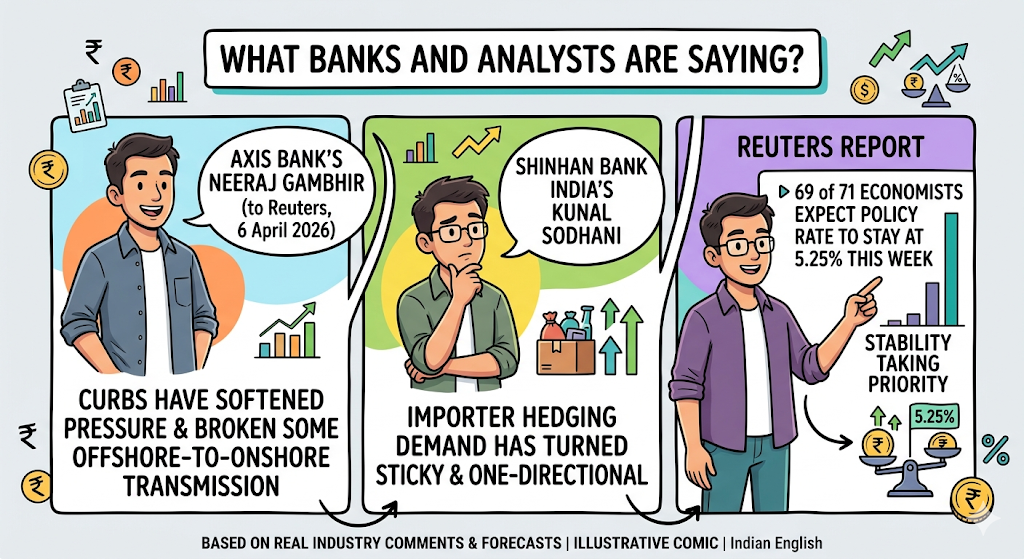
Axis Bank’s Neeraj Gambhir told Reuters on 6 April 2026 that the curbs had softened pressure and broken some of the offshore-to-onshore transmission.
Shinhan Bank India’s Kunal Sodhani said importer hedging demand had turned sticky and one-directional. Reuters also reported that 69 of 71 economists expected the policy rate to stay at 5.25% this week, with stability taking priority.
The rupee has regained ground, but the stress has only shifted. Oil, outflows and hedging demand will decide whether 93 holds or cracks again.
Related Financial News | |||
*T&C Apply









.png&w=3840&q=75)



