By continuing, you agree to LoansJagat's Credit Report Terms of Use, Terms and Conditions, Privacy Policy, and authorize contact via Call, SMS, Email, or WhatsApp
Disclaimer: The information published on LoansJagat is intended for general informational and educational purposes only and should not be considered financial, legal, or investment advice. Interest rates, loan terms, statistics, and other data may change over time and may vary by lender or source. Please verify the latest information and consult a qualified financial advisor or the respective Bank/NBFC before making any financial decisions.
Subscribe Now
About the author

LoansJagat Team
‘Simplify Finance for Everyone.’ This is the common goal of our team, as we try to explain any topic with relatable examples. From personal to business finance, managing EMIs to becoming debt-free, we do extensive research on each and every parameter, so you don’t have to. Scroll up and have a look at what 15+ years of experience in the BFSI sector looks like.
Related News
Simplify All Your Loans Into One Affordable EMI

Customers Served

Debt Consolidated

1200+ Reviews

Locations in India
Club all Loans & Credit Card Bills into Single EMI

Quick Apply Loan
Consolidate your debts into one easy EMI.

Takes less than 2 minutes. No paperwork.

10 Lakhs+
Trusted Customers

2000 Cr+
Loans Disbursed

4.7/5
Google Reviews

50+
Banks & NBFCs Offers
Other services mentioned in this article
Indian credit card debt is turning costlier and riskier. The first card a borrower repays can cut interest outgo, ease pressure, and avoid a longer debt spiral.
For Indian borrowers, the problem is not just having 2 or 3 cards. It is the cost of carrying balances month after month. SBI Card’s public terms say finance charges can go up to 3.75% a month, or 45% a year, and the interest-free period of 20 to 50 days is suspended if any previous balance remains unpaid.
HDFC Bank’s key fact statement examples from June 2025 onwards show finance charges of 3.6% a month, or 43.2% a year. Mint, in a report published on 13 June 2025, noted that minimum due is usually 5% to 10% of the total amount due.
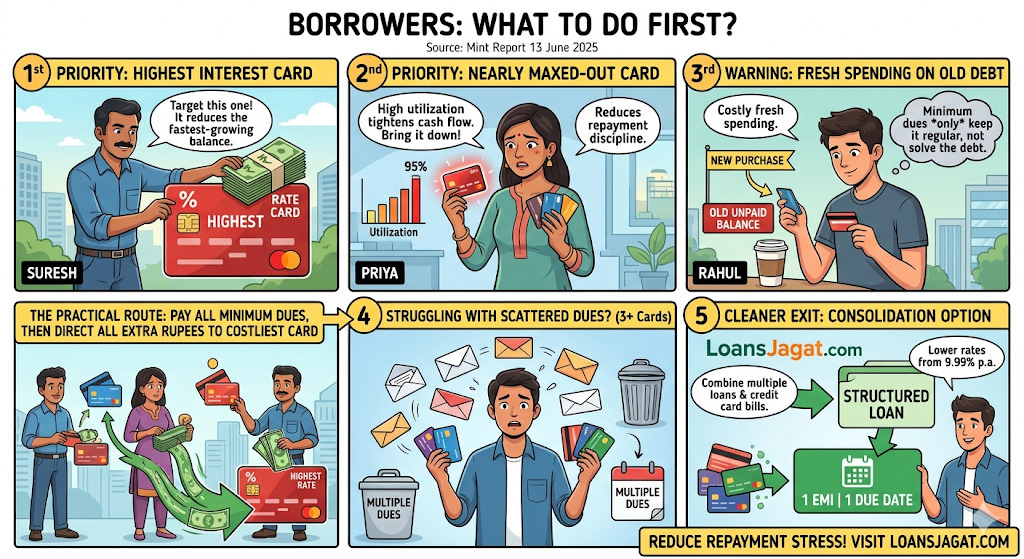
The first card to target is usually the one charging the highest % rate. That reduces the fastest-growing balance first. The second priority is a card that is nearly maxed out, because high utilisation can tighten cash flow and damage repayment discipline. The third warning sign is the card used for everyday expenses while an old balance is still unpaid. In that case, fresh spending can become costly very quickly.
Read More - Hidden Motive Behind Credit Card
Paying only the minimum due may keep the account regular for the moment, but it does not solve the debt. Mint’s 13 June 2025 report said minimum due is only a small slice of the bill. The practical route is simple: pay minimum dues on all cards, then direct every extra rupee to the costliest one.
If the borrower is already struggling with multiple due dates, one structured loan can become a cleaner exit.
This is where LoansJagat enters the picture. On its debt consolidation page, the platform says borrowers can combine multiple loans and overspent credit card bills into a single EMI, with rates starting from 9.99% a year. Its example shows lower repayment stress through one loan instead of scattered card dues.
The stress is not isolated. The Indian Express, in a report published on 28 July 2025, said credit card delinquencies in the 91 to 360 days overdue bucket rose 44.34% to Rs 33,886.5 crore in March 2025, from Rs 23,475.6 crore a year earlier.
The same report said credit card outstanding stood at Rs 2.90 lakh crore in May 2025, while active cards reached 11.11 crore.
That backdrop explains why choosing the first card to repay is no longer a small budgeting decision. It is now a debt-control step.
A borrower deciding which card to close first should start by comparing the borrowing cost across cards, not just the monthly bill amount.
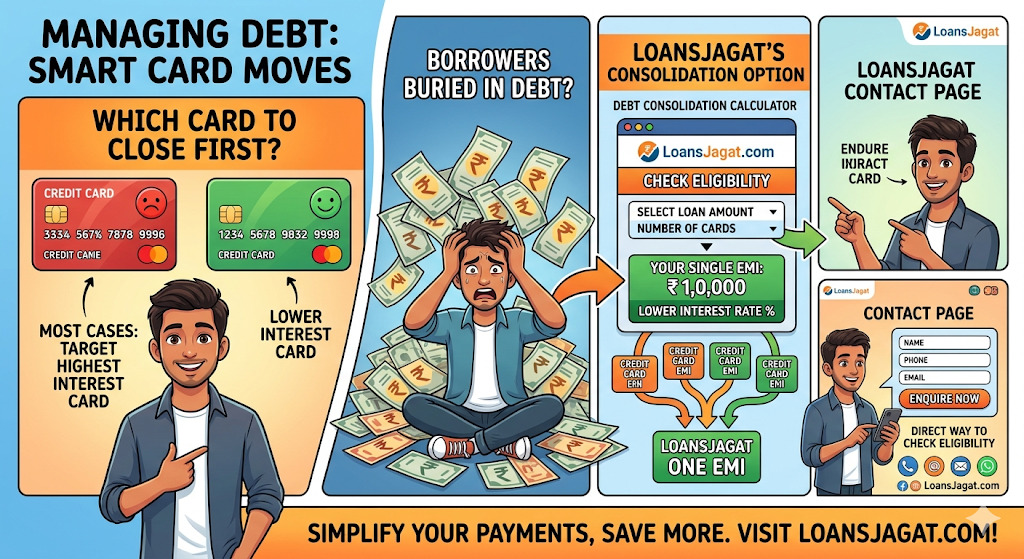
Banks are openly disclosing finance charges above 40% a year in card documents. Mint has flagged how minimum due works. The Indian Express has highlighted rising delinquencies. LoansJagat is pitching consolidation as a route to merge card dues into 1 loan at a lower rate.
In most cases, the first card to close should be the one charging the highest interest. For borrowers buried under several card bills, LoansJagat’s consolidation option and contact page offer a direct way to check eligibility for 1 lower-rate EMI.
Related Financial News |
Mint, 13 June 2025
*T&C Apply









.png&w=3840&q=75)



