By continuing, you agree to LoansJagat's Credit Report Terms of Use, Terms and Conditions, Privacy Policy, and authorize contact via Call, SMS, Email, or WhatsApp
Disclaimer: The information published on LoansJagat is intended for general informational and educational purposes only and should not be considered financial, legal, or investment advice. Interest rates, loan terms, statistics, and other data may change over time and may vary by lender or source. Please verify the latest information and consult a qualified financial advisor or the respective Bank/NBFC before making any financial decisions.
Subscribe Now
About the author

LoansJagat Team
‘Simplify Finance for Everyone.’ This is the common goal of our team, as we try to explain any topic with relatable examples. From personal to business finance, managing EMIs to becoming debt-free, we do extensive research on each and every parameter, so you don’t have to. Scroll up and have a look at what 15+ years of experience in the BFSI sector looks like.
Related Blog Post
Simplify All Your Loans Into One Affordable EMI

Customers Served

Debt Consolidated

1200+ Reviews

Locations in India
Club all Loans & Credit Card Bills into Single EMI

Quick Apply Loan
Consolidate your debts into one easy EMI.

Takes less than 2 minutes. No paperwork.

10 Lakhs+
Trusted Customers

2000 Cr+
Loans Disbursed

4.7/5
Google Reviews

50+
Banks & NBFCs Offers
Other services mentioned in this article
Key Takeaways
India’s forex friction is now less about daily rupee moves and more about who controls pricing, volatility and hedging costs when global stress hits the market.
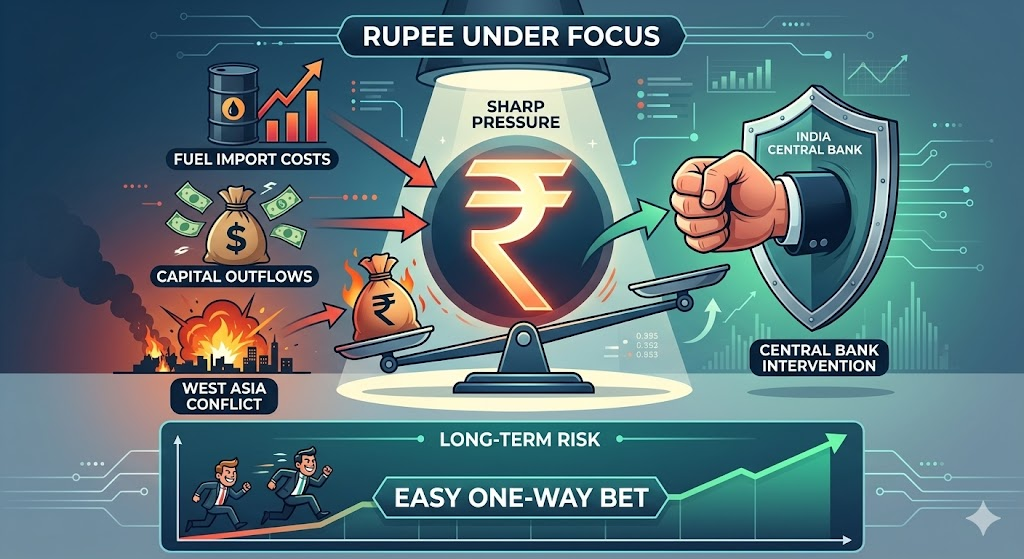
India’s central bank stepped in after the rupee came under sharp pressure from foreign outflows and geopolitical stress linked to the West Asia conflict. The short-term risk is higher import costs, especially for fuel. The longer-term risk is a market where traders begin to treat the rupee as an easy one-way bet.
The trigger was not just rupee weakness. It was the build-up of arbitrage between the onshore rupee market and offshore non-deliverable forward, or NDF, contracts. That gap had become large enough for banks to build positions that regulators saw as adding pressure rather than improving liquidity.
For ordinary Indians, the immediate effect is indirect but real. A weak rupee can push up the landed cost of crude, electronics and other imports. That can filter into fuel bills, transport costs and prices across supply chains.
There is also a positive side. If speculative pressure reduces, the rupee can trade in a narrower range, which helps importers, exporters and borrowers plan better. A more orderly market also cuts the risk of sudden price spikes feeding inflation expectations.
Market participants say the central bank’s push has raised hedging costs and made some genuine trade flows harder to manage. Economic Times reported on 6 April 2026 that banks had sought clarity, warning that some rules could hit normal business payments and hedges.
Officials have taken the opposite line. Reuters reported on 13 April 2026 that the concern is whether corporate channels were used for trades that looked more speculative than protective. The likely solution now is tighter reporting, sharper position checks and fewer gaps between onshore and offshore rupee pricing.
*T&C Apply
This is no routine currency wobble. It is a policy push to stop speculation from shaping the rupee faster than real flows do.
Related Financial News | |||









.png&w=3840&q=75)



