
By continuing, you agree to LoansJagat's Credit Report Terms of Use, Terms and Conditions, Privacy Policy, and authorize contact via Call, SMS, Email, or WhatsApp
Disclaimer: The information published on LoansJagat is intended for general informational and educational purposes only and should not be considered financial, legal, or investment advice. Interest rates, loan terms, statistics, and other data may change over time and may vary by lender or source. Please verify the latest information and consult a qualified financial advisor or the respective Bank/NBFC before making any financial decisions.
Subscribe Now
About the author

LoansJagat Team
‘Simplify Finance for Everyone.’ This is the common goal of our team, as we try to explain any topic with relatable examples. From personal to business finance, managing EMIs to becoming debt-free, we do extensive research on each and every parameter, so you don’t have to. Scroll up and have a look at what 15+ years of experience in the BFSI sector looks like.
Related Blog Post
Simplify All Your Loans Into One Affordable EMI

Customers Served

Debt Consolidated

1200+ Reviews

Locations in India
Club all Loans & Credit Card Bills into Single EMI

Quick Apply Loan
Consolidate your debts into one easy EMI.

Takes less than 2 minutes. No paperwork.

10 Lakhs+
Trusted Customers

2000 Cr+
Loans Disbursed

4.7/5
Google Reviews

50+
Banks & NBFCs Offers
Other services mentioned in this article
Key Takeaways
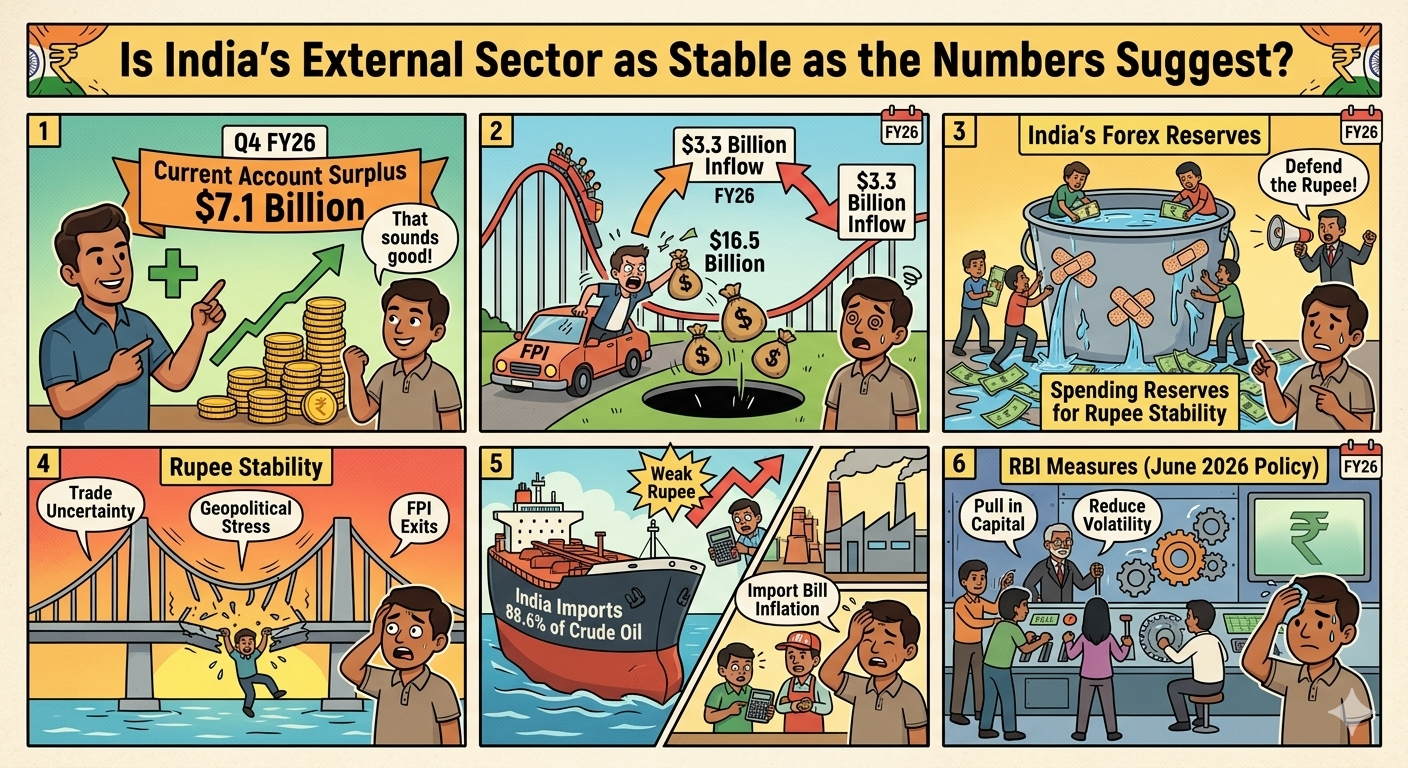
India maintained a current account surplus of $7.1 billion in Q4 FY26. Good, isn’t it? But wait. Under the hood, net outflows of FPI stood at $16.5 billion in FY26 as against inflows of $3.3 billion in FY25.
India’s forex reserves declined by $30.8 billion on BoP basis according to the RBI’s Annual Report 2025-26 during April-December 2025. India is drawing more upon reserves to defend the rupee.
The Indian rupee came under pressure throughout FY26 due to trade uncertainty, geopolitical stress and FPI outflows. It is pertinent to mention that India’s oil imports account for nearly 88.6% of crude oil demand. Every rupee that weakens adds directly to the fuel import bill and to inflation. A weaker rupee also raises costs for businesses using imported components.
RBI Governor Sanjay Malhotra announced fresh measures in the June 2026 monetary policy to pull in more foreign capital and reduce rupee volatility.
The deficit itself is not the issue. “The current account deficit at 1.3% of GDP in Q3 FY26 is not the problem. The problem is what is financing it,” said Nikunj Saraf, Vice President at Choice Wealth, Mumbai.
Here is how India’s capital flows looked in FY26 versus FY25:
FDI is long-term. A foreign factory built in Tamil Nadu in 2024 cannot leave overnight. FPI is the opposite. It can exist in hours. “The capital account is the more fragile variable today,” Saraf said.
As per LoansJagat, the typical annual interest rates on loans for self-employed borrowers in India usually range between 12% and 20%, whereas they range between 10% and 14% for salaried borrowers since interest rates depend on income risk. The weak rupee increases input costs to self-employed borrowers first, which makes their income riskier than that of salaried borrowers.
Economists are clear that 2026 is nothing like 1991. In June 1991, India held foreign exchange for barely 3 weeks of imports. Today’s $691.1 billion reserve covers 11 months. “1991 was a structural collapse. Today is manageable volatility,” said Dr. Manoranjan Sharma, Chief Economist at Infomerics Ratings. Comparisons to 1991, he added, are “odious.”
The solution, experts say, lies in improving the quality of capital inflows. These measures under the RBI policy announced for June 2026 is aiming to exactly that, to attract stable long term FII money and de-emphasize FPI inflows. Commerce Minister Piyush Goyal reaffirmed on June 8, 2026, that the government will prevent the current account deficit from widening further.
India’s services exports rose to $37 billion in April 2026 alone, up from $32.8 billion in April 2025. That structural strength limits the downside.
India will not be in a 1991-like dollar crunch in June 2026. It is managing who brings the dollars in, and for how long they stay. The $691.1 billion reserve cushion is real. But with net FPI outflows hitting $16.5 billion in FY26, the bigger risk is keeping foreign capital flowing in steadily.
How does India’s $691.1 billion forex reserve protect against global capital flow risks in FY26?
India’s forex reserves stood at $691.1 billion at end-March 2026, which covers 11 months of imports. This buffer protects against short-term shocks. But with net FPI outflows at $16.5 billion in FY26, reserves alone cannot guarantee stability if foreign capital keeps exiting.
India’s forex reserves fell by $30.8 billion between April and December 2025. What does this mean for the rupee?
Reserves fell $30.8 billion in April-December 2025 because capital inflows fell short of the current account deficit. When fewer dollars enter than leave, RBI sells reserves to stabilise the rupee. This is manageable today but signals growing pressure on the capital account.
*T&C Apply









.png&w=3840&q=75)



