
By continuing, you agree to LoansJagat's Credit Report Terms of Use, Terms and Conditions, Privacy Policy, and authorize contact via Call, SMS, Email, or WhatsApp
Disclaimer: The information published on LoansJagat is intended for general informational and educational purposes only and should not be considered financial, legal, or investment advice. Interest rates, loan terms, statistics, and other data may change over time and may vary by lender or source. Please verify the latest information and consult a qualified financial advisor or the respective Bank/NBFC before making any financial decisions.
Subscribe Now
About the author

LoansJagat Team
‘Simplify Finance for Everyone.’ This is the common goal of our team, as we try to explain any topic with relatable examples. From personal to business finance, managing EMIs to becoming debt-free, we do extensive research on each and every parameter, so you don’t have to. Scroll up and have a look at what 15+ years of experience in the BFSI sector looks like.
Related Blog Post
Simplify All Your Loans Into One Affordable EMI

Customers Served

Debt Consolidated

1200+ Reviews

Locations in India
Club all Loans & Credit Card Bills into Single EMI

Quick Apply Loan
Consolidate your debts into one easy EMI.

Takes less than 2 minutes. No paperwork.

10 Lakhs+
Trusted Customers

2000 Cr+
Loans Disbursed

4.7/5
Google Reviews

50+
Banks & NBFCs Offers
Other services mentioned in this article
Key Takeaways
NSE filed its DRHP with SEBI for its long-awaited public listing. The proposed IPO is expected to be worth around ₹30,000 crore. It is structured entirely as an OFS, meaning existing shareholders are selling a portion of their holdings rather than NSE issuing fresh shares.
Since it is entirely an OFS, NSE will not receive any proceeds. All offer proceeds will go to selling shareholders after deducting offer-related expenses and applicable taxes.
Among state-owned insurers, General Insurance Corporation (GIC Re) plans to sell up to 1.06 crore shares acquired at a weighted average cost of ₹5.26 per share. New India Assurance, National Insurance, United India Insurance, and Oriental Insurance all acquired their holdings at less than ₹1 per share and will partially exit through the IPO.
The Canada Pension Plan Investment Board (CPPIB), which entered at a weighted average cost of ₹324.13 per share, is among the foreign sellers. Even at those entry levels, an IPO priced at ₹2,000 would generate multibagger returns.
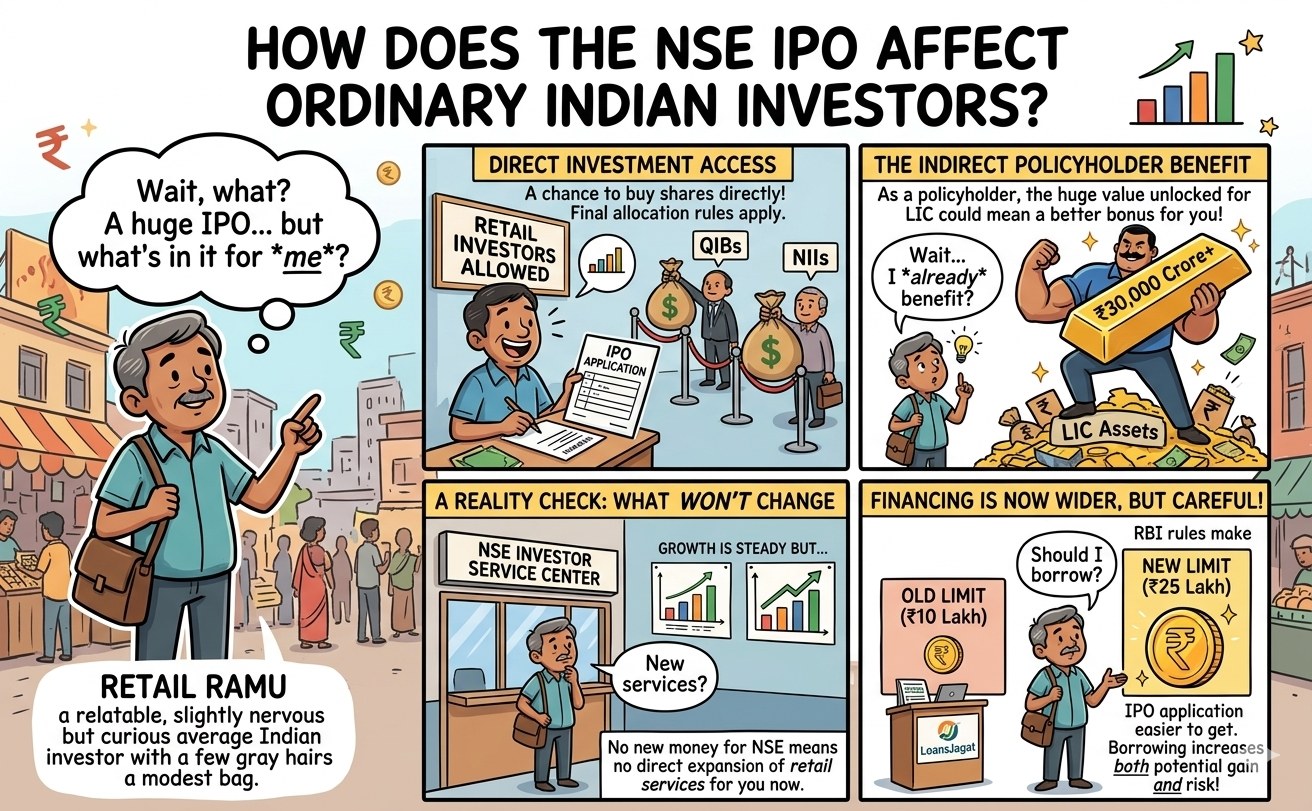
Once launched, the NSE IPO is expected to be available to retail investors, Qualified Institutional Buyers (QIBs), and Non-Institutional Investors (NIIs), subject to the final allocation structure mentioned in the prospectus.
This matters for policyholders of LIC and customers of SBI. LIC, the largest NSE shareholder with a 10.72% stake, is not selling. But if NSE lists at ₹3,000 per share, LIC’s holding would be worth over ₹30,000 crore, a windfall ultimately benefiting its 25 crore+ policyholders.
However, the IPO brings no fresh capital into NSE. NSE’s revenue from operations grew at a CAGR of 5.98% from ₹14,780 crore in FY2024 to ₹16,601 crore in FY2026. Profit grew at a CAGR of 11.37%, from ₹8,306 crore to ₹10,302 crore over the same period. Since no new money goes to NSE, none of this IPO capital will directly expand services for retail investors.
According to LoansJagat, India’s RBI raised the IPO financing limit from ₹10 lakh to ₹25 lakh in October 2025, a reform that widened access for retail borrowers. This makes a high-profile issue like the NSE IPO more accessible to individual applicants who rely on structured borrowing.
NSE’s DRHP flags key risks, including heavy dependence on trading volumes, particularly derivatives, which makes earnings sensitive to market cycles and regulatory changes. It also cites ongoing regulatory scrutiny and technology and cybersecurity risks, given NSE's role as critical market infrastructure.
Globally, NSE was the largest multi-asset class exchange by number of trades in FY2026, with an 11.38% share in cash equities trades and 51.18% in equity derivatives contracts, as per the World Federation of Exchanges. The exchange currently serves approximately 257 million investor accounts.
*T&C Apply
Analysts note the price band is not yet fixed. NSE said the price band will be decided in consultation with book-running lead managers and advertised at least 2 working days before the bid opening date.
NSE’s DRHP filing on June 18, 2026, marks the clearest move yet toward India’s potentially largest-ever IPO. SBI, PSU insurers, and foreign investors holding shares bought for fractions of a rupee now stand to exit with thousands of crores in gains. Retail investors will get a chance to own a piece of India’s largest exchange. The price band, once announced, will determine whether the ₹30,000 crore estimate holds.
How do I buy NSE unlisted shares before the IPO, and what price should I expect?
NSE shares are available via unlisted share platforms at roughly ₹2,055 per share as of June 2026. Buy only through SEBI-registered dealers. The final IPO price band is not declared yet, so unlisted prices may correct after the announcement.
Is the NSE IPO worth investing in?
NSE reported a net profit of ₹10,302 crore in FY2026 with a PAT margin above 50%. It holds a 51.18% share in global equity derivatives trading. These are solid numbers. Wait for the price band before deciding, since valuation will determine returns.
Related News Updates | |||









.png&w=3840&q=75)



