
By continuing, you agree to LoansJagat's Credit Report Terms of Use, Terms and Conditions, Privacy Policy, and authorize contact via Call, SMS, Email, or WhatsApp
Disclaimer: The information published on LoansJagat is intended for general informational and educational purposes only and should not be considered financial, legal, or investment advice. Interest rates, loan terms, statistics, and other data may change over time and may vary by lender or source. Please verify the latest information and consult a qualified financial advisor or the respective Bank/NBFC before making any financial decisions.
Subscribe Now
About the author

LoansJagat Team
‘Simplify Finance for Everyone.’ This is the common goal of our team, as we try to explain any topic with relatable examples. From personal to business finance, managing EMIs to becoming debt-free, we do extensive research on each and every parameter, so you don’t have to. Scroll up and have a look at what 15+ years of experience in the BFSI sector looks like.
Related News
Simplify All Your Loans Into One Affordable EMI

Customers Served

Debt Consolidated

1200+ Reviews

Locations in India
Club all Loans & Credit Card Bills into Single EMI

Quick Apply Loan
Consolidate your debts into one easy EMI.

Takes less than 2 minutes. No paperwork.

10 Lakhs+
Trusted Customers

2000 Cr+
Loans Disbursed

4.7/5
Google Reviews

50+
Banks & NBFCs Offers
Other services mentioned in this article
ECB President Christine Lagarde stated that the Iran war would cause a “material impact on near-term inflation” with the ECB estimating eurozone inflation to be at 2.6% in 2026 under normal circumstances, whereas in an energy shock scenario, it might even reach 4.4%.
Inflation based on India's Consumer Price Index stood at 3.21% compared to the previous year's 2.74% in February 2026, amid Brent crude hovering around $100 per barrel, resulting in the RBI holding rates constant despite inflation due to oil prices.
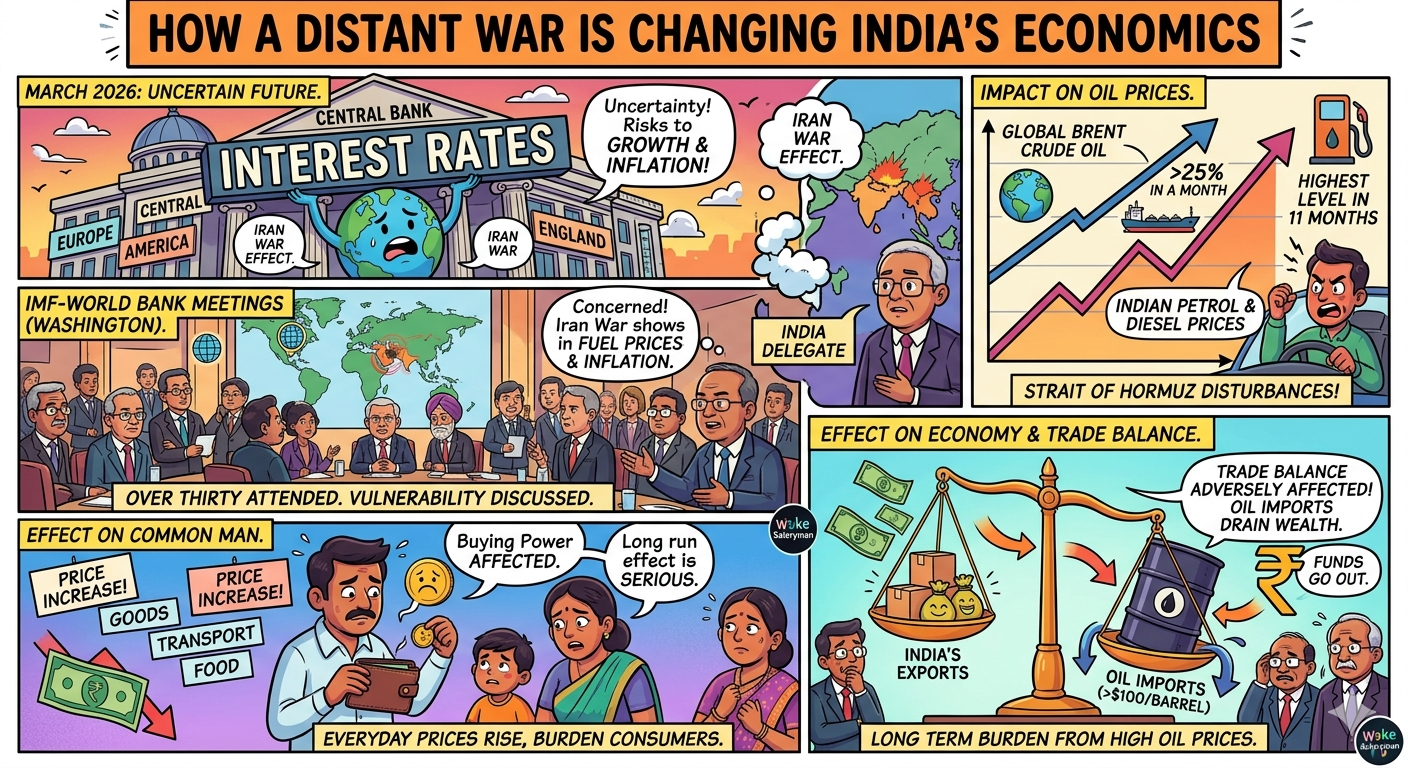
March 2026 was characterised by central banks in Europe, America, and England holding interest rates at their existing levels, due to the Iran war that had brought about a situation.
The economic future had become “much more uncertain,” thus causing both risks of growth and inflation from the same.
Over thirty central bankers, politicians, and policymakers attended the IMF-World Bank meetings.
In Washington were concerns that the Iran war had started showing signs in the fuel prices and inflation levels in the global economy, with no end in sight.
India is among the most vulnerable countries when it comes to such developments.
While Brent crude oil prices increased by over 25% in a month after the Strait of Hormuz disturbances, Indian prices went up to the highest level in eleven months.
The buying power of individuals gets affected, but in the long run, oil prices in excess of $100 a barrel affect India's trade balance adversely in the short term.
The figures show how vulnerable the Indian economy remains to prolonged increases in global energy prices, with major central banks around the world keeping interest rates unchanged.
Remittances to India from the Gulf region constitute about 3.5% of GDP, while continued turmoil in that part of the world poses risks to that vital revenue source.
Together, the risks of inflation and remittances pose a double-edged sword in the war on Iran’s external balance.
Pressure is being exerted on Indian families owing to the increase in crude oil prices.
The monetary policy strategy adopted by the RBI focuses on maintaining the balance between controlling inflation and promoting economic growth.
Did you know? There are 85 million Indians who depend upon subsidies on LPG, and the rise in the price of petrol is one of the reasons behind higher living costs, higher expenditures, and increased electricity rates.
But with increasing crude oil prices, the RBI of India has constantly been attempting to preserve the rupee, and when required, the local institutions step in the stock market to support it.
Long-term equity investors can be relaxed about the fluctuations in oil prices not affecting industries like defence, renewable energy, and domestic consumption.
Speaking to CNBC, Bank of France governor François Villeroy de Galhau confirmed that the European Central Bank “will do whatever is necessary”.
Do you know? To avoid second-round inflationary impact on short-run energy price, but not to allow those pressures to spill over into inflation expectations.
Investment houses such as Barclays and JPMorgan foresee a rise in ECB rates beginning in June 2026, marking a significant deviation from forecasts for interest rate cuts earlier on.
Goldman Sachs has alluded to a worsening of the “adverse scenario” if the tension escalates.
Should this be the case, it is bound to boost the dollar and increase pressure on the Indian rupee alongside the RBI.
*T&C Apply
The Iran war has turned what was once a regional issue into a global concern about inflation. Nevertheless, for tackling these problems, India needs not only the backing of the Reserve Bank of India but also to speed up diversification in its sources of energy, increase its exports, and evolve an effective BoP strategy.
How are the current issues in the Middle East affecting global inflation?
The current problem in the Middle East is increasing global inflation due to the scarcity of energy sources and disrupted shipping channels.
How is the current Middle East unrest affecting fuel prices and inflation in India?
The current unrest in the Middle East region has direct effects on the Indian foreign trade bills, leading to rising retail fuel prices in India, reaching Rs 7.5 per litre.
Related Financial News | |||
Why Investors Are Shifting from Bank Deposits to Mutual Funds | |||









.png&w=3840&q=75)



