By continuing, you agree to LoansJagat's Credit Report Terms of Use, Terms and Conditions, Privacy Policy, and authorize contact via Call, SMS, Email, or WhatsApp
Disclaimer: The information published on LoansJagat is intended for general informational and educational purposes only and should not be considered financial, legal, or investment advice. Interest rates, loan terms, statistics, and other data may change over time and may vary by lender or source. Please verify the latest information and consult a qualified financial advisor or the respective Bank/NBFC before making any financial decisions.
Subscribe Now
About the author

LoansJagat Team
‘Simplify Finance for Everyone.’ This is the common goal of our team, as we try to explain any topic with relatable examples. From personal to business finance, managing EMIs to becoming debt-free, we do extensive research on each and every parameter, so you don’t have to. Scroll up and have a look at what 15+ years of experience in the BFSI sector looks like.
Related News
Simplify All Your Loans Into One Affordable EMI

Customers Served

Debt Consolidated

1200+ Reviews

Locations in India
Club all Loans & Credit Card Bills into Single EMI

Quick Apply Loan
Consolidate your debts into one easy EMI.

Takes less than 2 minutes. No paperwork.

10 Lakhs+
Trusted Customers

2000 Cr+
Loans Disbursed

4.7/5
Google Reviews

50+
Banks & NBFCs Offers
Other services mentioned in this article
Key Takeaways
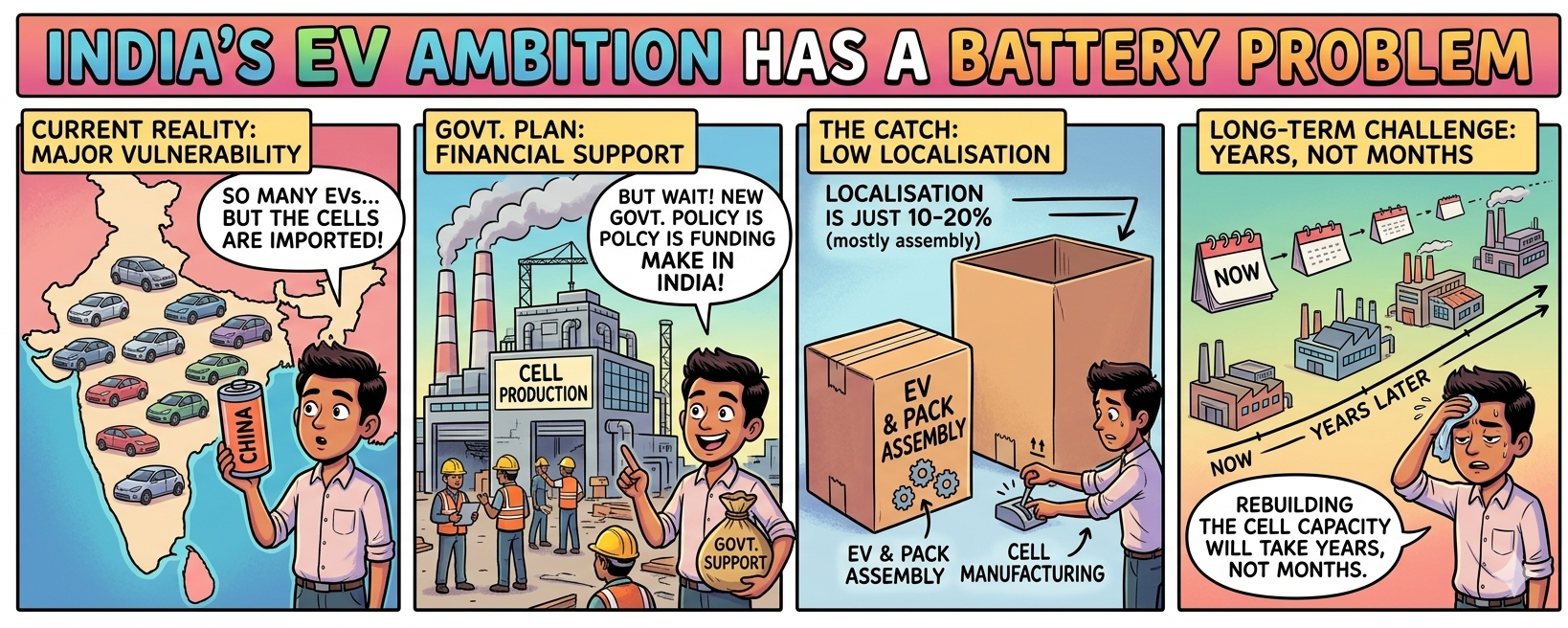
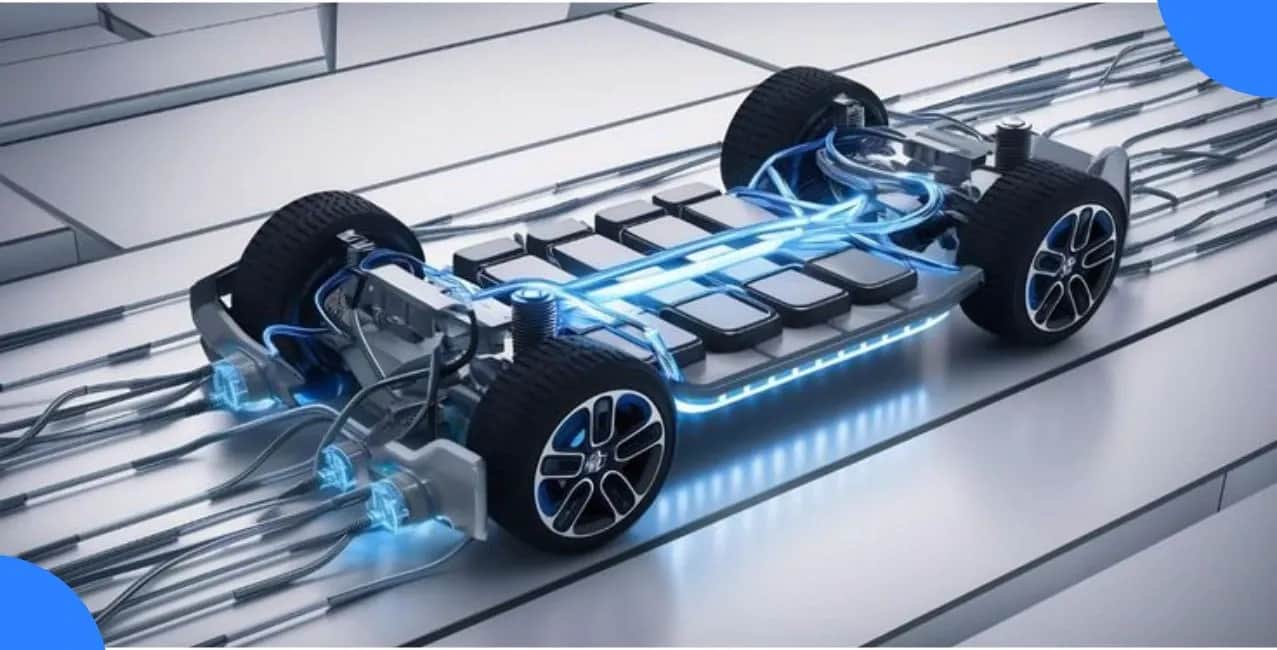
Almost every lithium-ion battery cell used in Indian EVs today comes from China. That is a serious vulnerability for a country that wants to sell millions of electric vehicles. The government now wants to fix this by offering financial support to companies that make battery parts right here in India.
In the near term, this could bring new factories and jobs. But there is a catch. India’s localisation in battery manufacturing sits at just 10 to 20%, which is mostly limited to assembling battery packs, not making the cells themselves. The building of actual cell component capacity will take years, not months.
The battery alone makes up the bulk of an EV’s cost. If India starts making cathodes, anodes, and separators domestically, companies won’t need to pay import costs on top. That savings can eventually reach the buyer.
Here’s where government money is already going:
The PLI-Auto scheme had supported over 10 lakh electric two-wheelers, 2 lakh three-wheelers, and around 80,000 four-wheelers by January 2026. A stronger battery supply chain could push these numbers much higher.
The government knows the gap exists and is moving to address it.
Vijay Mittal, Joint Secretary at the Ministry of Heavy Industries, said at the 4th India Battery Manufacturing and Supply Chain Summit, “The Ministry is currently developing a concept note aimed at bringing policymakers together to agree on specific schemes that will support the manufacturing of advanced-chemistry battery cell components. This support will involve financial systems, policy regulations, and ease of doing business.”
The urgency becomes clearer when you look at China. China controls 90% of global cathode production and 97% of anode production.
Analysts at ORF recommend that India build one unified national strategy, bring more companies under subsidy coverage, and pour money into domestic research. The diversifying technology partnerships and giving states clearer incentive guidelines will also be key to fixing regional imbalances.
India knows where the problem is. Battery components, not just finished cells, need to be made at home. If the new schemes are designed with clear targets and faster approvals, they could genuinely cut import bills and bring down EV prices. Past schemes have stumbled on execution. This time, the government needs to get that part right.
Can India reduce dependency on China regarding batteries and other parts of EVs?
India can. However, it will take a while. The country intends to introduce subsidies for locally manufactured battery components such as cathodes and anodes to achieve the reduction in dependency. At the moment, India imports nearly all of its battery cells and other parts from China. The process of developing a comprehensive battery supply chain will take some time.
What is the reason behind a shortage of EVs in India despite having support from the government?
The cost of the batteries used in electric vehicles. The price of the batteries constitute the largest part of the overall expense incurred for purchasing an EV. Additionally, all components required to build a battery are sourced from China. Thus, to see an improvement in the number of EVs, India requires effective battery production, low prices of components and batteries, improvement in charging facilities, and proper implementation of support policies.
*T&C Apply









.png&w=3840&q=75)



