By continuing, you agree to LoansJagat's Credit Report Terms of Use, Terms and Conditions, Privacy Policy, and authorize contact via Call, SMS, Email, or WhatsApp
Disclaimer: The information published on LoansJagat is intended for general informational and educational purposes only and should not be considered financial, legal, or investment advice. Interest rates, loan terms, statistics, and other data may change over time and may vary by lender or source. Please verify the latest information and consult a qualified financial advisor or the respective Bank/NBFC before making any financial decisions.
Subscribe Now
About the author

LoansJagat Team
‘Simplify Finance for Everyone.’ This is the common goal of our team, as we try to explain any topic with relatable examples. From personal to business finance, managing EMIs to becoming debt-free, we do extensive research on each and every parameter, so you don’t have to. Scroll up and have a look at what 15+ years of experience in the BFSI sector looks like.
Related Blog Post
Simplify All Your Loans Into One Affordable EMI

Customers Served

Debt Consolidated

1200+ Reviews

Locations in India
Club all Loans & Credit Card Bills into Single EMI

Quick Apply Loan
Consolidate your debts into one easy EMI.

Takes less than 2 minutes. No paperwork.

10 Lakhs+
Trusted Customers

2000 Cr+
Loans Disbursed

4.7/5
Google Reviews

50+
Banks & NBFCs Offers
Other services mentioned in this article
Key Takeaways
Moody’s Ratings has placed Indian banks at the top of its risk watch list across Asia-Pacific. The reason is simple, that India imports most of its oil and gas from West Asia.
A sustained disruption through the Strait of Hormuz, with oil prices averaging $90-110 per barrel, will keep financial conditions tight across energy-importing economies, according to Moody’s.
This is not just a banking problem. Higher fuel costs will raise prices for goods, transport, and farming. Businesses will earn less. Borrowers will struggle to repay loans. All of this feeds directly into bank balance sheets.
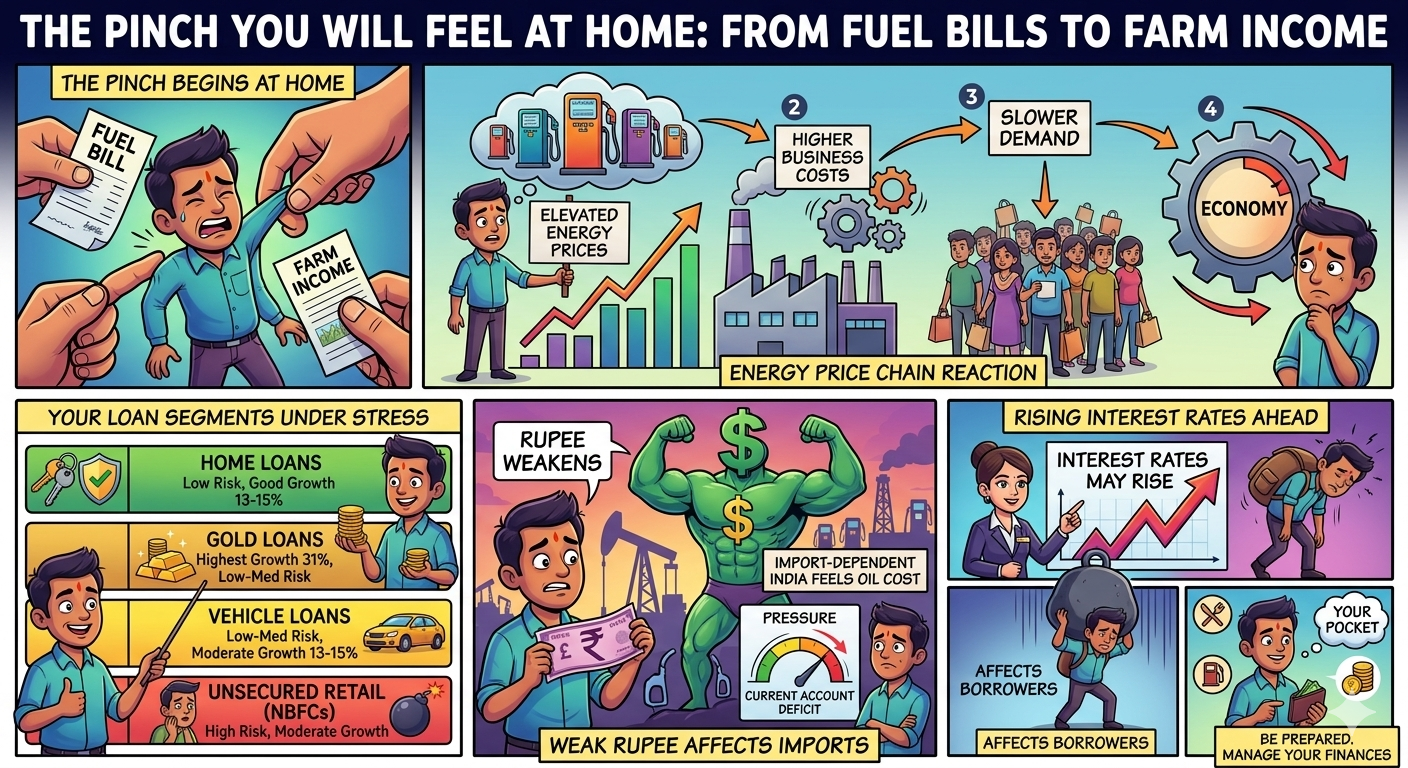
Elevated energy prices for the long term will increase the cost of doing business for many companies. Demand will slow down and, in turn, so will the economy, according to Amit Pandey, Vice-President, Financial Institutions Group, Moody’s Ratings.
Here is how different loan segments compare under current stress:
The ₹ in your pocket will also feel it. The rupee has already crossed the 92 level against the US dollar. Since much of India’s oil and gas requirements are import-dependent, sustained high prices will put pressure on the current account deficit. Interest rates may have to be raised to attract capital, and that will affect borrowers.
Moody’s VP Amit Pandey said, “From a very good growth, moderate inflation and interest rate trajectory, you tend to see a slowdown in growth, high inflation and high interest rates. Business will slow down, it has an implication for NPAs' net margins and so on.”
On the brighter side, Indian banks enter this period with solid buffers. Banks’ NPAs are expected to remain low, supported by economic growth and low borrower leverage.
Corporate asset quality remains strong. Net interest margins are also expected to improve as last year's rate cuts reflect in deposit rates, noted Moody’s.
Moody’s has projected India’s GDP to grow 6.4% in FY27, with structural reforms like GST rationalisation and income tax cuts boosting consumption. If the West Asia conflict ends soon, India’s banking sector has enough strength to bounce back fast.
Indian banks face real short-term pressure from the West Asia crisis. Rising oil prices, a weaker rupee, and stressed borrowers are genuine risks. However, strong capital reserves and a stable long-term growth outlook mean India is not without defences. The key question is: how long does the conflict last?
1. What is Moody’s concern about the effect of rising oil prices on Indian banks?
Most of India’s oil imports come from west Asia. Higher oil prices mean more expensive fuel, higher inflation, higher costs for businesses and problems for borrowers repaying loans. This can increase the risk of loan defaults and put stress on the financial health of banks.
31% in FY25
*T&C Apply
Crude oil prices rise, boosting India’s import bill as oil is purchased in US dollars. That pushes the rupee and increases the demand for dollars. A weaker rupee makes imports costlier and can add to inflation in the economy.
Related Financial News | |||
Why Investors Are Shifting from Bank Deposits to Mutual Funds | |||









.png&w=3840&q=75)



