
By continuing, you agree to LoansJagat's Credit Report Terms of Use, Terms and Conditions, Privacy Policy, and authorize contact via Call, SMS, Email, or WhatsApp
Disclaimer: The information published on LoansJagat is intended for general informational and educational purposes only and should not be considered financial, legal, or investment advice. Interest rates, loan terms, statistics, and other data may change over time and may vary by lender or source. Please verify the latest information and consult a qualified financial advisor or the respective Bank/NBFC before making any financial decisions.
Subscribe Now
About the author

LoansJagat Team
‘Simplify Finance for Everyone.’ This is the common goal of our team, as we try to explain any topic with relatable examples. From personal to business finance, managing EMIs to becoming debt-free, we do extensive research on each and every parameter, so you don’t have to. Scroll up and have a look at what 15+ years of experience in the BFSI sector looks like.
Related Blog Post
Simplify All Your Loans Into One Affordable EMI

Customers Served

Debt Consolidated

1200+ Reviews

Locations in India
Club all Loans & Credit Card Bills into Single EMI

Quick Apply Loan
Consolidate your debts into one easy EMI.

Takes less than 2 minutes. No paperwork.

10 Lakhs+
Trusted Customers

2000 Cr+
Loans Disbursed

4.7/5
Google Reviews

50+
Banks & NBFCs Offers
Other services mentioned in this article
India may grow 6.9% in FY27, but oil prices, inflation and West Asia tensions could test household budgets and business costs.
Key Takeaways

India’s economy is expected to stay strong in FY27, but the pressure may show up first in fuel bills, transport charges, and food prices. The latest annual economic view from the central bank projects 6.9% real GDP growth in FY27, lower than 7.6% in FY26, as West Asia tensions add risk to crude oil and trade flows.
In the short term, families may face higher daily costs if oil rises. In the long term, companies may delay pricing decisions, imports may get costlier, and inflation may again pinch borrowers. The same outlook pegs CPI inflation at 4.6% in FY27, against 2.1% in FY26.
The growth story is not weak, but it is no longer free from external heat. Domestic demand, investment activity, and stronger balance sheets are expected to support India, while oil and geopolitical tensions pose the biggest outside threat. NDTV Profit reported the 6.9% FY27 growth projection on May 29, 2026.
Here is the current number trail from different reports.
These figures show a slowdown, not a shock. The risk is that high crude oil prices can lift freight, fertilizer, and imported input costs. That can travel from factories to shops and then to monthly household spending.
For ordinary Indians, the first pressure can come from petrol, diesel, LPG, vegetables, and packaged goods. If transport gets costlier, retailers often pass part of that burden to buyers. Borrowers may also track loan rates if inflation stays sticky.
There is a positive side too. India still supports services, public spending, credit growth, and domestic consumption. Outlook Business reported on May 29, 2026, that steady demand remains a key support even as global risks rise.
This announcement was not the first signal. LoansJagat reported on April 8, 2026, that the repo rate stayed at 5.25%, while FY27 growth was projected at 6.9%, with quarterly growth at 6.8% in Q1, 6.7% in Q2, 7% in Q3, and 7.2% in Q4.
LoansJagat also noted on May 25, 2026, that FY27 could get tougher if oil stays high, while policy support and infrastructure spending may help cushion demand.
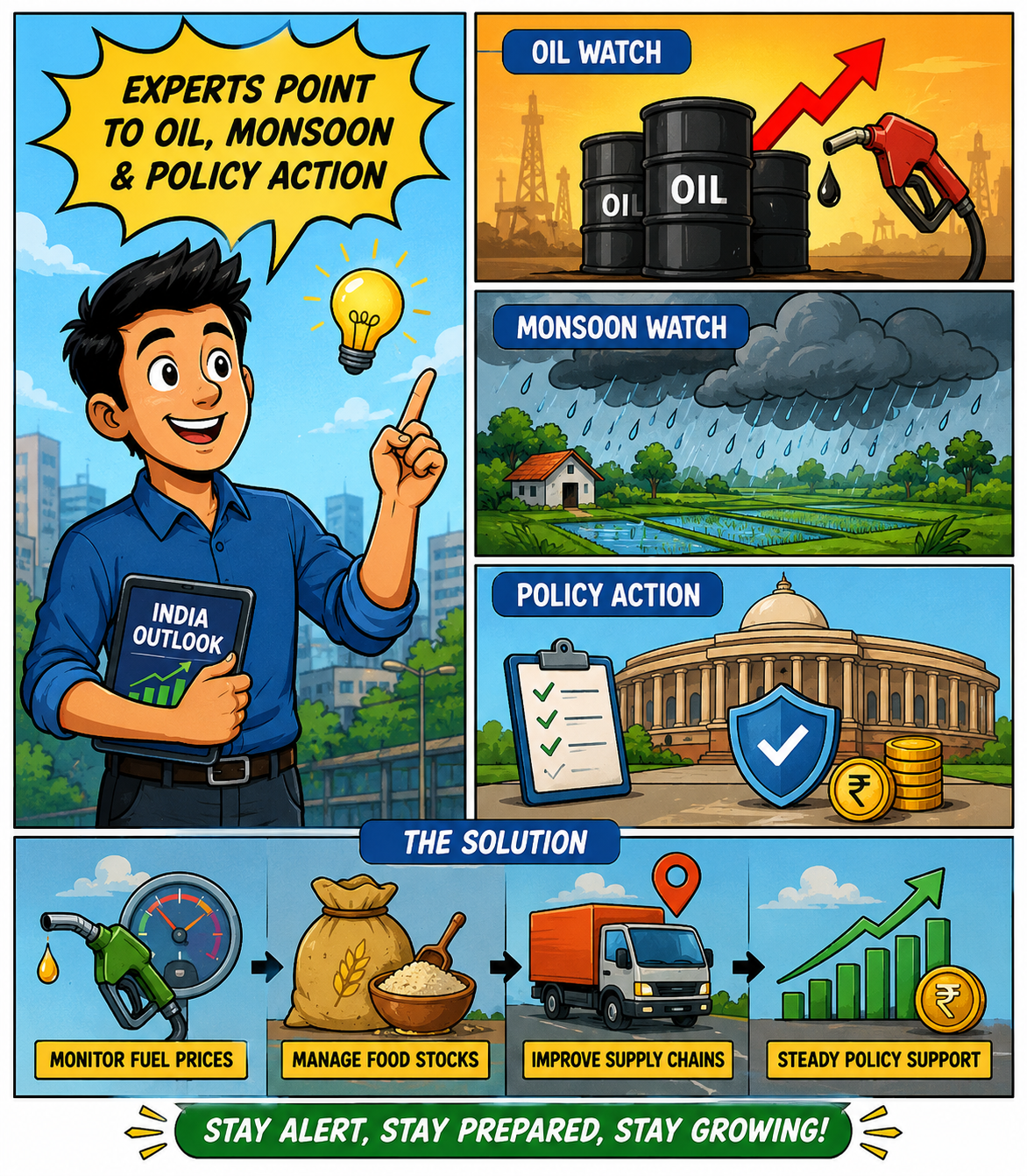
Policy watchers see 3 pressure points: crude oil, food inflation, and monsoon risk. Moneycontrol reported that El Niño and uneven rainfall could add pressure, though a positive Indian Ocean Dipole may reduce part of the stress.
The solution may come from fuel monitoring, food stock releases, faster logistics support, and steady public investment. If oil does not spike for long, India may still keep one of the strongest growth tracks among major economies.
*T&C Apply
India’s FY27 outlook still looks strong, but households may not escape higher prices if West Asia tensions worsen. The next big watches will be oil, monsoon, and inflation prints.
Can India’s FY27 GDP growth stay strong despite global conflict and oil risks?
Yes, India’s FY27 GDP growth can stay strong, but it will depend on oil prices, inflation, and global trade pressure. Current projections place FY27 growth around 6.9%, supported by domestic demand, public spending, credit growth, and stronger balance sheets. The risk comes from the West Asian conflict, which can raise crude oil prices and increase transport, fertilizer, and import costs. If those costs stay high, household budgets and business margins may feel pressure. Still, India has a large consumption base and steady services activity. So growth may slow slightly, but a sharp fall looks less likely now.
Why Can India’s Lower Fiscal Deficit Target Still Hurt Long-Term Economic Growth?
India’s lower fiscal deficit target can hurt long-term growth if the government reduces spending in the wrong areas. A smaller deficit looks positive because it means less borrowing and better financial control. But if this reduction comes by cutting infrastructure, rural development, health, education, or job-creating schemes, future growth may suffer. Public investment often supports private business activity, employment, and demand. When spending slows too much, companies may delay expansion, and consumption can weaken. So, a lower deficit helps only when it comes through better revenue and efficient spending, not by reducing growth-focused investment.
Related Financial News | |||
Why Investors Are Shifting from Bank Deposits to Mutual Funds | |||









.png&w=3840&q=75)



