By continuing, you agree to LoansJagat's Credit Report Terms of Use, Terms and Conditions, Privacy Policy, and authorize contact via Call, SMS, Email, or WhatsApp
Disclaimer: The information published on LoansJagat is intended for general informational and educational purposes only and should not be considered financial, legal, or investment advice. Interest rates, loan terms, statistics, and other data may change over time and may vary by lender or source. Please verify the latest information and consult a qualified financial advisor or the respective Bank/NBFC before making any financial decisions.
Subscribe Now
About the author

‘Simplify Finance for Everyone.’ This is the common goal of our team, as we try to explain any topic with relatable examples. From personal to business finance, managing EMIs to becoming debt-free, we do extensive research on each and every parameter, so you don’t have to. Scroll up and have a look at what 15+ years of experience in the BFSI sector looks like.
Related News
Simplify All Your Loans Into One Affordable EMI

Customers Served

Debt Consolidated

1200+ Reviews

Locations in India
Club all Loans & Credit Card Bills into Single EMI

Quick Apply Loan
Consolidate your debts into one easy EMI.

Takes less than 2 minutes. No paperwork.

10 Lakhs+
Trusted Customers

2000 Cr+
Loans Disbursed

4.7/5
Google Reviews

50+
Banks & NBFCs Offers
Other services mentioned in this article
Key Insights
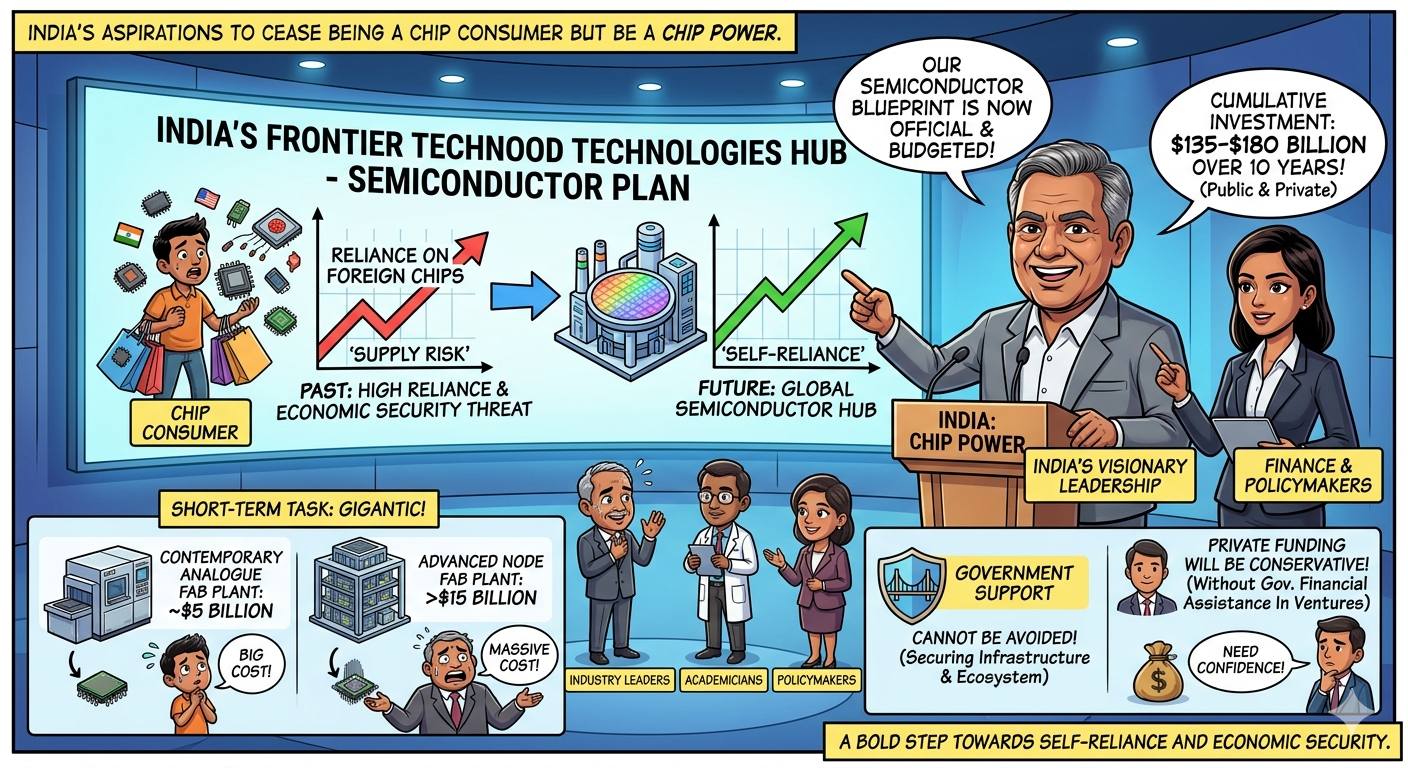
India's Aspirations to Cease to be a Chip Consumer but be a Chip Power
India's plans concerning semiconductors now have an officially approved and budgeted plan.
The Frontier Technologies Hub of NITI Aayog has unveiled the document amidst Finance Minister Nirmala Sitharaman.
The Union Minister of Electronics, Ashwini Vaishnaw, was also present, along with policymakers, industry representatives, and academicians also present.
The plan foresees cumulative investments from the public and private sectors for the country's semiconductor ecosystem, estimated to amount to about $135-$180 billion over ten years.
The government support cannot be avoided.
Short-term, the task is gigantic. To set up a contemporary analogue fabrication plant may take up to $5 billion, and setting up an advanced node fab might cost even more than $15 billion.
The private funding will continue to be conservative, with no financial assistance from the Indian government in securing these ventures.
At this point of geopolitical changes in global supply chains, India's reliance on foreign chips poses a significant threat to the state's economic security.
The opportunity for semiconductors in India is no longer theoretical; it can be quantified. The following table highlights the key objectives of NITI Aayog’s Roadmap.
The roadmap projects that India will build a semiconductor value chain worth $120–150 billion by 2035, accounting for 10–13% of the global semiconductor market and achieving self-sufficiency in 35–50% of domestic chip demand.
Semiconductors sound far-fetched to many Indians. They shouldn't. Semiconductors are found in phones, automobiles, equipment in hospitals, and power grids.
“Dependence on imported black-box technology” is among the top strategic challenges for “Viksit Bharat,” according to NITI Aayog Vice Chairman Ashok Kumar Lahiri.
Semiconductors are integral to artificial intelligence, defence, mobility, energy, communications, and citizens' services.
A chip industry would provide affordable electronics, employment opportunities, and more reliable supplies of goods.
These are the directions India needs to take according to the NITI Aayog report: maturity logic and mixed signal nodes.
Production of compound semiconductors, advanced packaging, and secure manufacturing of semiconductors for the defence, aerospace and other strategic sectors.
These targets are concrete and translate directly into industrial jobs and a decrease in India's dependence on global supply chains.
“The NITI Aayog report highlights that the 'race' cannot be won by India merely continuing to participate in the same race,” according to the report.
India must make a course correction, aiming to become the ecosystem player in the global semiconductor industry that the industry cannot function without.
“As a nation, we are determined to make a shift from our position of being a large consumer of semiconductors to that of becoming an indispensable part of the global semiconductor value chain.”
That's what Finance Minister Sitharaman has said.
*T&C Apply
India's semiconductor strategy will revolve around five pillars Pioneering, Policy and Investments, Production, People, and Partnership.
India's approach to becoming a chip maker is ambitious, clear, and timely. With appropriate investment by the government, the necessary private capital will flow. It's up to the coming decade which path India chooses: a chip maker or chip buyer.
Why, according to NITI Aayog, should India switch tracks from semiconductor chip racing?
As per NITI Aayog, India should abandon the conventional wafer fabrication race, which is highly capital-intensive and one where a very few players dominate internationally. Instead, NITI Aayog suggests that India must switch tracks to the “More-than-Moore” age, where emphasis is laid upon advanced packaging, system-level integration, and smart manufacturing.
Is it worth spending 20 lakhs to pursue a CSE course at MIT Manipal?
It may be deemed worthwhile to spend (approximately $20 - $25) Lakhs in pursuing a course such as Computer Science Engineering in MIT Manipal, provided that you are either self-funded or borrowing only a little money. However, taking a huge amount of loans may not be recommended.
Related Financial News | |||
Why Investors Are Shifting from Bank Deposits to Mutual Funds | |||









.png&w=3840&q=75)



