By continuing, you agree to LoansJagat's Credit Report Terms of Use, Terms and Conditions, Privacy Policy, and authorize contact via Call, SMS, Email, or WhatsApp
Disclaimer: The information published on LoansJagat is intended for general informational and educational purposes only and should not be considered financial, legal, or investment advice. Interest rates, loan terms, statistics, and other data may change over time and may vary by lender or source. Please verify the latest information and consult a qualified financial advisor or the respective Bank/NBFC before making any financial decisions.
Subscribe Now
About the author

LoansJagat Team
‘Simplify Finance for Everyone.’ This is the common goal of our team, as we try to explain any topic with relatable examples. From personal to business finance, managing EMIs to becoming debt-free, we do extensive research on each and every parameter, so you don’t have to. Scroll up and have a look at what 15+ years of experience in the BFSI sector looks like.
Related News
Simplify All Your Loans Into One Affordable EMI

Customers Served

Debt Consolidated

1200+ Reviews

Locations in India
Club all Loans & Credit Card Bills into Single EMI

Quick Apply Loan
Consolidate your debts into one easy EMI.

Takes less than 2 minutes. No paperwork.

10 Lakhs+
Trusted Customers

2000 Cr+
Loans Disbursed

4.7/5
Google Reviews

50+
Banks & NBFCs Offers
Other services mentioned in this article
The rupee gained after oil prices eased on US-Iran ceasefire hopes, but foreign outflows and dollar demand kept traders cautious.
Key Takeaways
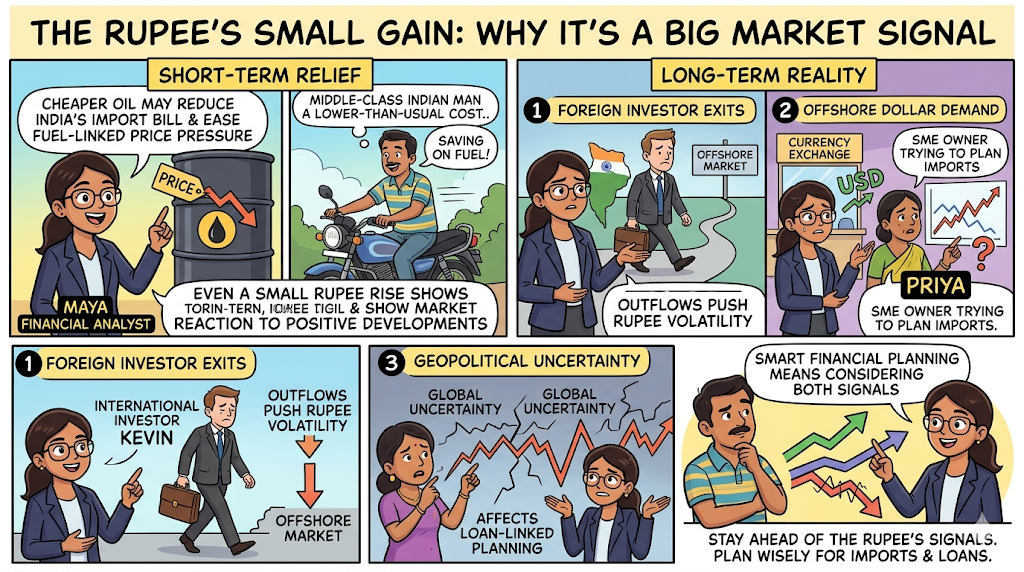
The Indian rupee recovered on May 29, 2026, after oil prices slipped on reports of a possible US-Iran ceasefire extension. Reuters reported that the rupee rose 0.3% to 95.4150 per dollar after state-run banks sold dollars.
In the short term, cheaper oil may reduce India’s import bill and ease fuel-linked price pressure. But in the long term, foreign investor exits, offshore dollar demand and geopolitical uncertainty can keep the rupee volatile, which can affect fuel prices, imports and loan-linked financial planning.
Here is a quick snapshot of the latest numbers shaping the rupee’s movement.
The numbers show that oil gave relief, but the rupee’s weakness was not only about crude. Foreign selling and offshore market demand also played a major role.
A weak rupee can make imported crude oil costlier for India. That can raise pressure on petrol, diesel, transport, logistics and imported raw materials. If this continues, household budgets may face higher monthly expenses through fuel and daily goods.
There is one positive side. If crude stays lower, fuel-linked inflation pressure can reduce. Borrowers tracking EMIs, credit costs or personal loan options can also compare regulated lenders through LoansJagat while planning repayments.

Traders told Reuters that dollar sales by state-run banks helped the rupee recover after it weakened past 95.80. Reuters also reported that maturing non-deliverable forward positions created heavy dollar demand near the reference rate.
The solution, experts indicate, depends on 2 things: steady oil flows through the Strait of Hormuz and a slowdown in foreign investor selling. Until then, traders may keep watching oil, equity outflows and offshore dollar demand together.
On April 29, 2026, Reuters reported that foreign investors had withdrawn over $20 billion from Indian equities in 2026. Around $19 billion had exited since the Iran conflict began, adding pressure on Indian markets and the rupee.
Oil had already been volatile. On May 10, 2026, Brent settled at $104.21 after US President Donald Trump said the Iran ceasefire was “on life support”. By May 29, Brent was near $94.05 as ceasefire extension hopes grew.
The rupee got support from cheaper oil, but the pressure has not gone away. Foreign outflows and dollar demand can still decide its next move.
Why Is The Indian Rupee Going Down Against The Dollar?
*T&C Apply
Foreign investors also sell Indian shares during global tension or when US returns look better. When they take money out, they convert rupees into dollars. A strong US dollar, high import bills, war-like situations and trade deficit can also pull the rupee down. This does not always mean India’s economy is weak. It often shows outside pressure too.
Why Is The Rupee Falling Against The US Dollar?
The rupee falls when India needs more dollars than it receives. A big reason is imports. India buys crude oil, gold, machines, chips and many daily-use items from abroad, and most payments are made in dollars. When the import bill goes up, demand for dollars rises.
Foreign investors also play a role. If they sell Indian shares or bonds and take money back, they buy dollars and sell rupees. High US interest rates, a strong dollar and global tensions can add more pressure. So, rupee fall is not always due to India alone. It is also linked to world markets.
Related Financial News | |||
Why Investors Are Shifting from Bank Deposits to Mutual Funds | |||









.png&w=3840&q=75)



