
By continuing, you agree to LoansJagat's Credit Report Terms of Use, Terms and Conditions, Privacy Policy, and authorize contact via Call, SMS, Email, or WhatsApp
Disclaimer: The information published on LoansJagat is intended for general informational and educational purposes only and should not be considered financial, legal, or investment advice. Interest rates, loan terms, statistics, and other data may change over time and may vary by lender or source. Please verify the latest information and consult a qualified financial advisor or the respective Bank/NBFC before making any financial decisions.
Subscribe Now
About the author

LoansJagat Team
‘Simplify Finance for Everyone.’ This is the common goal of our team, as we try to explain any topic with relatable examples. From personal to business finance, managing EMIs to becoming debt-free, we do extensive research on each and every parameter, so you don’t have to. Scroll up and have a look at what 15+ years of experience in the BFSI sector looks like.
Related News
Simplify All Your Loans Into One Affordable EMI

Customers Served

Debt Consolidated

1200+ Reviews

Locations in India
Club all Loans & Credit Card Bills into Single EMI

Quick Apply Loan
Consolidate your debts into one easy EMI.

Takes less than 2 minutes. No paperwork.

10 Lakhs+
Trusted Customers

2000 Cr+
Loans Disbursed

4.7/5
Google Reviews

50+
Banks & NBFCs Offers
Other services mentioned in this article
Key Insights
India's Foreign Exchange Reserve Loses After Two Weeks
It appears that the foreign exchange reserves of India have started dwindling at a rapid pace.
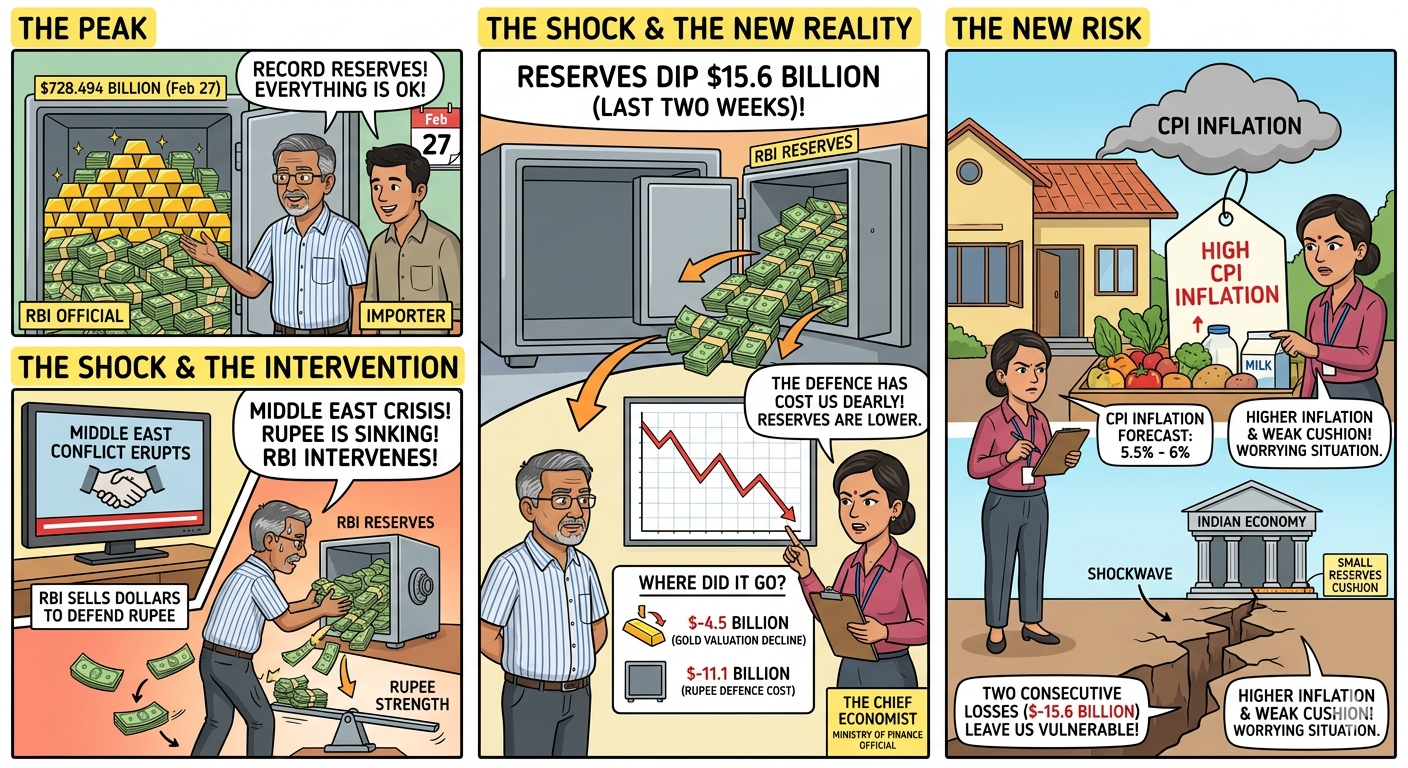
When the country enjoyed record reserves worth $728.494 billion for the period ending February 27.
This year, before the eruption of hostilities between countries in the Middle East.
The decline that followed over the next several weeks was a result of rupee depreciation and the RBI's intervention by selling dollars.
The latest dip represents the cost of the said defence. Most of the dip was attributed to an almost $4.5 billion decline in the valuation of the country's gold reserve vis-à-vis last week.
The current trend indicates that the RBI deliberately draws down its forex reserves as a means to slow down the currency depreciation.
The worry arises from the fact that two such consecutive losses amounting to about $15.6 billion will provide little cushion against further shocks to the Indian economy.
The Ministry of Finance seems to have raised its forecast for Consumer Price Index (CPI) for the coming fiscal year to 5.5% - 6%. A weakening rupee only complicates the matter.
The data shows the fall in reserves highlights a trend that deserves close attention. Below is a week-by-week view of India's position.
India's gold holdings rose to 880.52 metric tonnes by March 2026, with gold's share in total reserves increasing from 13.92% in September 2025 to nearly 16.7% by March 2026.
The falling gold value, therefore, had an outsized impact on the weekly reserve figure.
Reserve depletion affects individuals even when this issue isn't obvious.
When the RBI spends dollars to prop up the rupee exchange rate, the prices on imported goods stay lower than they otherwise would have been.
The country produces insufficient amounts of crude oil to cover its own consumption needs. India has to purchase quite a lot from abroad.
As most oil is purchased in dollars, when prices for this raw material go up, expenses in US dollars rise automatically.
Hence, without the RBI's interventions, fuel and food prices might have risen much faster. With $681.4 billion in total, India still has considerable savings to rely on.
They are sufficient to provide funds for several months of imports, leaving India capable of facing external challenges without freaking out.
Experts are concerned about this tendency but aren't ringing the alarm yet.
Prime Minister Narendra Modi also asked Indians twice to save money on forex by limiting their trips abroad, decreasing fuel consumption, and postponing any plans for purchasing gold until next year.
RBI started its $5 billion dollar-rupee swap auction back in May 2026, attracting bids for $9.8 billion in total.
It signals that banks still trust India's management of foreign currency and don't expect anything catastrophic soon, even amidst increased volatility.
*T&C Apply
Despite the pressure, the rupee keeps getting weaker because the RBI remains the only source of stability, while the overall tendency remains bearish.
This was reported by Anitha Rangan, chief economist at RBL Bank.
Depending on whether global oil prices stabilise and foreign investments come back to Indian equity markets, the currency can weaken further or get some support.
Even though the reserves of India are still significant and able to help the country overcome any challenge, the speed of their reduction, with two sharp weekly drops in a row, forces policy-makers to pay attention to every single dollar spent.
Why have India's forex reserves fallen to a more than one-year low?
This rapid decline is primarily driven by the aggressive selling of US dollars by the Reserve Bank of India (RBI) to defend the rupee.
Why did India's foreign exchange reserves dip below $600 billion?
India's foreign exchange reserves fall below the \(\$600\) billion threshold primarily when the Reserve Bank of India (RBI) aggressively sells U.S. dollars to protect the rupee against severe geopolitical or tariff shocks.
Related Financial News | |||
Why Investors Are Shifting from Bank Deposits to Mutual Funds | |||









.png&w=3840&q=75)



