
By continuing, you agree to LoansJagat's Credit Report Terms of Use, Terms and Conditions, Privacy Policy, and authorize contact via Call, SMS, Email, or WhatsApp
Disclaimer: The information published on LoansJagat is intended for general informational and educational purposes only and should not be considered financial, legal, or investment advice. Interest rates, loan terms, statistics, and other data may change over time and may vary by lender or source. Please verify the latest information and consult a qualified financial advisor or the respective Bank/NBFC before making any financial decisions.
Subscribe Now
About the author

LoansJagat Team
‘Simplify Finance for Everyone.’ This is the common goal of our team, as we try to explain any topic with relatable examples. From personal to business finance, managing EMIs to becoming debt-free, we do extensive research on each and every parameter, so you don’t have to. Scroll up and have a look at what 15+ years of experience in the BFSI sector looks like.
Related News
Simplify All Your Loans Into One Affordable EMI

Customers Served

Debt Consolidated

1200+ Reviews

Locations in India
Club all Loans & Credit Card Bills into Single EMI

Quick Apply Loan
Consolidate your debts into one easy EMI.

Takes less than 2 minutes. No paperwork.

10 Lakhs+
Trusted Customers

2000 Cr+
Loans Disbursed

4.7/5
Google Reviews

50+
Banks & NBFCs Offers
Other services mentioned in this article
India’s GST-linked supply data shows a wider demand pickup, but import-led revenue and base effects still need close tracking.
Key Takeaways
India’s goods taxable supply grew 26.9% year-on-year to ₹40.10 lakh crore in April 2026, compared with ₹31.61 lakh crore a year earlier. GST returns filed during May 2026 reflected the data. Government sources called it a sign of “genuine demand expansion” as all 27 commodity groups reported positive growth.
In the long term, such growth can support production, jobs, credit demand, and tax revenues. In the short term, the concern is different. In May, GST headline growth was only 3.2%, with import-linked collections contributing more significantly. That means policymakers may still watch domestic consumption, business input costs, and refunds closely.
The growth was not restricted to one industry. Reports said agriculture, manufacturing, chemicals, metals, electronics, automobiles, and consumer goods all recorded better activity in April 2026. Services taxable supply also grew 22.2% to ₹11.50 lakh crore from ₹9.41 lakh crore.
The table shows why officials are reading the data as broad demand, not a narrow spike. Ten News reported that gold and precious metals grew 46.9%, electric machinery and electronic appliances rose 34.1%, passenger vehicles and buses grew 21.3%, and prepared food products rose 27.1%.
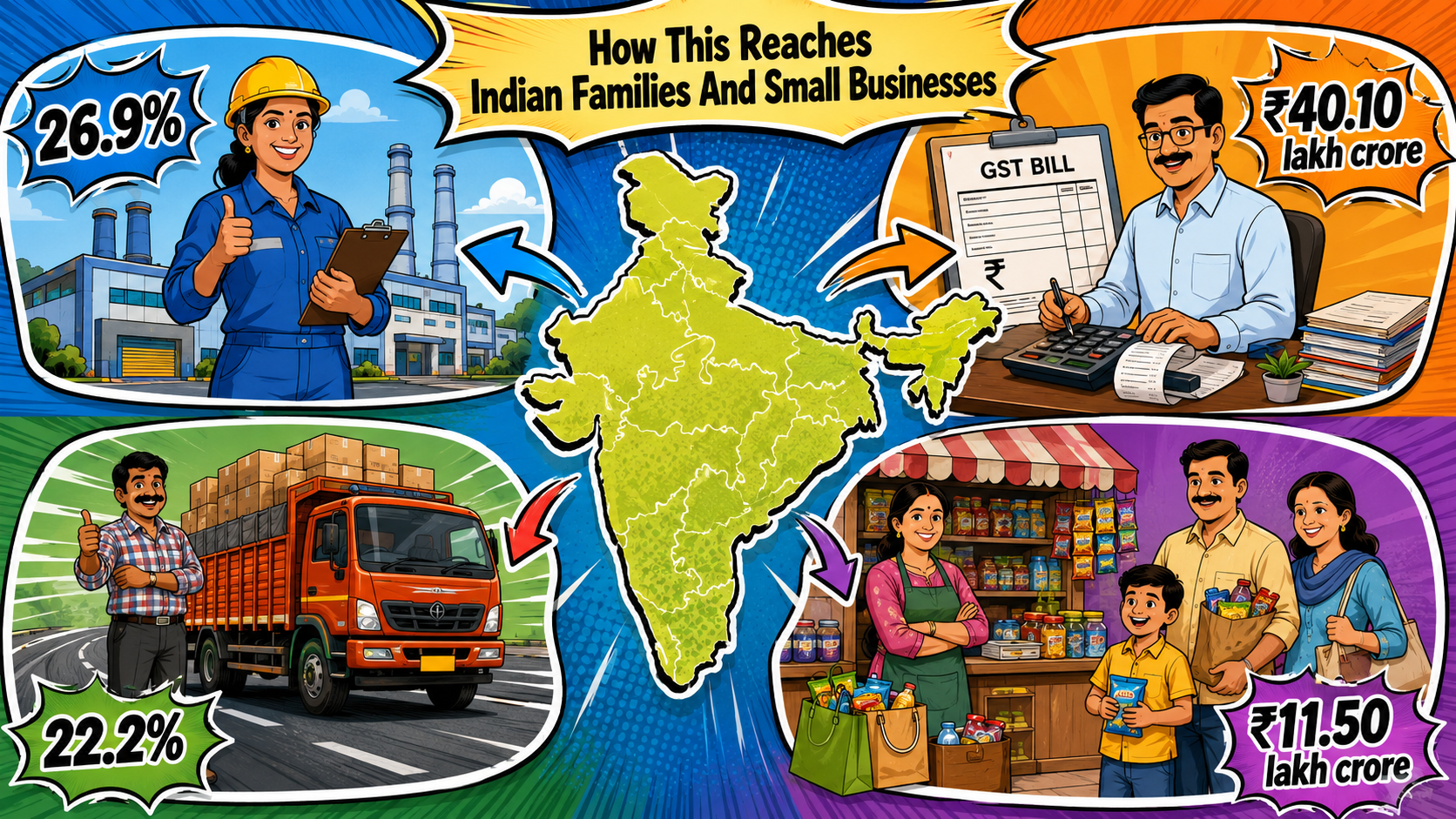
For Indian households, a wider GST supply rise can mean steadier factory orders, more transport activity, stronger retail movement, and better hiring in linked sectors. LoansJagat’s GST explainer says GST has helped organise trade, reduce logistics barriers, and support revenue collections, which can strengthen public spending over time.
For small firms, the useful part is the spread. Food services, real estate services, transport, and postal and courier activities are closer to daily spending. If demand stays active here, shopkeepers, delivery operators, traders, and service providers can see better order flow. The risk is that a higher import-linked tax may also reflect dearer inputs for some businesses.
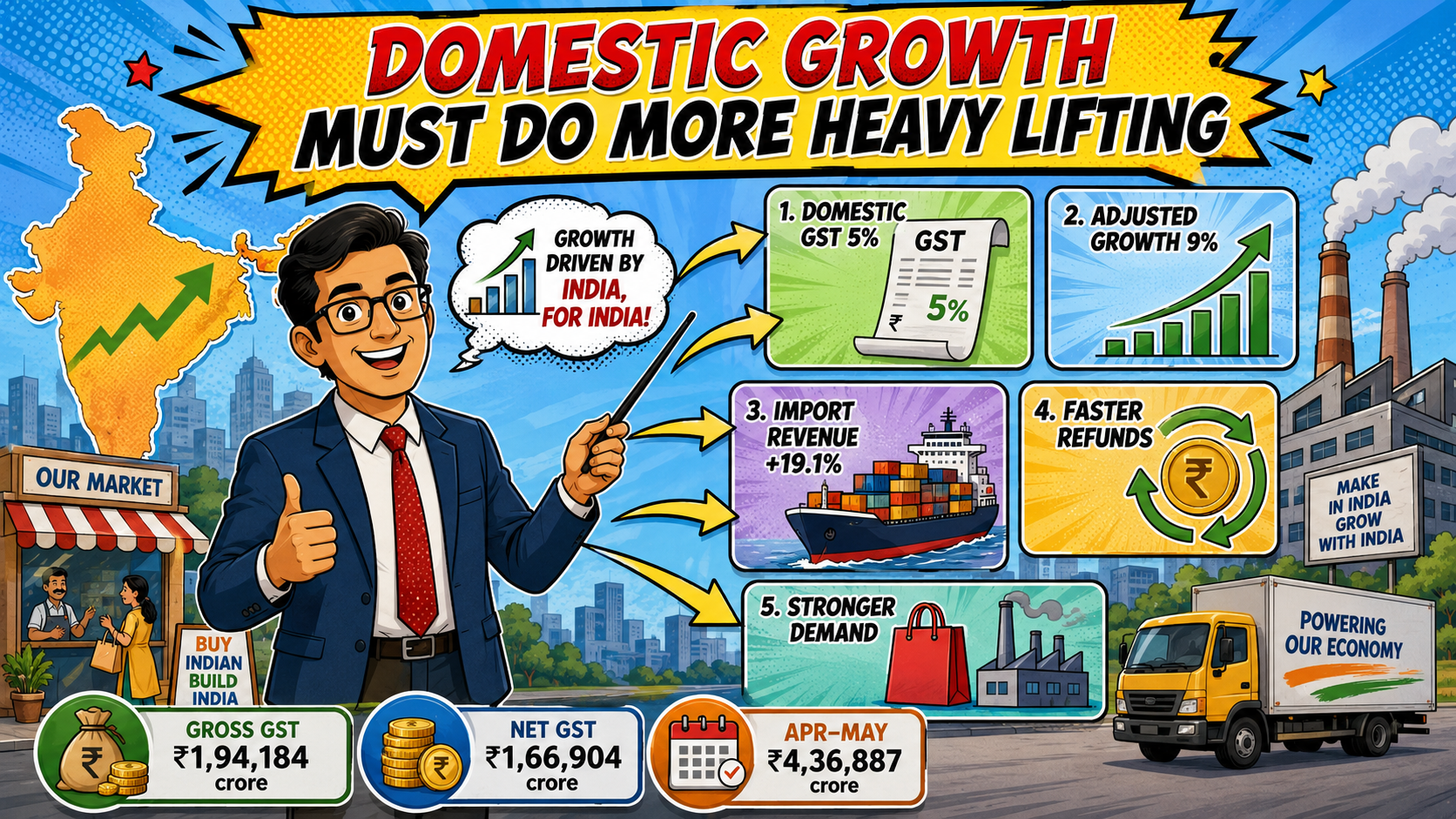
The official GST data released on June 1, 2026, showed gross GST revenue of ₹194,184 crore in May 2026, up 3.2% year-on-year. Net GST revenue after refunds stood at ₹1,66,904 crore, up 3.3%. April-May gross GST revenue rose 6.2% to ₹4,36,887 crore.
Officials said May 2025 included around ₹10,000 crore from a one-time telecom spectrum payment. After adjusting that base, gross GST growth stood at 9%, domestic gross GST growth was 5%, and adjusted net GST growth was 10.1%. Economists quoted by Moneycontrol pointed to consumption and imports, while also flagging working capital pressure from the build-up of input tax refunds.
The GST supply data gives India a strong early FY27 demand signal. The next proof will come from domestic GST growth, factory output, services activity, and how quickly refunds support business cash flow.
What If India Didn’t Tax Income But Only Taxed Consumption?
If India removed income tax and taxed only consumption, people may feel immediate relief in salaries and business earnings. More take-home income could increase spending, savings, and investment. But the risk is that consumption taxes like GST affect everyone, including low-income families. A richer person may spend more in total, but a poor household spends a larger share of its income on daily needs. So, GST rates would need strong protection on essentials. The government may also lose a stable revenue source. India can reduce income tax pressure, but relying only on consumption tax may hurt fairness and household budgets.
Is a boom expected in India after the GST?
*T&C Apply
A boom can happen after GST only when lower tax rates, simpler compliance, and stronger demand move together. GST has made India’s tax system more organised and easier for many businesses, but it has not created growth by itself. The latest 26.9% rise in goods taxable supply shows stronger demand across sectors, which is a positive sign. If businesses get faster refunds, consumers spend more, and small firms face less paperwork, growth can improve further. Still, India should not depend only on GST. Jobs, wages, exports, manufacturing, and private investment will decide whether the current situation turns into a real economic boom.
Related Financial News | |||









.png&w=3840&q=75)



