By continuing, you agree to LoansJagat's Credit Report Terms of Use, Terms and Conditions, Privacy Policy, and authorize contact via Call, SMS, Email, or WhatsApp
Disclaimer: The information published on LoansJagat is intended for general informational and educational purposes only and should not be considered financial, legal, or investment advice. Interest rates, loan terms, statistics, and other data may change over time and may vary by lender or source. Please verify the latest information and consult a qualified financial advisor or the respective Bank/NBFC before making any financial decisions.
Subscribe Now
About the author

LoansJagat Team
‘Simplify Finance for Everyone.’ This is the common goal of our team, as we try to explain any topic with relatable examples. From personal to business finance, managing EMIs to becoming debt-free, we do extensive research on each and every parameter, so you don’t have to. Scroll up and have a look at what 15+ years of experience in the BFSI sector looks like.
Related Blog Post
Simplify All Your Loans Into One Affordable EMI

Customers Served

Debt Consolidated

1200+ Reviews

Locations in India
Club all Loans & Credit Card Bills into Single EMI

Quick Apply Loan
Consolidate your debts into one easy EMI.

Takes less than 2 minutes. No paperwork.

10 Lakhs+
Trusted Customers

2000 Cr+
Loans Disbursed

4.7/5
Google Reviews

50+
Banks & NBFCs Offers
Other services mentioned in this article
Cheap global money is fading. India is already seeing the hit through a weaker rupee, foreign selling, dearer borrowing and some pressure on imported prices.
Key Takeaways
For many years, cheap dollar money helped emerging markets. That phase looks different now. The US Federal Reserve kept rates at 3.50% to 3.75% on April 29, 2026, Reuters reported. So a foreign investor now has a decent return option in dollar assets. India has to offer stronger growth, better earnings and currency comfort to attract the same money.
This is not only a stock market story. A weak rupee can make crude oil, electronics, fertilisers, machinery and overseas education costlier. A company with dollar debt may also face a heavier repayment bill. For households, the impact quietly shows up in higher fuel, transport, and goods prices, as well as slower EMI relief.
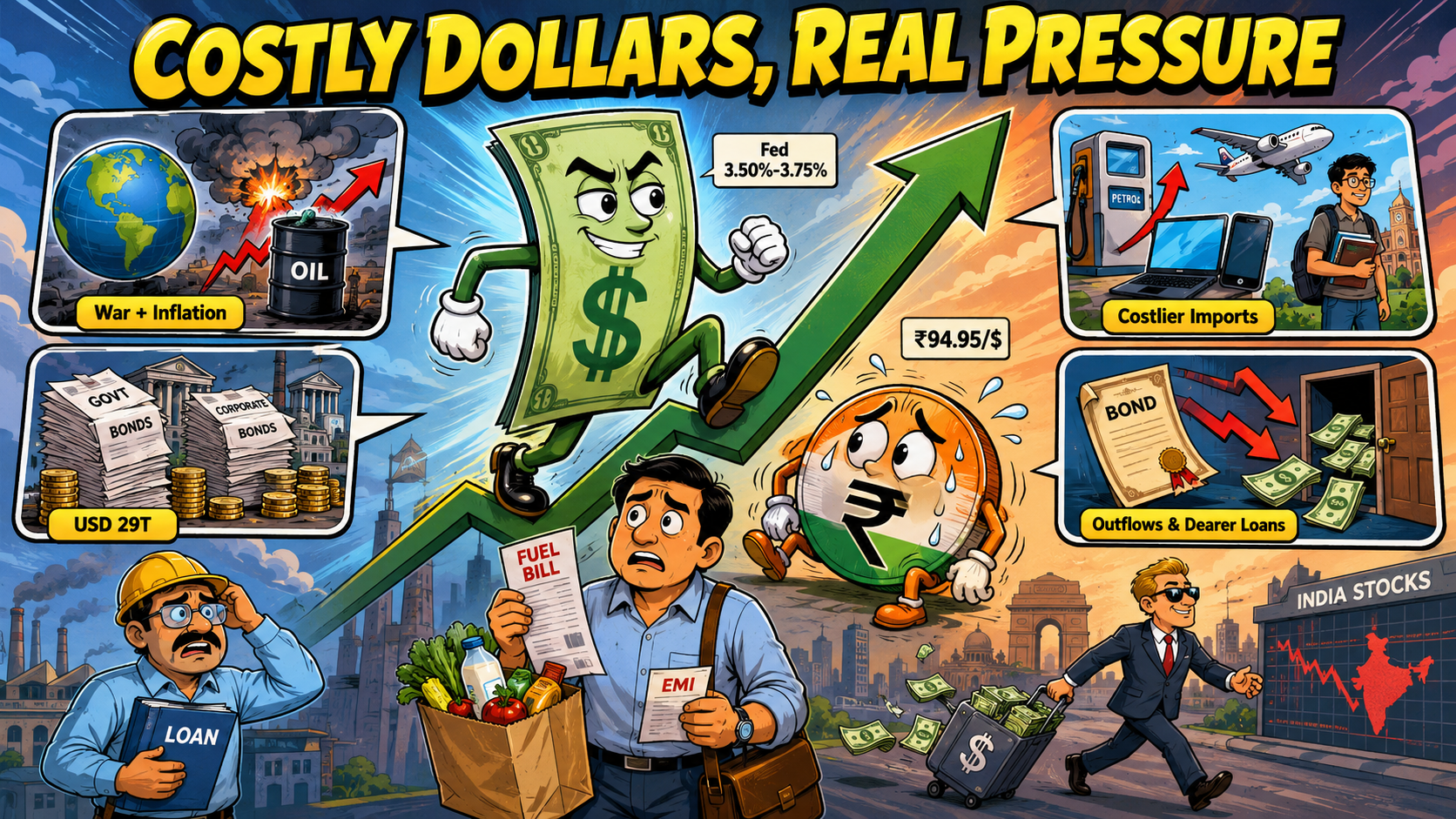
The IMF Global Financial Stability Report, April 2026, released on April 14, 2026, flagged high financial stability risks due to the Middle East war, inflation pressure and tighter financial conditions.
The OECD Global Debt Report 2026, released on March 4, 2026, said that governments and companies may borrow USD 29 trillion in 2026. That is USD 4 trillion or 17% higher than 2024. When so many borrowers enter the market, lenders do not hand out cheap money easily.
This is why global rates reach India faster than many people expect. They travel through crude invoices, bond yields, FPI flows and company loan books.

Reuters reported on June 1, 2026, that the rupee traded around 94.95 per US dollar after closing near 95. For a country that imports a large share of its oil, that number is not just a market ticker. It can affect petrol, diesel, logistics and input costs.
LoansJagat reported on May 18, 2026, that the rupee touched 96.25 against the dollar, weighed down by crude prices, a stronger dollar, and global uncertainty. A family paying for a child’s US college fee or a small importer buying electronic parts would feel the impact quickly.
The pressure was visible before June. The Times of India reported on June 1, 2026, that FPIs pulled out nearly ₹32,963 crore from Indian equities in May 2026 due to West Asia tensions, crude price swings and policy uncertainty.
Reuters also reported a USD 2.22 billion foreign outflow in 1 session. In another report, Reuters said Indian firms planned ₹85.5 billion floating-rate bonds, as fixed-rate borrowing had become less attractive.
*T&C Apply
There is also some cushion. Reuters reported on March 2, 2026, that services receipts and remittances helped India’s current account, even as the trade gap widened to USD 93.6 billion in the December quarter.
India is not short of funds today. But the free-flowing foreign money phase is gone. The next hit may not come all at once. It may show up gradually in the rupee, borrowing costs, company profits, and family budgets.
What Happens If The Rupee Crashes Sharply Against The US Dollar?
If the rupee crashes sharply against the US dollar, India’s import bill rises first because crude oil, electronics, machinery and fertilisers are mostly bought in dollars. This can push fuel, transport and daily goods prices higher. Foreign education, overseas travel and dollar-linked payments become costlier for families. Companies with dollar loans face heavier repayment pressure, which can affect profits and expansion plans. Stock markets may also see foreign investors selling if currency risk increases. Exporters in IT, pharma and textiles may gain some benefit because they earn in dollars. However, a very sharp fall usually hurts inflation, confidence and household budgets.
Is the Indian Rupee very likely to become one of the most valuable foreign currencies in the world in future?
No, the Indian rupee is not very likely to become one of the world’s most valuable currencies in nominal exchange-rate terms. A “valuable” currency usually means 1 unit buys many US dollars, like the Kuwaiti dinar or Swiss franc. The rupee is still far from that level because India has a large import bill, regular dollar demand, inflation pressure and trade gaps. But that does not mean India’s economy is weak. A country can grow fast with a lower-valued currency. For India, the bigger goal should be a stable rupee, strong exports, lower inflation, higher reserves and more global trust.
Related Financial News | |||









.png&w=3840&q=75)



