
By continuing, you agree to LoansJagat's Credit Report Terms of Use, Terms and Conditions, Privacy Policy, and authorize contact via Call, SMS, Email, or WhatsApp
Disclaimer: The information published on LoansJagat is intended for general informational and educational purposes only and should not be considered financial, legal, or investment advice. Interest rates, loan terms, statistics, and other data may change over time and may vary by lender or source. Please verify the latest information and consult a qualified financial advisor or the respective Bank/NBFC before making any financial decisions.
Subscribe Now
About the author

LoansJagat Team
‘Simplify Finance for Everyone.’ This is the common goal of our team, as we try to explain any topic with relatable examples. From personal to business finance, managing EMIs to becoming debt-free, we do extensive research on each and every parameter, so you don’t have to. Scroll up and have a look at what 15+ years of experience in the BFSI sector looks like.
Related Blog Post
Simplify All Your Loans Into One Affordable EMI

Customers Served

Debt Consolidated

1200+ Reviews

Locations in India
Club all Loans & Credit Card Bills into Single EMI

Quick Apply Loan
Consolidate your debts into one easy EMI.

Takes less than 2 minutes. No paperwork.

10 Lakhs+
Trusted Customers

2000 Cr+
Loans Disbursed

4.7/5
Google Reviews

50+
Banks & NBFCs Offers
Other services mentioned in this article
Indian students in the US are paying more in rupees as the dollar rises, wars push costs up, and education loans become harder.
Key Takeaways
Indian students studying in the US are getting caught in a cost spiral. WION Horizons reported on 30 May 2026 that the rupee slide, wars, and travel costs have made overseas education pricier for Indian families.
The short-term pain is direct. Parents sending dollars for fees, rent, food, and health insurance now need more rupees for the same amount. Over time, the situation can push families towards bigger loans, cheaper universities, part-time work pressure, or even a change of country.
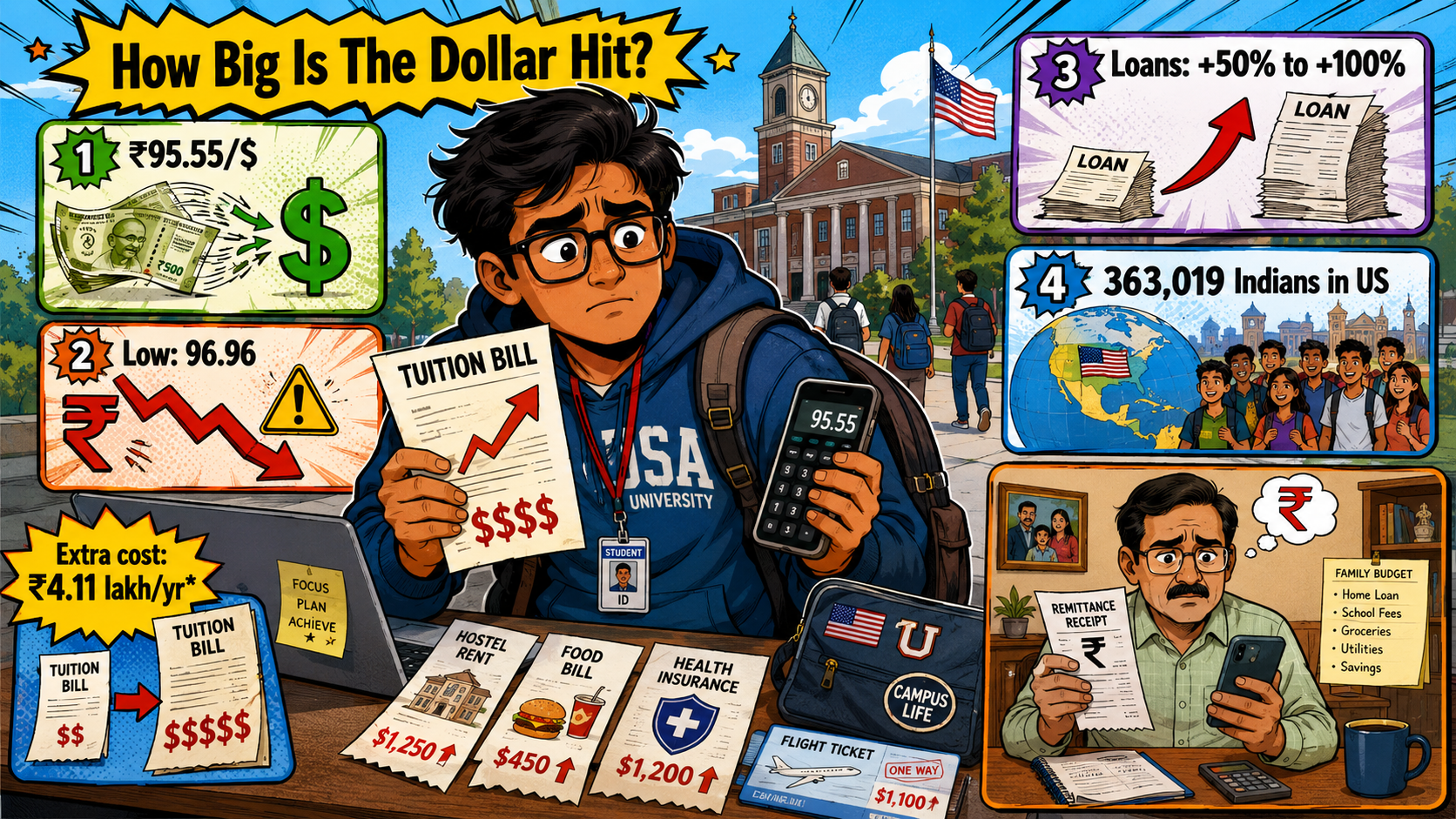
Reuters reported on 29 May 2026 that the rupee was around ₹95.77 to ₹95.78 before opening near ₹95.55 per dollar. In another report the same day, Reuters said the rupee had touched 96.96 per dollar during the week before moving back near 95.
Moneycontrol reported on 22 May 2026 that the rupee had fallen 23% in 4 years and touched 96.81 per dollar. It also reported that overseas education loans have gone up 50% to 100% since 2022. For families paying in dollars, this increase is not a small jump. It changes the full college budget.

For many Indian families, a US degree is still a big goal. But the numbers have changed fast. A $55,000 yearly expense, which includes fees and living costs, becomes much heavier when the rupee weakens. Mint earlier estimated that such a student could pay about ₹4.11 lakh extra in 2026 due to currency movement alone.
There is also a shift in student choices. Moneycontrol reported on 22 January 2026 that education loans for the US and Canada had fallen 45% and 34%, while applications for Europe and Australia rose 150% in 2025. This shows families are not dropping foreign education, but they are looking beyond the usual destinations.
The US still has a large Indian student base. Open Doors 2025, released in November 2025, reported that 363,019 Indian students studied in the US in 2024-25. That was a 10% rise from the previous year. The total number of international students in the US stood at 1,177,766.
The later intake data looked weaker. The Fall 2025 Snapshot by IIE reported a 1% fall in total international student numbers, a 12% drop in graduate enrollment, and a 17% fall in new international enrollments. On 17 November 2025, ThePrint reported that 96% of institutions cited worries about visa applications.
Currency traders told Reuters that state-run banks likely sold dollars on 29 May 2026 to support the rupee. Reuters also reported that India’s forex reserves fell to $681.4 billion for the week ended 22 May 2026.
Education counselors are now asking students to plan with a wider cost buffer. Students may need to check fixed-rate loan options, scholarship deadlines, cheaper US cities, forex charges, and visa timelines before paying deposits. Families also need to compare repayment risk, not just university ranking.
*T&C Apply
LoansJagat reported that under the PM Vidyalaxmi Scheme 2025, 21,967 loans were disbursed out of 55,887 applications, while ₹688.27 crore was released out of ₹4,427 crore sanctioned. That gap shows why loan approval and actual disbursal must be checked early.
The US degree is still attractive, but the bill is no longer straightforward to predict. Indian students now need a rupee buffer, confirmed loan support, and a backup country plan before they fly.
Can students reduce risk from rupee depreciation while paying US tuition?
Yes, students can reduce some risk, but they cannot remove it fully. Indian students paying US tuition can convert money in parts instead of waiting for one large transfer. This helps average out the exchange rate. They can also use forex cards, authorized remittance platforms, or dollar accounts after checking charges. Families should keep at least 10% to 15% extra as a currency buffer for tuition, rent, insurance, and travel. Scholarships, assistantships, and part-time campus jobs can reduce dollar spending. Students taking loans should compare fixed and floating rates and avoid last-minute transfers during sharp rupee falls.
How can we decrease the dollar rate against the rupee?
India cannot reduce the dollar rate against the rupee through one quick step. The rupee strengthens when India earns more foreign currency and reduces dollar demand. This can happen through higher exports, lower oil imports, more foreign investment, stronger tourism, stable inflation, and better fiscal control. The Reserve Bank of India can sell dollars from its forex reserves to reduce sharp volatility, but it cannot keep doing so indefinitely. In the long run, India needs stronger manufacturing, service exports, energy security, and investor confidence. People can also reduce dollar pressure by avoiding unnecessary imports and supporting Indian-made products.
Related Financial News | |||









.png&w=3840&q=75)



