By continuing, you agree to LoansJagat's Credit Report Terms of Use, Terms and Conditions, Privacy Policy, and authorize contact via Call, SMS, Email, or WhatsApp
Disclaimer: The information published on LoansJagat is intended for general informational and educational purposes only and should not be considered financial, legal, or investment advice. Interest rates, loan terms, statistics, and other data may change over time and may vary by lender or source. Please verify the latest information and consult a qualified financial advisor or the respective Bank/NBFC before making any financial decisions.
Subscribe Now
About the author

LoansJagat Team
‘Simplify Finance for Everyone.’ This is the common goal of our team, as we try to explain any topic with relatable examples. From personal to business finance, managing EMIs to becoming debt-free, we do extensive research on each and every parameter, so you don’t have to. Scroll up and have a look at what 15+ years of experience in the BFSI sector looks like.
Related Blog Post
Simplify All Your Loans Into One Affordable EMI

Customers Served

Debt Consolidated

1200+ Reviews

Locations in India
Club all Loans & Credit Card Bills into Single EMI

Quick Apply Loan
Consolidate your debts into one easy EMI.

Takes less than 2 minutes. No paperwork.

10 Lakhs+
Trusted Customers

2000 Cr+
Loans Disbursed

4.7/5
Google Reviews

50+
Banks & NBFCs Offers
Other services mentioned in this article
India’s queer consumers have huge spending power, but exclusion is still cutting jobs, income, health access and business growth.
India’s pink economy has returned to public debate after fresh reporting highlighted an old but still powerful estimate: LGBTQ exclusion may cost India up to ₹2.93 lakh crore ($30.8 billion) every year. The cost shows up in lost work, poor health outcomes, lower wages and unsafe workplaces.
In the short term, the impact hits families through job insecurity and healthcare costs. In the long term, it can reduce India’s consumer strength, tourism earnings, corporate talent pool and services-led growth. ORF estimated India’s LGBTQIA+ purchasing power at ₹15.96 lakh crore ($168 billion) in an article published on 2 March 2024.
Key Takeaways
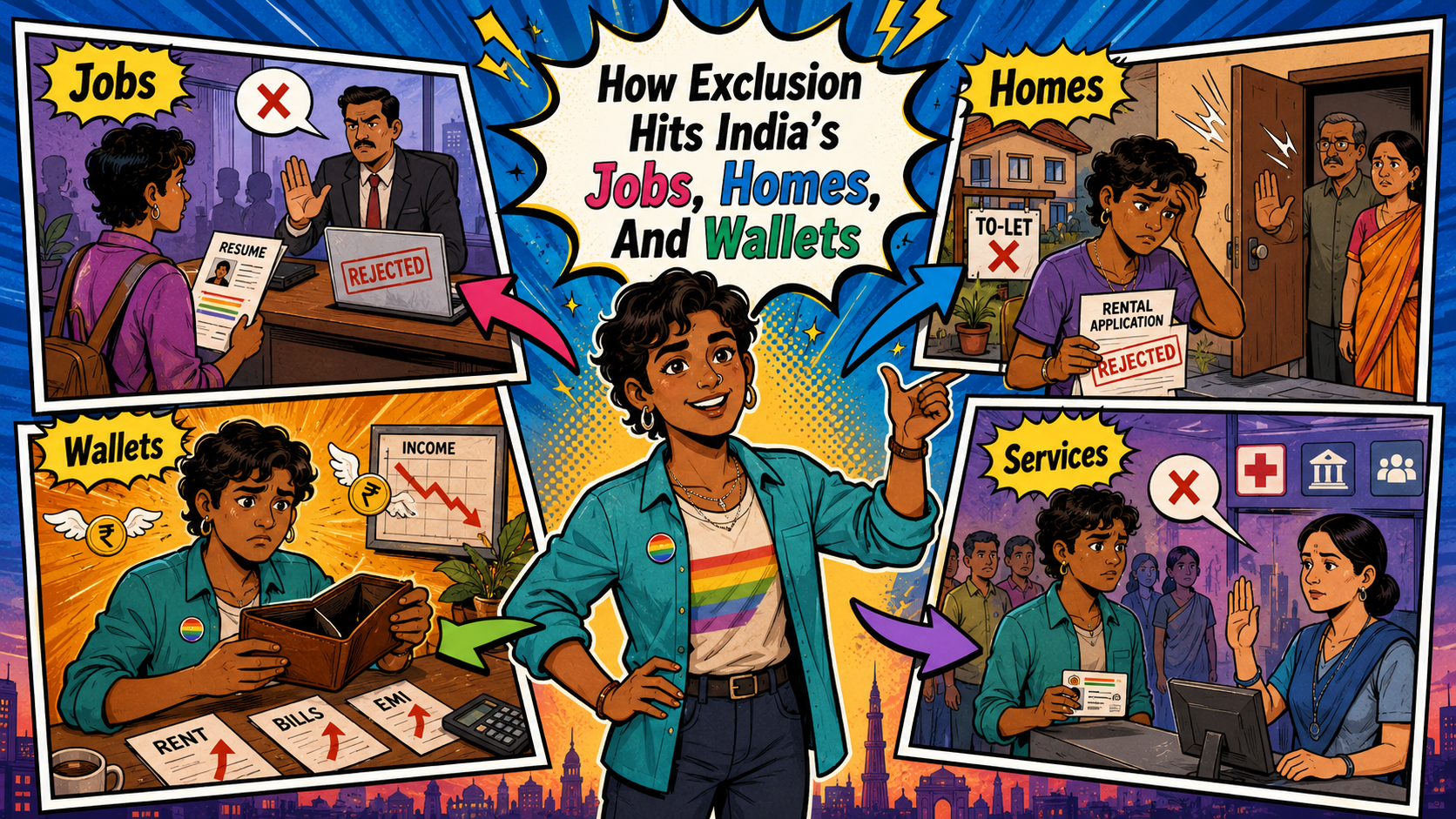
The World Bank-linked study, The Economic Cost Of Homophobia, estimated India’s LGBT exclusion cost at 0.1% to 1.7% of GDP, equal to around ₹18,055 crore to ₹2.93 lakh crore ($1.9 billion to $30.8 billion) annually. It also placed health-related losses between ₹6,766 crore and ₹2.19 lakh crore ($712 million to $23.1 billion) and labour-related losses between ₹11,404 crore and ₹73,173 crore ($1.2 billion to $7.7 billion).
For the masses, this issue is not a distant corporate topic. When discrimination keeps people out of jobs, education, housing and healthcare, families lose income. Businesses also lose skilled workers. India’s growth reporting has already shown pressure from external demand and softer industrial activity, with a Reuters poll on 1 June 2026 estimating Q1 2026 growth at 7.2%.
A LoansJagat economy report also linked India’s growth path with consumption, oil prices and global pressure. That is why a high-spending consumer group that is pushed away from full market participation can also hurt the wider demand story.

India’s earlier breakthrough came on 6 September 2018, when the Supreme Court read down Section 377 and decriminalised consensual same-sex relations between adults. That ruling gave LGBTQ individuals stronger protection around dignity, privacy and equality. NDTV had reported in September 2018 that the ruling could help businesses address LGBTQ consumers more openly.
The next big legal update came on 17 October 2023, when the Supreme Court declined to legalise same-sex marriage and left the issue to Parliament. Reuters reported that the ruling disappointed LGBTQ groups, 5 years after the court scrapped the colonial-era ban on gay sex.
The 2023 ruling kept gaps around inheritance, adoption, tax, medical consent and family benefits. AP also reported that the court asked the government to protect LGBTQ rights and consider a special panel for social and legal benefits.
Keshav Suri, Executive Director of The LaLiT Suri Hospitality Group, told NDTV that India has nearly 135 million to 140 million queer individuals and about $168 billion in purchasing power. He argued that inclusion must move beyond symbolic branding.
Experts point to practical fixes: safe hiring, anti-harassment systems, gender-neutral benefits, healthcare coverage, leadership audits and equal customer access. Companies that want young talent and consumer loyalty cannot treat queer inclusion as a Pride-month campaign.
India’s pink economy already has money, talent and demand. The loss comes when queerphobia keeps that power outside the formal growth story.
*T&C Apply
Yes, queer inclusion in India remains stuck between law and society. The Supreme Court removed the criminal tag from same-sex relations in 2018, but social acceptance has moved slowly. Many LGBTQ people still face family pressure, workplace bias, housing refusal, bullying and lack of legal protection for partnerships. The 2023 same-sex marriage verdict also left issues like adoption, inheritance, medical consent and spouse benefits unresolved. Urban spaces and some companies are becoming more inclusive, but daily life remains challenging for many queer Indians. So, legal progress exists, but full social equality is still far away.
How does the LGBT culture boost the economy?
LGBT culture can boost the economy by increasing spending, jobs, tourism and workplace productivity. LGBTQ consumers support sectors like fashion, travel, beauty, entertainment, hospitality, healthcare, housing and fintech. Inclusive cities and brands also attract young talent, global tourists and investors. When companies create safe workplaces, employees do not waste energy hiding their identity, so retention and performance improve. Pride events, queer-owned businesses and inclusive media also generate income for local markets. In India, the pink economy shows how acceptance can turn into stronger consumption, better employment, more entrepreneurship and wider tax contribution. Inclusion is not charity; it supports growth.
Related Financial News | |||









.png&w=3840&q=75)



