By continuing, you agree to LoansJagat's Credit Report Terms of Use, Terms and Conditions, Privacy Policy, and authorize contact via Call, SMS, Email, or WhatsApp
Disclaimer: The information published on LoansJagat is intended for general informational and educational purposes only and should not be considered financial, legal, or investment advice. Interest rates, loan terms, statistics, and other data may change over time and may vary by lender or source. Please verify the latest information and consult a qualified financial advisor or the respective Bank/NBFC before making any financial decisions.
Subscribe Now
About the author

LoansJagat Team
‘Simplify Finance for Everyone.’ This is the common goal of our team, as we try to explain any topic with relatable examples. From personal to business finance, managing EMIs to becoming debt-free, we do extensive research on each and every parameter, so you don’t have to. Scroll up and have a look at what 15+ years of experience in the BFSI sector looks like.
Related Blog Post
Simplify All Your Loans Into One Affordable EMI

Customers Served

Debt Consolidated

1200+ Reviews

Locations in India
Club all Loans & Credit Card Bills into Single EMI

Quick Apply Loan
Consolidate your debts into one easy EMI.

Takes less than 2 minutes. No paperwork.

10 Lakhs+
Trusted Customers

2000 Cr+
Loans Disbursed

4.7/5
Google Reviews

50+
Banks & NBFCs Offers
Other services mentioned in this article
Key Takeaways
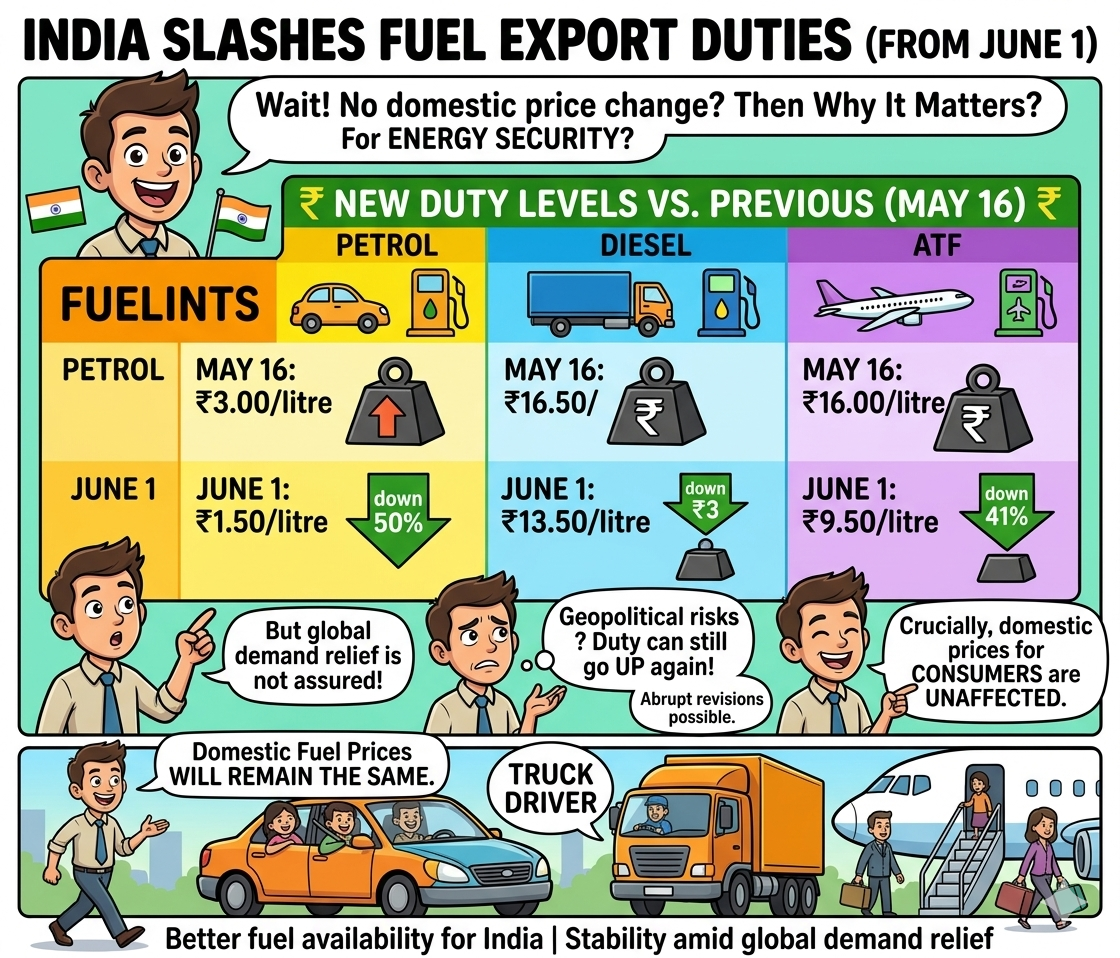
In a move towards energy security and availability of petroleum products within India, the Central government has revised its fuel export levies effective June 1, 2026. The rates are set taking into account average international prices of crude oil, petrol, diesel, and ATFO prevailing since the last review. This shows some relief due to global demand but does not assure stability.
Fuel export duties have been levied since March 27, 2026, in order to restrict petroleum product exports in wake of the West Asia crisis situation. However, even now in the event of further geopolitical issues, the possibility remains strong for an abrupt upwards revision of duty levels in coming fortnights.
New Fuel Export Duty Levels Compared to Previous Level on May 16
“The Government has decided to revise the export duty rates w.e.f June 1, 2026, for petrol and diesel. There is no change in the existing excise duty rates on petrol and diesel cleared for domestic consumption.” Thus, the new export duty rate change will not affect any domestic consumer as the current fuel prices will remain the same.
The government’s decision is expected to boost Indian refiners’ ability to export fuel, besides increasing domestic security. A reduction in export levies will increase net margins for refiners like Reliance Industries, HPCL, and BPCL.
Observers have noted that this could be beneficial for refinery activities and increase operational confidence for companies operating in a volatile global market. Retail consumers can expect no benefits whatsoever due to unchanged domestic excise duties and other factors impacting fuel prices.
With regard to the June 1, 2026, revisions, the environment for diesel and ATFO is expected to shift towards moderate to low. This may encourage export-oriented refiners to export their volumes in international markets.
Analysts at S&P Global have observed that private refiners face a considerable revenue hit from exporting gasoline and gasoil. According to Shreyans Baid, “the imposition of additional duties will likely impact some marginal export barrels but may not impact export flows significantly as long as it makes sense for them to export.”
Fuel levy cuts represent a formula-based response to falling international prices, rather than relaxation of policy stance. The geopolitical situation in West Asia represents an ongoing factor, making future revisions in subsequent fortnights a distinct possibility.
June 1, 2026, revision provides some respite for Indian refiners, although no changes will be seen on the pump by the consumer. The government remains focused on ensuring fuel security against the back-drop of the West Asia situation. Consumers need to be aware of any possible future upward revision.
Why was there a reduction in the export duty on fuel from June 1, 2026?
The reason for reducing the export duties is that there has been an easing of fuel prices in the global market since the previous review. This will allow the refineries to have the option to export their fuel, keeping some aside for their domestic use as well.
What would be the economic implications of reduced export duty on India?
There are various economic advantages to reducing export duties, such as better margins for Indian refineries, and revenues from exports. However, fuel prices in India should not be affected due to unchanged taxes on fuel in India.
Down 50%
*T&C Apply
Related Financial News | |||









.png&w=3840&q=75)



