By continuing, you agree to LoansJagat's Credit Report Terms of Use, Terms and Conditions, Privacy Policy, and authorize contact via Call, SMS, Email, or WhatsApp
Disclaimer: The information published on LoansJagat is intended for general informational and educational purposes only and should not be considered financial, legal, or investment advice. Interest rates, loan terms, statistics, and other data may change over time and may vary by lender or source. Please verify the latest information and consult a qualified financial advisor or the respective Bank/NBFC before making any financial decisions.
Subscribe Now
About the author

LoansJagat Team
‘Simplify Finance for Everyone.’ This is the common goal of our team, as we try to explain any topic with relatable examples. From personal to business finance, managing EMIs to becoming debt-free, we do extensive research on each and every parameter, so you don’t have to. Scroll up and have a look at what 15+ years of experience in the BFSI sector looks like.
Related Blog Post
Simplify All Your Loans Into One Affordable EMI

Customers Served

Debt Consolidated

1200+ Reviews

Locations in India
Club all Loans & Credit Card Bills into Single EMI

Quick Apply Loan
Consolidate your debts into one easy EMI.

Takes less than 2 minutes. No paperwork.

10 Lakhs+
Trusted Customers

2000 Cr+
Loans Disbursed

4.7/5
Google Reviews

50+
Banks & NBFCs Offers
Other services mentioned in this article
Key Takeaways
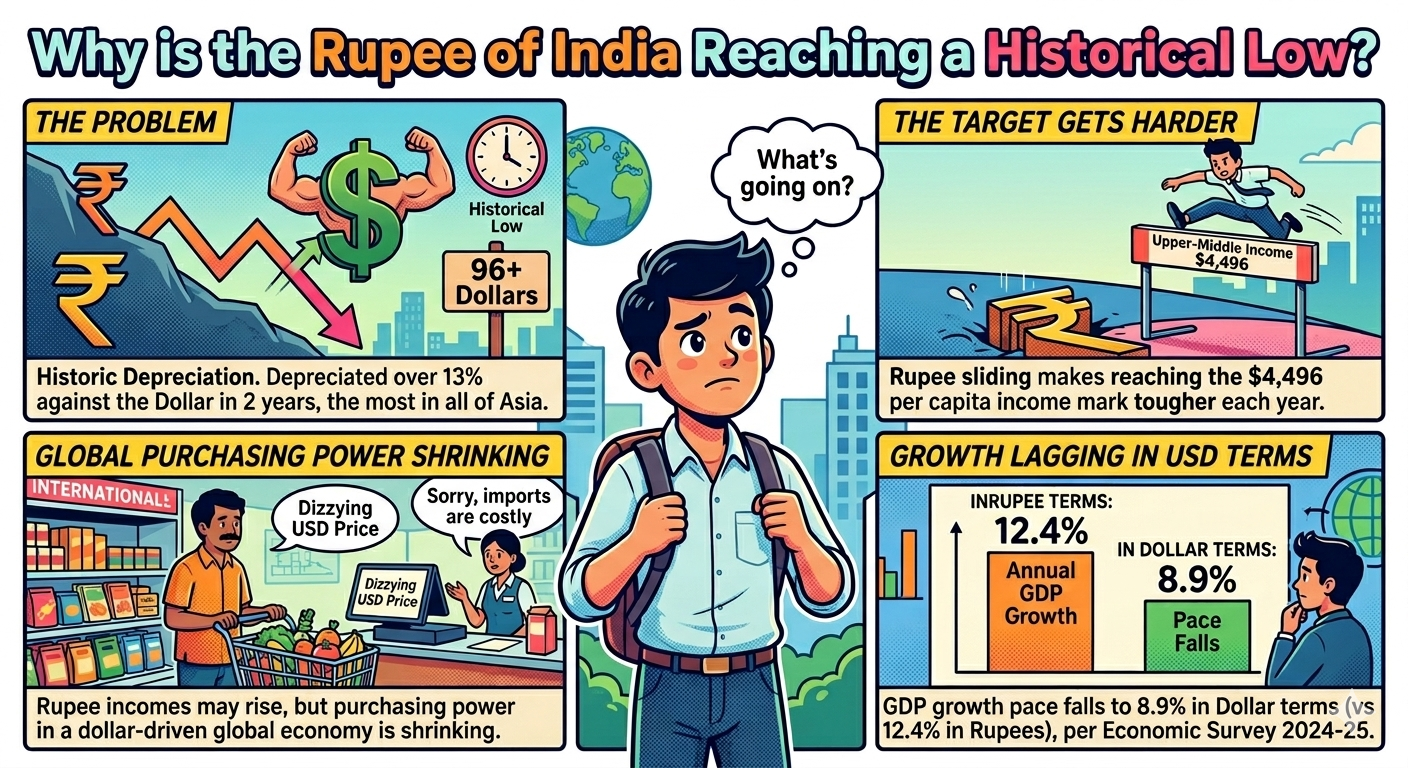
The rupee depreciated to 96 dollars in the first half of May. It should be noted that two years earlier, it was difficult even to imagine such an exchange rate. Since then, however, the currency has depreciated by over 13% against the dollar, the most in all of Asia.
India’s national per capita income has always lagged behind the threshold of upper-middle-income countries at $4,496. A rupee that keeps sliding makes reaching that mark harder each year.
This is not just a number on a screen for ordinary Indians. Incomes may be rising in rupee terms, but what those rupees can actually buy in a dollar-driven global economy keeps shrinking.
India’s GDP grew at 12.4% annually over three decades in rupee terms. In dollar terms, that pace falls to 8.9%, per the Economic Survey 2024-25.
Electronics exports nearly doubled. But imports grew faster. The trade gap widened, not narrowed. This pattern runs across sectors.
Nearly 56.2% of India’s merchandise exports come from industries where import dependence far exceeds the manufacturing average of 33.4%, according to the Exim Bank of India.
Oil makes it worse. India meets almost 90% of its crude needs through imports. Any time oil prices increase in international markets, the cost of imports increases. Even companies throughout the nation experience this impact.
The latest Purchasing Managers Index for the sector was released by HSBC, which shows a decline to a near four-year low. According to the firm’s chief economist, “firms appear to be absorbing much of the increase, keeping output prices relatively contained.”
Dhananjay Sinha, CEO at Systematix Group, does not mince words. “Foreign investors are no longer interested in your headline growth rate or fiscal deficit. They want productivity and innovation, besides external stability. The rupee’s sharp depreciation reflects India’s fading appeal as an investment destination.”
Michael Patra, former RBI Deputy Governor, points to the bigger picture. “Capital flows are highly vulnerable to global spillovers from geopolitical events, trade policy uncertainties, and overall economic policy uncertainty caused by systemically important economies.”
Ajay Srivastava of Global Trade Research Initiative connects the dots. “With India importing nearly 90% of its oil needs, higher crude prices widen the import bill and put further pressure on the rupee, creating a feedback loop of rising costs and currency weakness.”
The fix, per the Economic Survey 2024-25, lies in learning from East Asia. Countries that stabilised their currencies did so by building genuine export-led manufacturing growth, not assembly lines that depend on imported parts.
India’s rupee problem did not start with Trump or oil prices. Those are triggers, not causes. The deeper issue is that India has not built the kind of export machine that generates dollars on its own. Until that changes, the rupee will keep reflecting that gap.
1. Can the rupee recover if India keeps importing more than it exports?
A lasting recovery is difficult if imports continue to grow faster than exports. India needs stronger export-led manufacturing and higher dollar earnings to reduce pressure on the rupee. Short-term improvements are possible, but long-term stability depends on narrowing the trade gap.
2. How does a weak rupee affect my money and expenditure?
All foreign commodities and services cost more to acquire when the rupee is weakened. Your savings in Indian currency will not depreciate. However, the global buying power of your savings may diminish further due to depreciation.
*T&C Apply









.png&w=3840&q=75)



