By continuing, you agree to LoansJagat's Credit Report Terms of Use, Terms and Conditions, Privacy Policy, and authorize contact via Call, SMS, Email, or WhatsApp
Disclaimer: The information published on LoansJagat is intended for general informational and educational purposes only and should not be considered financial, legal, or investment advice. Interest rates, loan terms, statistics, and other data may change over time and may vary by lender or source. Please verify the latest information and consult a qualified financial advisor or the respective Bank/NBFC before making any financial decisions.
Subscribe Now
About the author

LoansJagat Team
‘Simplify Finance for Everyone.’ This is the common goal of our team, as we try to explain any topic with relatable examples. From personal to business finance, managing EMIs to becoming debt-free, we do extensive research on each and every parameter, so you don’t have to. Scroll up and have a look at what 15+ years of experience in the BFSI sector looks like.
Related News
Simplify All Your Loans Into One Affordable EMI

Customers Served

Debt Consolidated

1200+ Reviews

Locations in India
Club all Loans & Credit Card Bills into Single EMI

Quick Apply Loan
Consolidate your debts into one easy EMI.

Takes less than 2 minutes. No paperwork.

10 Lakhs+
Trusted Customers

2000 Cr+
Loans Disbursed

4.7/5
Google Reviews

50+
Banks & NBFCs Offers
Other services mentioned in this article
India met its FY26 fiscal deficit target, but early FY27 numbers show pressure on government spending, borrowing plans, and future welfare space.
India’s fiscal deficit for FY26 came at 4.4% of GDP, matching the Centre’s revised estimate. The deficit stood at ₹15.19 trillion, or 97.5% of the revised estimate, as reported on June 1, 2026.
In the short term, the figure gives the government some comfort regarding borrowing and investor confidence. But the risk has shifted to FY27. April’s deficit already touched 21.4% of the full-year target, which can tighten space for subsidies, welfare spending, and fresh capital outlay later in the year.
Key Takeaways

The Centre managed the deficit with better receipts and controlled spending. Net tax receipts rose to ₹33 trillion from ₹30.87 trillion. Non-tax revenue climbed to ₹6.8 trillion from ₹5.31 trillion. Total spending was ₹49 trillion, higher than ₹47.16 trillion last year.
The table below gives the main numbers from the latest fiscal data and related budget update.
The data also fits the earlier LoansJagat update published on January 30, 2026, which said India’s fiscal deficit had narrowed to 4.8% of GDP in FY25 and was on track to reach 4.4% in FY26.
For Indian families, the deficit figure is not just a budget line. It can affect government borrowing, public works, interest costs, and spending on schemes. Lower pressure on borrowing can help the broader economy, though it does not directly reduce EMIs overnight.
The positive part is that capital expenditure was not heavily cut. Reuters reported that capex rose to ₹10.7 trillion from ₹10.18 trillion, supporting roads, railways, logistics, and construction-linked jobs.
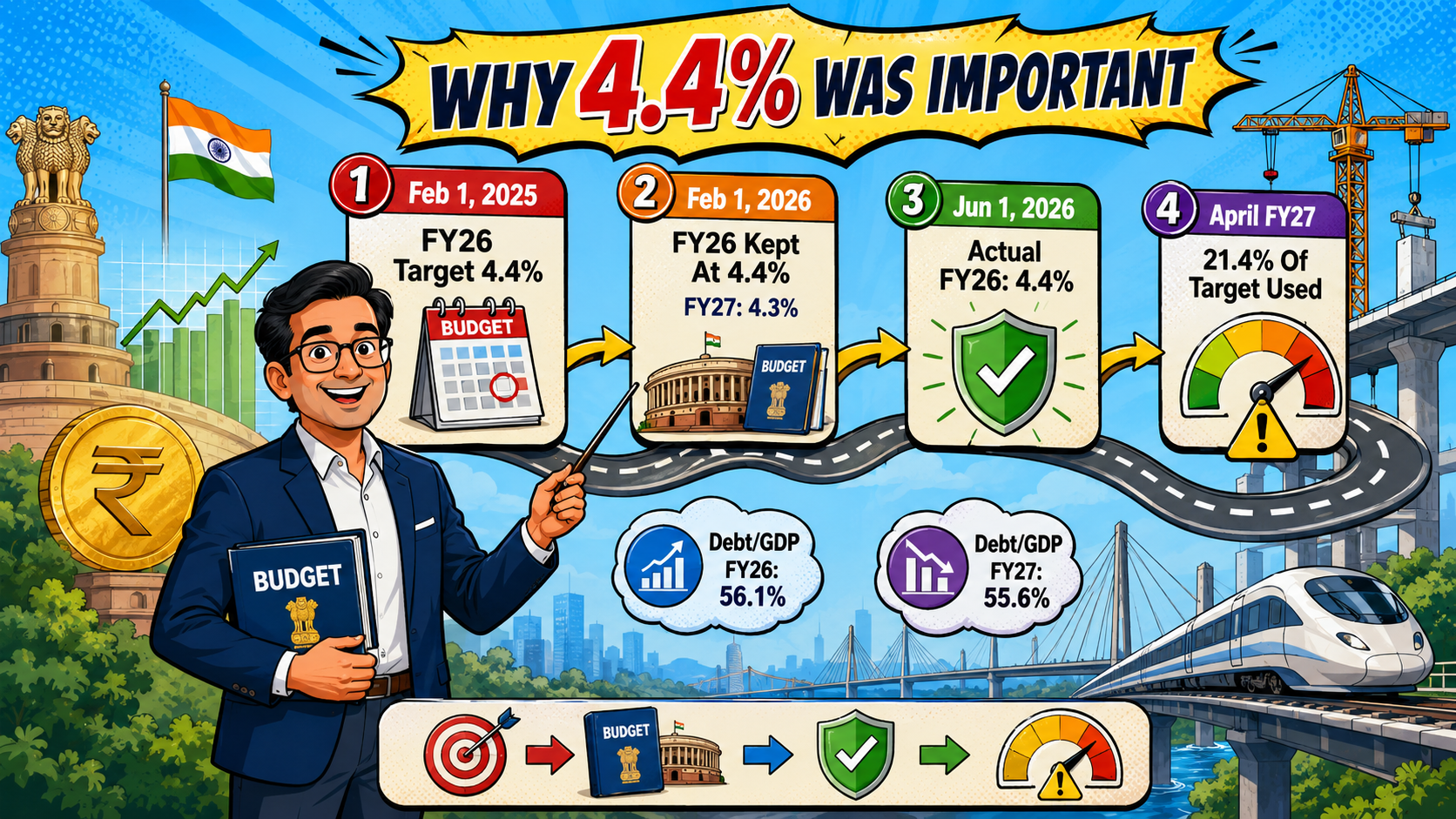
The previous update came in Budget 2026. On February 1, 2026, the PIB said the FY26 fiscal deficit was retained at 4.4% of GDP, while FY27 was budgeted at 4.3%. Debt-to-GDP was estimated at 56.1% in RE FY26 and 55.6% in BE FY27.
The table below shows how the target moved from the budget promise to the actual result.
Finance Minister Nirmala Sitharaman told Parliament on February 1, 2026, that the FY22 promise to bring the deficit below 4.5% of GDP by FY26 had been fulfilled.
PRS said it is targeting the FY27 fiscal deficit at 4.3% of GDP, lower than FY26’s 4.4%, while it estimates liabilities at 55.6% of GDP. Fitch, cited by Reuters on February 2, 2026, said further deficit reduction may get harder without hurting growth.
India hit its FY26 deficit target, helped by stronger revenue and steady capex. The next test is FY27, where the target is lower, and April has already used 21.4% of the annual gap.
How does India’s fiscal deficit affect common people like taxpayers, students and salaried families?
India’s fiscal deficit affects common people because it shapes government borrowing, spending, and future tax pressure. When the deficit stays controlled, the government can manage interest payments better and continue funding roads, schools, colleges, healthcare, and job-linked projects. Taxpayers may feel more confident that the government is not stretching public money too far. Salaried families can benefit if stable finances support lower inflation pressure and better public services. Students may see gains through education schemes, scholarships, and infrastructure. But if the deficit rises too much, borrowing costs increase, prices can rise, and future budgets may leave less room for welfare and growth spending.
*T&C Apply
Why does India’s fiscal deficit target of 4.3% for FY27 sound appealing, but may not actually benefit the economy in the long run?
India’s 4.3% fiscal deficit target for FY27 looks appealing because it signals lower borrowing, better debt control, and stronger confidence among investors. But if the government meets the target by cutting useful spending, it may not benefit the economy over the long term. India still needs heavy investment in roads, railways, jobs, health, education, and rural support. If the government reduces spending too quickly, growth can slow, and demand may weaken. The April FY27 deficit has already reached 21.4% of the full-year target, indicating early pressure. So, the target looks positive, but the real test is balanced spending.
Related Financial News | |||









.png&w=3840&q=75)



