
By continuing, you agree to LoansJagat's Credit Report Terms of Use, Terms and Conditions, Privacy Policy, and authorize contact via Call, SMS, Email, or WhatsApp
Disclaimer: The information published on LoansJagat is intended for general informational and educational purposes only and should not be considered financial, legal, or investment advice. Interest rates, loan terms, statistics, and other data may change over time and may vary by lender or source. Please verify the latest information and consult a qualified financial advisor or the respective Bank/NBFC before making any financial decisions.
Subscribe Now
About the author

LoansJagat Team
‘Simplify Finance for Everyone.’ This is the common goal of our team, as we try to explain any topic with relatable examples. From personal to business finance, managing EMIs to becoming debt-free, we do extensive research on each and every parameter, so you don’t have to. Scroll up and have a look at what 15+ years of experience in the BFSI sector looks like.
Related Blog Post
Simplify All Your Loans Into One Affordable EMI

Customers Served

Debt Consolidated

1200+ Reviews

Locations in India
Club all Loans & Credit Card Bills into Single EMI

Quick Apply Loan
Consolidate your debts into one easy EMI.

Takes less than 2 minutes. No paperwork.

10 Lakhs+
Trusted Customers

2000 Cr+
Loans Disbursed

4.7/5
Google Reviews

50+
Banks & NBFCs Offers
Other services mentioned in this article
Key Takeaways
Why India’s Rising Bond Yields Should Worry You?
India’s bond market is flashing warning signs. The yields on the government 10-year benchmark bond are up by close to 90 basis points since May 2025. Despite cuts in interest rates and liquidity measures from the RBI, this has occurred.
There are twin pressures at play here. First, the geopolitical situation has driven up oil prices. The price of Brent crude stands above $100 per barrel, which puts negative sentiments in place because of supply worries. This has a direct impact on India, which is an oil-importing country.
Higher bond yields do not stay confined to the financial markets. They feed directly into borrowing costs for banks. When banks face higher costs, they pass them on through dearer loans. Home loans, car loans, and business credit all get more expensive.
Gross market borrowing for FY27 is set at ₹17.2 lakh crore, decreasing to ₹16.09 lakh crore after debt switches. Combined central and state borrowing is expected to surpass ₹30 trillion in 2026-27. This heavy supply pressure pushes bond prices down and yields up, which leaves less money available for private sector lending.
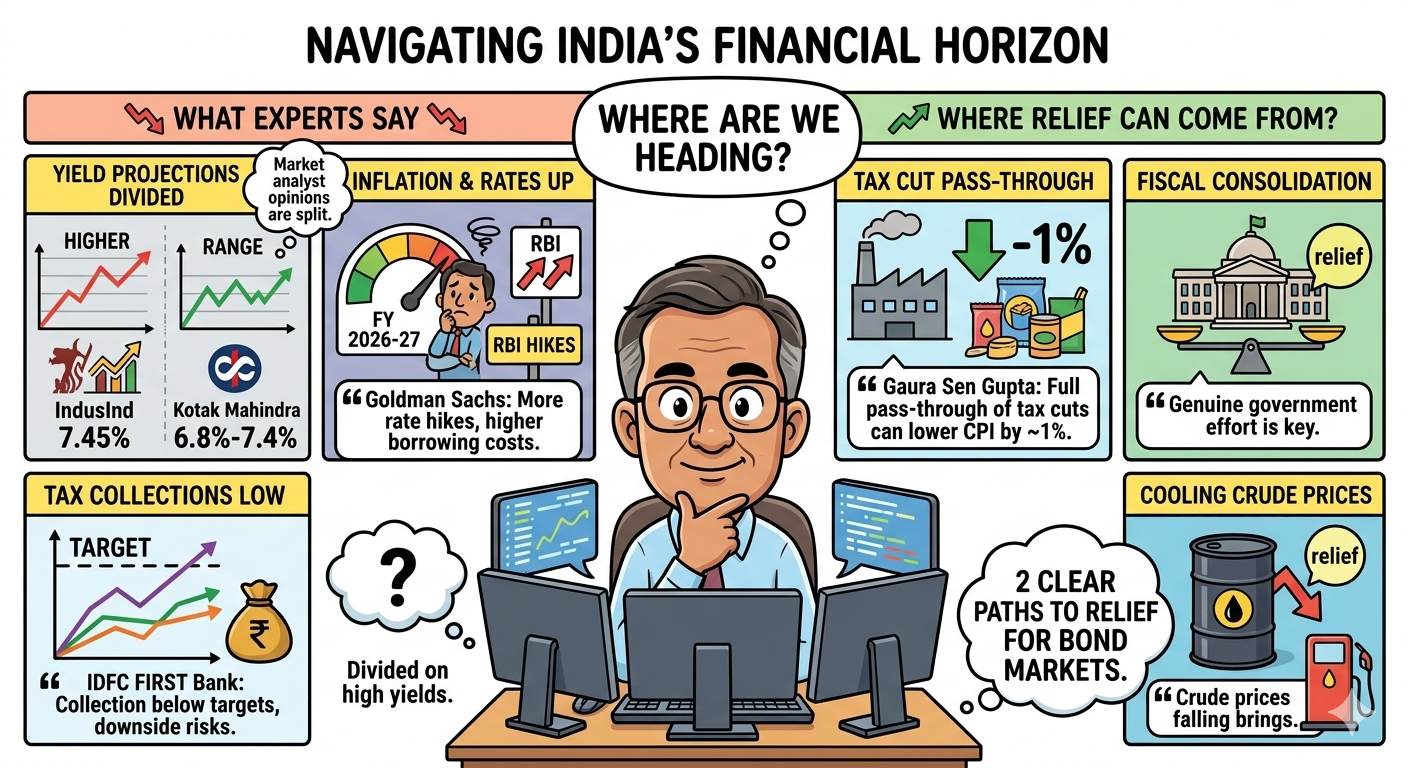
Market analysts are divided on how high yields can go. IndusInd Bank expects the 10-year yield to touch 7.45% by the end of 2026. Kotak Mahindra Bank sees it trading in the 6.8% to 7.4% range until March.
Goldman Sachs analysts have raised their inflation forecast for FY2026-27 and now expect two additional RBI rate hikes this year. If that happens, borrowing costs will stay elevated longer.
Gaura Sen Gupta, Chief Economist at IDFC FIRST Bank, noted that downside risks persist for income tax collections, which are tracking significantly below target levels.
She added that full pass-through of tax cuts could lower headline CPI inflation by around 1%. Any genuine fiscal consolidation by the government and a cooling in crude prices remain the two clearest paths to relief for bond markets.
India’s bond market is caught between a heavy borrowing calendar, rate hike risks, and an uncertain global backdrop. Yields could stay high, possibly requiring ₹3 to 4 lakh crore in bond purchases to absorb market supply without significant RBI intervention as a buyer of last resort. The government’s ability to stick to its fiscal targets will be the key factor to watch in the months ahead.
Q1. Why is the 10-year bond yield increasing despite RBI rate reductions?
The 10-year bond yield in India is increasing because of the rising price of crude oil, fears related to the risk of inflation, and massive government borrowings. Higher yields are needed to cope with high borrowings and the risks associated with them.
Q2. What will be the future of India’s bond market?
The current prospects of the country’s bond market are not good, owing to substantial borrowings by the government and inflation concerns. Lower crude oil prices and disciplined fiscal management might contribute to easing the bond yields in the coming period.
Related Financial News | |||
5.25%
*T&C Apply









.png&w=3840&q=75)



